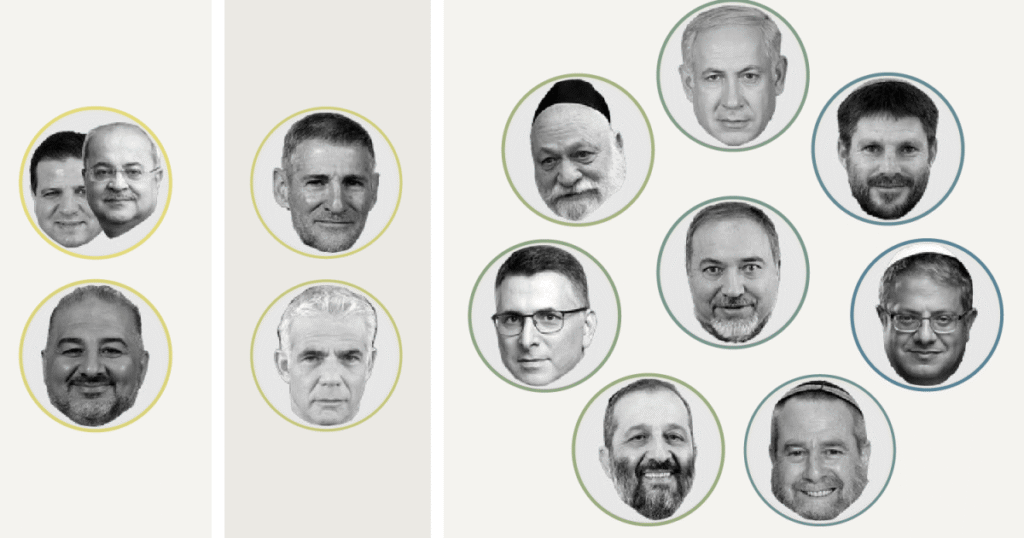
Mainstream Israeli parties align with far‑right on Palestinian issues
Israel prepares for a national election on October 27, the first since the Gaza conflict and the wars in Lebanon and Iran, a vote widely viewed as a judgment on Prime Minister Benjamin Netanyahu’s leadership. Since the Gaza war began in October 2023, the Knesset has approved or moved forward a series of measures that affect Palestinians, including rejecting Palestinian statehood, supporting annexation of the occupied West Bank and cutting Palestinian aid.
The Jewish‑led opposition positions itself as an alternative to Netanyahu’s right‑wing government, yet on matters concerning Palestinians the two sides frequently vote together.
In Israel the traditional left‑right labels differ from those in many other democracies. The left is generally linked to territorial compromise and negotiations with the Palestinians, while the right is associated with opposition to a Palestinian state and the expansion of illegal settlements. Over recent years the whole political spectrum has shifted rightward, with positions once considered fringe now forming part of the mainstream. Palestinian analyst Ehab Jabareen notes that many assumptions driving current Israeli politics would have been labeled right‑wing a generation ago.
No single party has ever secured a majority of the 120 Knesset seats, so any prime minister must assemble a coalition of at least 61 seats. This requirement gives small parties considerable influence, as the departure of even one can topple a government.
After the November 2022 election, Netanyahu’s Likud party, the largest with 32 seats, formed a 64‑seat coalition that included the ultra‑Orthodox parties Shas and United Torah Judaism, as well as the far‑right Religious Zionism alliance, a joint list of Religious Zionism and Otzma Yehudit. This coalition became the most right‑leaning government in Israel’s history. Far‑right leaders hold key ministries: Bezalel Smotrich, head of Religious Zionism, serves as finance minister and oversees civilian affairs in the occupied West Bank, including settlement planning; Itamar Ben‑Gvir, leader of Otzma Yehudit, is national security minister and controls the police. Both have championed annexation and settlement growth and have used the threat of resigning to shape policy.
The coalition has undergone several changes. Benny Gantz’s National Unity alliance entered after the October 7, 2023 Hamas attacks and left in June 2024, while Gideon Sa’ar’s New Hope joined in September. Ben‑Gvir’s Otzma Yehudit withdrew over a Gaza ceasefire in January 2025 and returned two months later. In July 2025 United Torah Judaism exited over a stalled exemption bill for ultra‑Orthodox men, prompting Shas to pull its ministers at the same time, though it remained in the coalition. When the Knesset was dissolved in July ahead of the October 27 election, the coalition counted 60 seats: Likud (32), Shas (11), Otzma Yehudit (7), Religious Zionism (6) and New Hope (4).
Opposition parties in Israel are not automatically left‑leaning. Yesh Atid, led by Yair Lapid, was the largest opposition party with 24 seats, and Benny Gantz’s Blue and White held the second‑largest bloc. Both are centrist and campaigned against Netanyahu’s proposed judicial overhaul. Yisrael Beiteinu, headed by Avigdor Lieberman, is secular and right‑wing, opposing draft exemptions for ultra‑Orthodox men. The Labor party, now part of the Democrats, is the only Jewish party in the outgoing Knesset that openly supports a two‑state solution.
Arab‑led parties, representing Israel’s Palestinian citizens, differ in ideology but share opposition to the occupation. Ra’am, led by Mansour Abbas, made history in 2021 as the first Arab party to join an Israeli government. Hadash‑Ta’al, led by Ayman Odeh and Ahmad Tibi, has never entered a coalition and is running this election as part of the Joint List together with Balad.
Al Jazeera examined the ten most consequential Knesset votes on Palestinian issues from July 2024 to March 2026. In Israel a bill must survive three votes to become law; most decisions require only a simple majority of members present. Parties often abstain deliberately, either to deny a bill legitimacy or to avoid a recorded stance, meaning some votes involve only a fraction of the 120‑member parliament.