
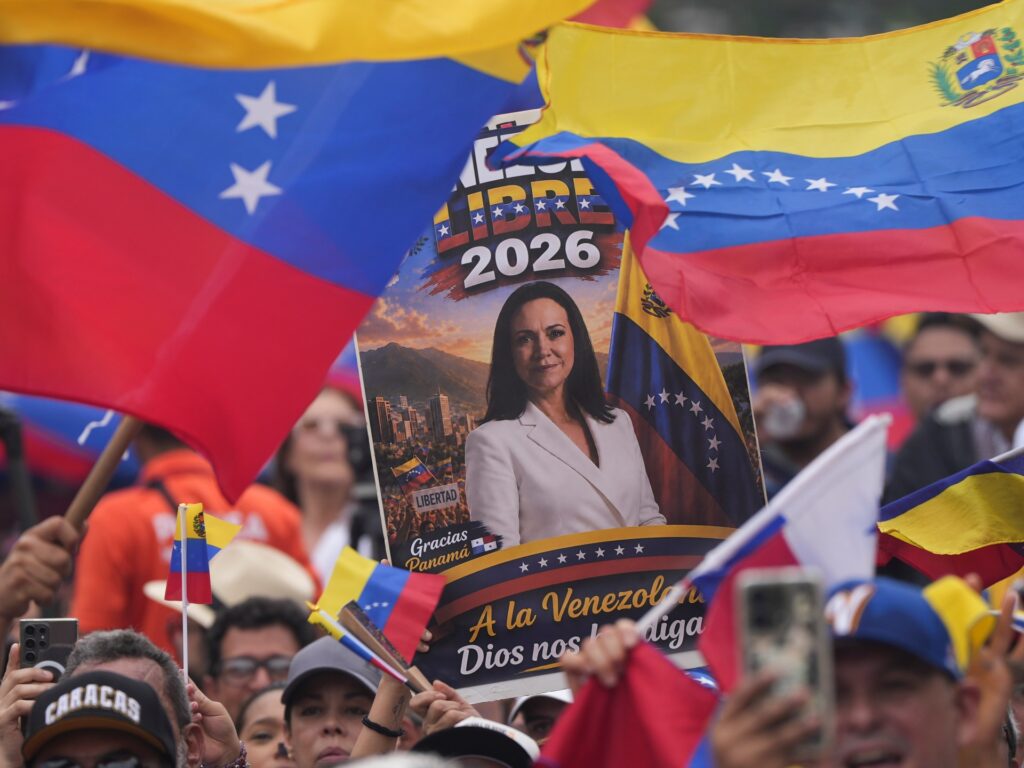
Venezuelan opposition reaffirms backing for Maria Corina Machado as leader
An alliance of opposition parties in Venezuela has once again pledged its support to exiled Nobel Peace Prize laureate Maria Corina Machado. In a meeting held in Caracas on Sunday, members of the Unitary Democratic Platform (PUD) voted to “recognise and support the leadership of Maria Corina Machado”. The coalition also reiterated its call for free elections after the disputed presidential votes of 2018 and 2024.
The statement released on Sunday listed fourteen proposals aimed at a democratic transition, including the liberation of all political prisoners, the return of exiles, and the restoration of political party freedoms. The move adds pressure on the government to allow Machado’s return; she has remained in exile since leaving Venezuela in December to accept her Nobel Prize.
“The will of the Venezuelans must once again govern the destiny of our nation,” wrote former opposition presidential candidate Edmundo Gonzalez on social media, endorsing the proposals. “We will not accept political prisoners, persecution or a governing power that disregards the mandate of its citizens. Living in freedom and under a genuine constitutional order is a legitimate demand of our society.”
Venezuela has not yet announced a date for a new presidential election. Since 3 January, the country has been led by interim President Delcy Rodriguez of the United Socialist Party of Venezuela (PSUV). PSUV officials have faced accusations of human‑rights violations, including arbitrary arrests, imprisonment and torture of political dissidents.
Despite a U.S. military operation that targeted former President Nicolas Maduro, the PSUV remains in power with backing from the White House. President Donald Trump has publicly supported Rodriguez’s leadership, even though she previously served as Maduro’s vice‑president. His administration continues to influence Venezuela’s oil sector and to press the Rodriguez government for reforms, though critics say Trump has been reluctant to demand new elections, preferring a three‑phase plan that prioritises stability and economic recovery before a political transition.
Machado told the Financial Times that she hopes Venezuela can hold elections by July of next year. “The US government and the Venezuelan people all agree that the only way to make this sustainable and a real victory is to turn Venezuela into a stable democracy,” she said in the interview.
Authorities in Venezuela have repeatedly blocked Machado’s attempts to re‑enter the country, according to her party, Vente Venezuela. She has also reportedly asked the Trump administration for assistance in returning. In January, she presented Trump with her Nobel Peace Prize during a visit to Washington, DC, but media reports suggest tension between the administration and Machado.
U.S. officials speaking to Reuters and Axios, who asked to remain anonymous, expressed frustration with Machado’s repeated attempts to return, especially after two deadly earthquakes struck Venezuela in July. An Axios source described her efforts as “political opportunism”.
Machado remains a popular figure among the opposition. She won the coalition’s presidential primary in October 2023, but a court decision in January 2024 barred her from running, upholding a 15‑year ban on holding public office because of her support for U.S. sanctions against the Maduro government. Edmundo Gonzalez replaced her as the opposition candidate in the 2024 election, which Maduro claimed as a third term despite widespread criticism of the vote’s credibility. The opposition released its own tallies suggesting Gonzalez had won, and the United States recognised him as president‑elect, rejecting Maduro’s claims.
Machado was previously removed from the National Assembly in 2014 for her activism against the government. A third round of talks between the Rodriguez interim government and the opposition began this month, but the negotiations have involved members of the 2015 National Assembly rather than Machado herself. The U.S. State Department praised these talks, stating they are delivering tangible reforms in civil liberties and political rights and laying the groundwork for credible elections and a democratic transition.