Islamabad Bars Unfit Vehicles From Today as Smog Crackdown Bites
From today, a vehicle without a fitness certificate cannot legally enter Islamabad. The capital administration has turned a long-ignored legal requirement into an entry condition, and the move is the sharpest step yet in its campaign against smog and dirty air.
What changes from today
Vehicles without fitness and emission test certificates will not be allowed to enter Islamabad from Wednesday, 18 November. The decision was taken at a meeting chaired by Minister of State for Interior Tallal Chaudhry to review steps for smog prevention and the reduction of air pollution. Chaudhry directed all relevant departments to ensure coordinated and effective action, and said Interior Minister Mohsin Naqvi was himself monitoring the anti-smog measures and their implementation. The enforcement is not limited to a warning. Unfit vehicles will be impounded and first information reports lodged for serious violations. Those found burning garbage or industrial waste will also be booked, heavy fines will be imposed for open burning and other smog-causing activities, and strict action will be taken against smoke-emitting brick kilns and industrial units.
Why now, and why it matters
The timing is no accident. Winter is when smog settles hardest over Pakistan’s cities, and Islamabad, long considered the cleaner capital, is no longer exempt. According to data published by the Pakistan Environmental Protection Agency, the average air quality index for Islamabad was 148 this October, compared with 169 in October 2025. Chaudhry said the capital’s air quality in October and November this year had remained better than the same period last year, but the figures still sit far above levels considered healthy. Vehicle fitness was already a legal requirement, the minister said, but it had been overlooked for quite some time, with violators facing fines in some cases. Strict enforcement has now started, and a certificate that was easy to ignore is now a condition of entry, with older, poorly maintained vehicles the most likely to fail the test.
The wider clean-air push
The vehicle ban is one piece of a broader effort that has been gathering pace. Last month, a two-day Pakistan National Clean Air Conference concluded with the adoption of the Islamabad Clean Air Compact, calling for coordinated federal and provincial action, stricter enforcement, regular emissions inventories and annual reviews to tackle air pollution. The National Assembly Standing Committee on Climate Change and Environmental Coordination has recommended a regular vehicle emission testing mechanism in Islamabad and called for updating the Pakistan Environmental Protection Act of 1997. Last year, Pak-EPA launched large-scale inspections of vehicles and industrial units and demolished non-compliant brick kilns as part of a multi-tier plan to curb escalating air pollution.
What to watch next
Three things will decide whether this crackdown lasts beyond the first week. First, enforcement at the capital’s entry points, where traffic police will have to check certificates without bringing traffic to a standstill. Second, testing capacity, because a sudden rush for fitness certificates will expose how many testing facilities actually exist and how quickly they can cope. Third, whether the fines and impoundments change behaviour among commercial operators, whose ageing trucks and buses are among the worst polluters. The minister stressed that public cooperation was crucial for smog control and that citizens would have to play a responsible role. That cooperation will follow credibility: if the rules apply equally to private cars and to influential transporters, the ban could become the first smog measure in the capital that people actually feel.
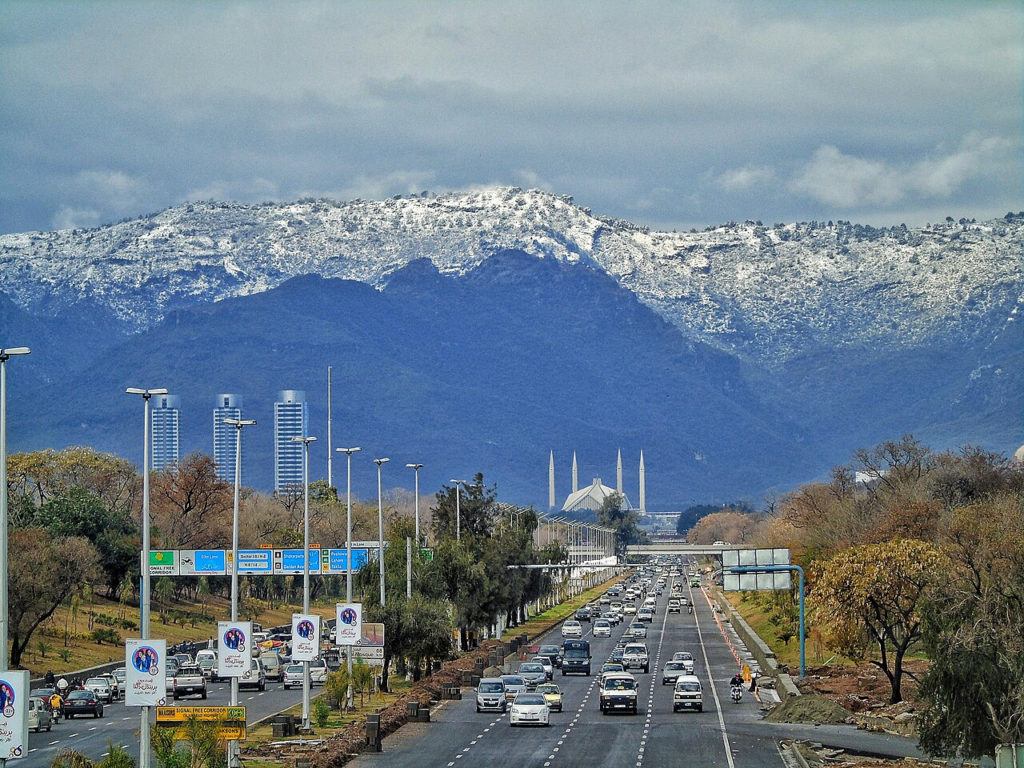
Featured image: Faisal Mosque in Islamabad. Photo: Fassifarooq, CC BY-SA 4.0, via Wikimedia Commons.
Sources: Dawn (https://www.dawn.com/news/2045239)