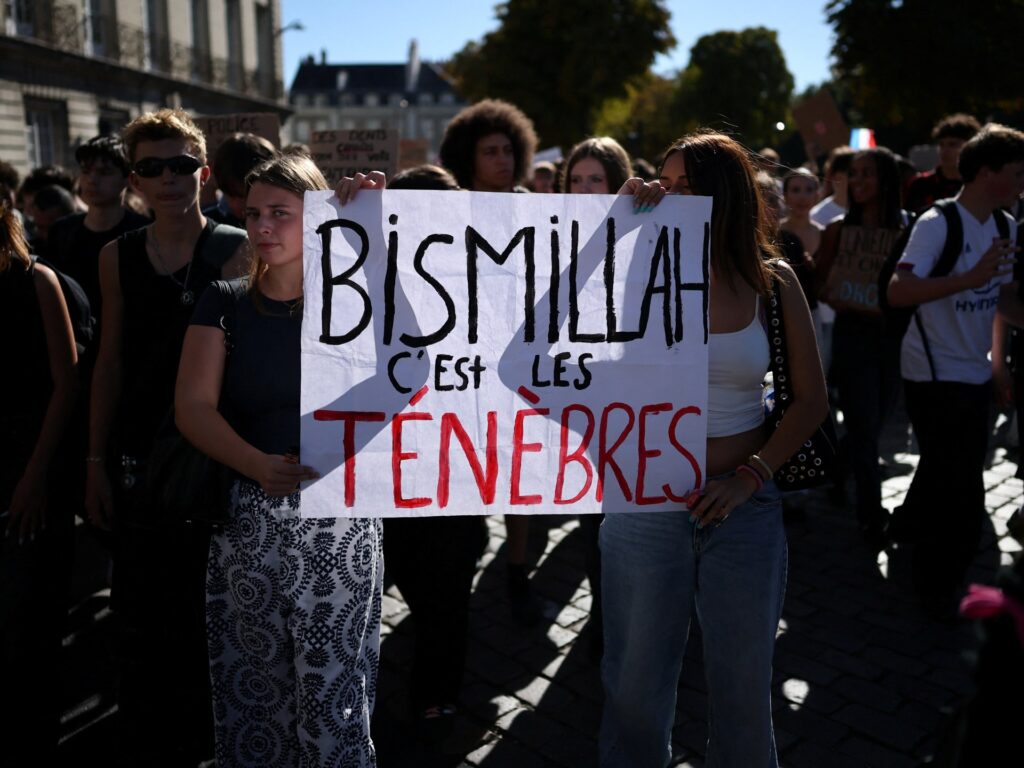
Why are French protesters chanting ‘Bismillah, c’est les ténèbres’?
Hundreds of thousands of demonstrators flooded French streets over the weekend, marking the biggest wave of unrest since protests over education reforms and rising living costs began last month. The movement brings together students demanding better school conditions and citizens fed up with the soaring cost of everyday life. Among the chants that have echoed through the crowds, one phrase has drawn particular attention: “Bismillah, c’est les ténèbres.”
The expression, which translates roughly as “In the name of God, it’s darkness,” does not convey a straightforward political message. “Bismillah” is an Arabic phrase traditionally used by Muslims before undertaking an action, but in French slang it has come to mean something like “let’s go.” “C’est les ténèbres” means “it’s the darkness,” a reference to a bleak or hopeless situation. Together, the words form a nonsensical slogan that protesters have adopted to mock what they see as racial stereotyping by the police.
The chant appears to have originated from a screenshot of a Snapchat conversation that began circulating in early October. In the exchange, a user named Mamadou asks to be added to a group, writing, “Hi, in the name of God, it’s the darkness. When’s the blockade, wallah, bro?” The message included emojis of the Algerian flag. Students claim the post was sent by undercover police officers trying to infiltrate protest chats, using a clumsy mix of Arabic and French slang. French authorities have not confirmed the allegation and have not issued an official comment.
Youssef El Chazli, an associate professor of Arab and Mediterranean sociology at Paris 8 University Vincennes‑Saint‑Denis, said the phrase highlights how police can appear out of touch and steeped in stereotypes. “Such stereotypes appear to disproportionately aim at youths from Arab and African descent,” he told Al Jazeera. “This is another example of how out‑of‑touch state agencies seem to be with the current movement.”
The slogan has shown up on cardboard placards and spread beyond France to Italy and Belgium, where similar protests over cost‑of‑living pressures and education took place. El Chazli noted that satirical memes and internet trends have become a key way for young people to voice political grievances, adding that youth‑led protests often draw heavily on subcultural references.
Police conduct is also under scrutiny. France’s police inspectorate, the IGPN, has opened dozens of investigations into alleged police violence since the demonstrations began. At the same time, public debate has turned to rising Islamophobia. A Reuters‑cited report from last year recorded a 72 percent increase in Islamophobic incidents during the January‑March quarter of 2025 compared with the same period in 2024. The French far right quickly resorted to racist language, blaming Muslim youths for the unrest, while former U.S. President Donald Trump echoed similar claims, suggesting the protests were about “Islam wanting to take over.”
El Chazli observed that what was once a marginal topic two decades ago has become a mainstream point of discussion. “For younger generations, Arab and African influences have been steadily mainstreaming in youth subcultures, through sports, arts, new radio shows and social media content,” he said. The chant “Bismillah, c’est les ténèbres” thus serves as both a critique of police stereotyping and a broader reflection of the cultural shifts shaping today’s protest movements.