
Weaponising AI anxieties
By Adji Bousso Dieng
Published 17 Oct 2026
As artificial intelligence advances, its immediate societal impacts are becoming hard to ignore. Companies are laying off workers whose roles can now be handled by AI models. The rapid expansion of data centres is driving up energy use and enlarging the carbon footprint. Malicious actors are deploying AI agents to automate the spread of disinformation. Algorithms are showing bias, prompting worries about unfair outcomes in technologies that rely on them. In warfare, AI is being used to identify targets, which has contributed to a rise in loss of human life.
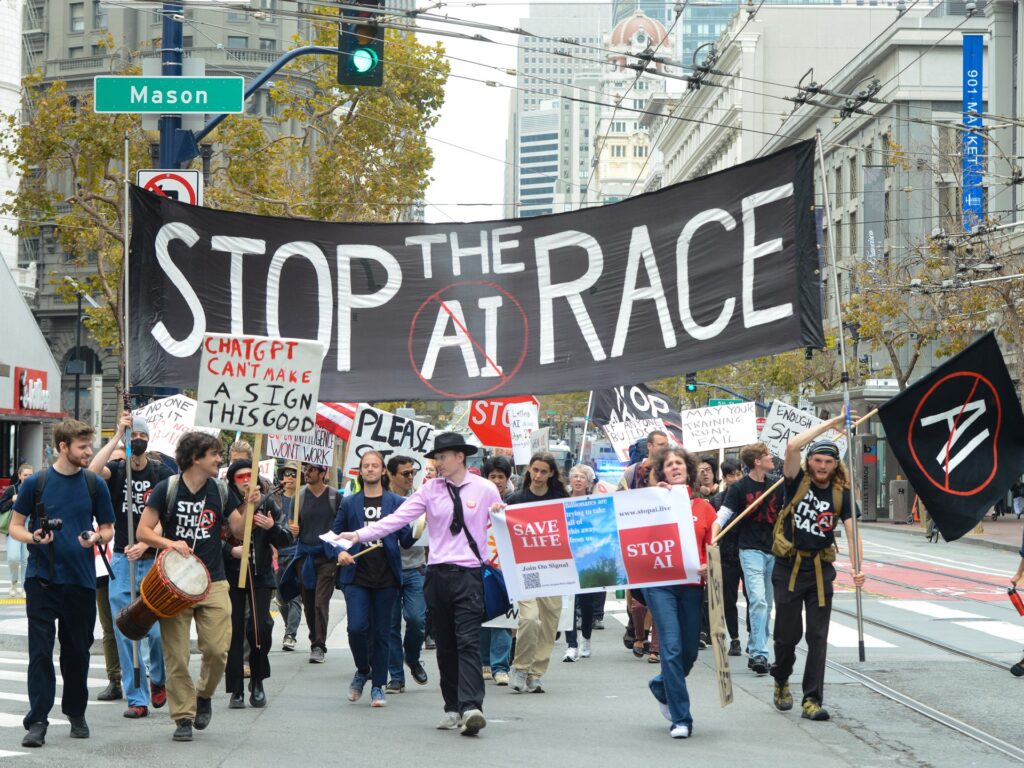
These pressing issues call for serious regulatory attention, yet the dominant conversation around AI policy rarely grounds itself in them. Instead, the global discourse has been overtaken by apocalyptic predictions. This doomsday narrative is promoted by certain voices inside the AI industry and echoed at the highest levels of decision‑making – from Senator Bernie Sanders advocating bans on superintelligence, to cautionary statements from the Vatican, to former Secretary of State Hillary Clinton describing open‑source AI as a genuine threat.
It is understandable that world leaders take these industry‑amplified warnings seriously. However, the resulting chorus of alarm about AI “existential risk” has diverted focus from the multiple crises AI is already creating – affecting labour, the environment and communications. Worse, the ensuing public panic is being harnessed to justify a modern form of digital colonisation, whereby power concentrates in the hands of a few AI corporations based in a handful of countries.
The doomsday framing offers a convenient rationale for regulations aimed at curbing open‑source AI models, which are free or inexpensive to use and can be modified to suit local needs. The argument presented to lawmakers is simple: if advanced AI could become a weapon of mass destruction, then only a trusted few should be allowed to develop it. Under the banner of safety, major tech firms are attempting to shape the rules to protect their monopolies, effectively shutting out competition from smaller, cheaper open‑source alternatives.
This approach mirrors historic colonial tactics – preventing local industry from emerging so that dependence on the “empire’s” exports becomes total. Today, the entire world relies on frontier AI systems built by tech giants, especially the Global South, which lacks the resources to train its own models from scratch. Training such models now costs upwards of $100 million in compute power alone.
Beyond the high price tag, these imported models often fail when applied to local realities. Kenya’s recent rollout of the AI‑driven Social Health Authority (SHA) system illustrates the problem. The model was constructed on assumptions that did not reflect the country’s vast informal economy, leading to a spectacular failure that systematically overestimated incomes and overcharged the poorest citizens for healthcare premiums.
For AI to work effectively in a given context, it must be adapted to local data. Building such models from scratch remains financially out of reach for most nations, making open‑source AI the only viable bridge for local innovators. Preserving open‑source access also enables the Global South to move beyond the West’s treadmill of human‑mimicking chatbots. Developing countries do not necessarily need conversational AI; they require tools that can address development challenges in energy, healthcare, agriculture, manufacturing and climate mitigation.
If open‑source AI is crushed under exaggerated fears of AI agents, developing nations lose the primary mechanism they have to build sovereign tech ecosystems for their own progress. Moreover, AI monopolies trap users in a cycle of data extraction and severe cognitive dependency. Early signs of cognitive degradation are already visible as people increasingly outsource critical thinking, creativity and agency to frontier AI systems. This dependency creates a feedback loop: greater reliance fuels more data extraction, which in turn produces even more capable systems that further erode human agency and concentrate absolute control.
Although the Global South is especially vulnerable because of historical inequities, this dependency threatens anyone not at the forefront of AI development. Even wealthy nations in the Global North face the same risk of lock‑in and extraction.
So what is the way forward? Calls for outright AI bans are not the answer. Abandoning AI would mean relinquishing a technology that is uniquely positioned to accelerate drug discovery and to devise solutions for energy and climate crises – advances already demonstrated by tools such as AlphaFold and MOFSeq. Banning open‑source AI models is equally misguided; safety does not have to come at the expense of equitable access. We can and must fund rigorous safety research and implement thorough testing for near‑term breaches, but we cannot let fear of hypothetical futures justify the deliberate consolidation of power in the present.
Protecting the future of AI means ensuring its development is decentralised, transparent and globally distributed. It means defending open‑source innovation as a public good and a fundamental weapon against digital colonisation. It means proactively addressing the