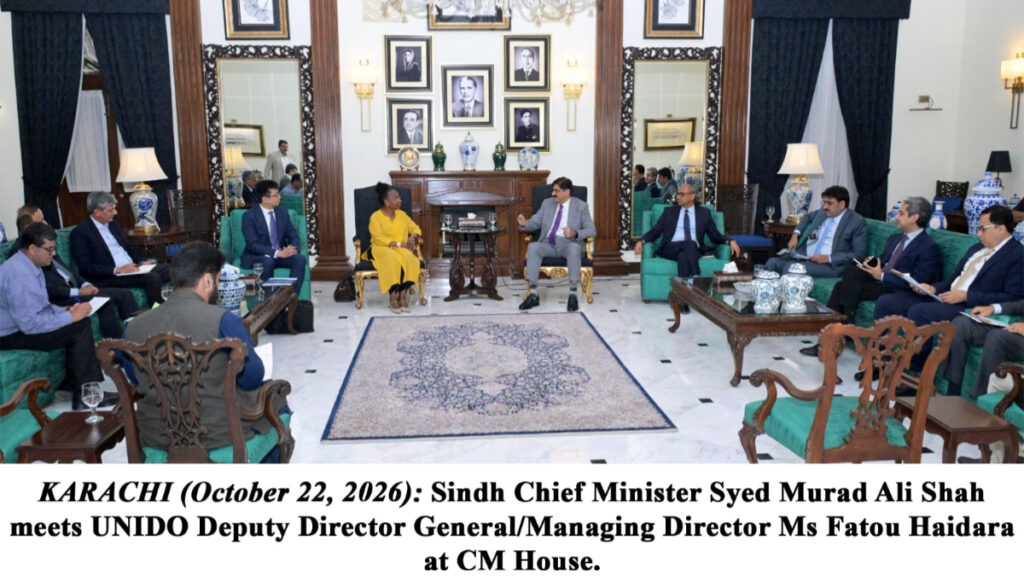
Sindh and UNIDO to Mobilize $40 Million for Development Programme
The chief minister of Sindh, Syed Murad Ali Shah, and Fatou Haidara, deputy director general and managing director of the United Nations Industrial Development Organization (UNIDO), agreed to deepen cooperation on inclusive growth, climate‑resilient infrastructure, rural development and job creation. UNIDO plans to raise roughly $40 million for a dedicated development programme in Sindh under its 2025‑2030 Programme for Country Partnership.
The pact was sealed at the chief minister’s office, where officials discussed expanding successful interventions, exploring new areas of collaboration to improve livelihoods and generate sustainable economic opportunities for vulnerable groups, and reviewing progress on the Poverty Alleviation and Inclusive Development Across Rural Sindh (PAIDAR) programme funded by the European Union. Present at the meeting were provincial minister for labour Saeed Ghani, minister for planning and development Jam Khan Shoro, special assistant to the chief minister on investment Syed Qasim Naveed, chairman of planning and development Najam Shah, secretary to the chief minister Asif Jameel, secretary for social protection Khadim Channa and additional secretary for investment Zahoor Marri. UNIDO’s delegation included Mr. Jie Zhao, chief of the Asia‑Pacific region, Mr. Badar‑ul‑Islam, officer‑in‑charge, and Mr. Farooque Ahmed Siddiqui, national technical advisor for PAIDAR.
After the devastating floods of 2022, the chief minister thanked UNIDO for its continued partnership, highlighting support for enterprise development, rural communities and climate‑resilient infrastructure. Minister Jam Khan Shoro explained that PAIDAR, implemented by UNIDO with a €49.55 million grant from the European Union, operates in Thatta, Sujawal, Badin, Tharparkar and Larkana districts. The programme aims to cut poverty, strengthen local economies, improve public services and create jobs for women and youth. It blends investment in rural infrastructure and community facilities with grants for micro, small and medium enterprises, technical assistance and capacity‑building for institutions.
The chief minister praised the programme’s role in rebuilding flood‑affected areas through climate‑smart settlement planning in partnership with the Sindh People’s Housing for Flood Affectees (SPHF). He also noted its assistance to rural entrepreneurs launching or expanding businesses. Special assistant Syed Qasim Naveed cited beneficiaries who turned financial aid into viable ventures, such as a woman who opened a restaurant in Badin and an entrepreneur in Larkana who established a pasta‑making unit linked to a flour mill. He said these cases illustrate how targeted funding, business development support and market access can generate livelihoods and spur economic activity in rural Sindh.
The meeting was informed that Community Resilient Settlement Development Plans have been prepared for about 300 villages across the five PAIDAR districts, providing a basis for climate‑informed planning, resilient infrastructure and better community services. Following the creation of a model village at Lakho Bhambhro in Thatta with SPHF, UNIDO will help replicate the model in another 100 villages. The initiative integrates essential infrastructure such as safe drinking water, sanitation, drainage, roads, energy‑efficient facilities and other improvements designed to raise living standards and enhance resilience to climate risks. The programme also supports the establishment of Rural Growth Centres to improve access to public services, boost local economic activity and foster enterprise development.
In a notable employment effort, PAIDAR will fund skills training for 200 young people from the five target districts through reputable institutions. The nine‑to‑twelve‑month courses will focus on market‑oriented trades such as hospitality, electric vehicles, solar technologies and other sectors with strong job and entrepreneurship potential. The chief minister welcomed the initiative, stressing the need to align training with market demand and emerging investment opportunities in Sindh.
The meeting also reviewed UNIDO’s technical assistance for the Sindh Development Portfolio Management System, being built with the Planning and Development Department. The digital platform aims to modernise management of the provincial development portfolio by linking planning, appraisal, approvals, documentation, monitoring, evaluation and reporting stages. It will enable electronic processing of PC‑I to PC‑V documents and is expected to improve transparency, administrative efficiency, accountability and evidence‑based decision‑making in the implementation of development schemes.