Remittances Are Papering Over Pakistan’s Export Problem as Trade Deficit Hits $12.29 Billion
Pakistan’s external account looks stable on the surface. Money sent home by overseas Pakistanis reached $14.8 billion in the first four months of the fiscal year, up 14 percent on a year ago, and October alone brought in $3.9 billion. The State Bank of Pakistan has raised its full-year remittance projection to $45 billion. But a closer look at the trade numbers published this week shows a different picture: exports are barely keeping up, imports are growing faster, and the gap between the two is being papered over by remittances rather than closed by trade.
The gap keeps widening
Goods exports rose 8 percent to $11.35 billion between July and October, but imports rose 13 percent to $23.64 billion over the same period. The result is a goods trade deficit of $12.29 billion, 17 percent wider than a year earlier. That is the arithmetic behind the current account, which swung to a $39 million surplus in October. The surplus is real, but it rests on remittances and a softer import month, not on exports doing the heavy lifting. The distinction matters: earning foreign exchange through exports builds industrial capacity and jobs at home, while remittances, however welcome, mostly support household consumption and bank liquidity.
Textiles, the engine that is idling
The weakest link is the sector Pakistan counts on most. Textile exports, traditionally the country’s largest source of export earnings, rose by just 1 percent to $6.3 billion in the four months, despite sitting at the centre of government export and industrial policy. Exporters have repeatedly asked for competitive energy prices, affordable financing, tax refunds and a predictable policy environment. Yet the returns are thin. US-based entrepreneur Sheikh Tahir Imran put it bluntly, saying the ineffectiveness of the export economy is becoming a burden, and arguing for tougher checks on traditional export sectors, including penalties if they fail to reach their targets.
The bright spots are real, but too small
Not everything is moving slowly. Services exports rose 23 percent to $3.7 billion, information technology exports grew 20 percent to $1.7 billion and set a monthly record of $453 million in October, and food exports rose 20 percent to $1.8 billion on the back of a 46 percent jump in rice shipments. These are genuine gains, and IT in particular is becoming a serious export line. But as Imran notes, they have yet to offset the weakness in merchandise exports. Meanwhile the import bill is rising in places that raise questions. Automobile-related imports jumped 29 percent to $1.5 billion, with car imports up 52 percent to $966 million, just as the government prepares its Auto Policy 2026-31. Consumers may welcome more choice, but the surge adds foreign exchange pressure unless local production and vendor development keep pace.
What has to change
Economic analyst Shahid Anwar argues that Pakistan’s export problem cannot be fixed through incentives and policy announcements alone. What is missing, in his view, is a professional and results-oriented export promotion system that helps businesses find international buyers, enter new markets and turn trade opportunities into actual orders. That message now has political backing: Prime Minister Shehbaz Sharif told the American Business Council this week that export-led growth is the only sustainable way forward. The test ahead is whether support for exporters starts coming with performance conditions, whether the IT and food momentum can scale, and whether import growth is matched by production at home. Until exports grow faster than imports, remittances will keep doing a job that trade is supposed to do.
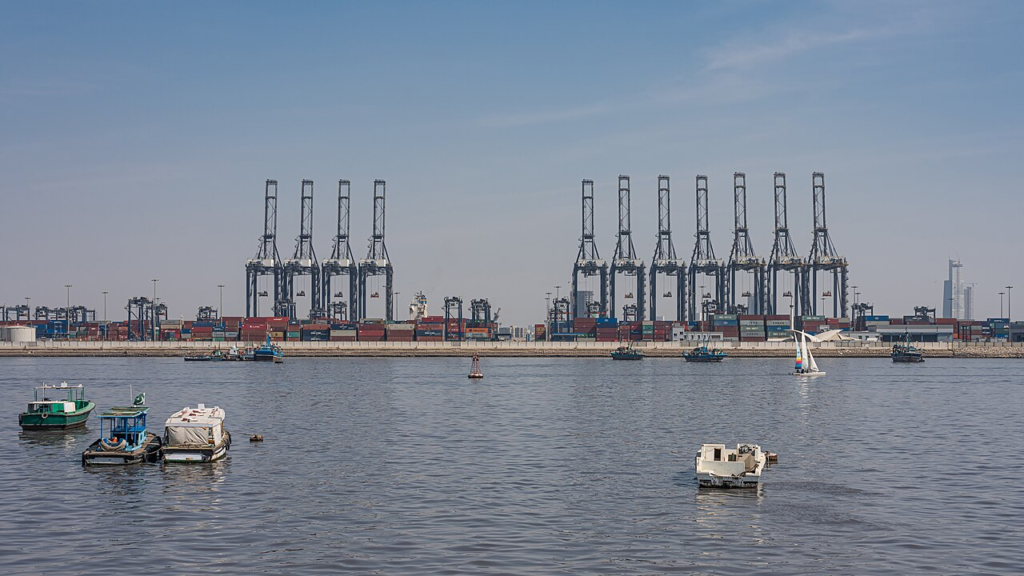
Featured image: Container port in Karachi. Photo: A.Savin, Free Art License, via Wikimedia Commons.
Sources: The Express Tribune (https://tribune.com.pk/story/2641255/remittances-mask-export-weakness?amp=1); Dawn (https://www.dawn.com/news/2045788)