
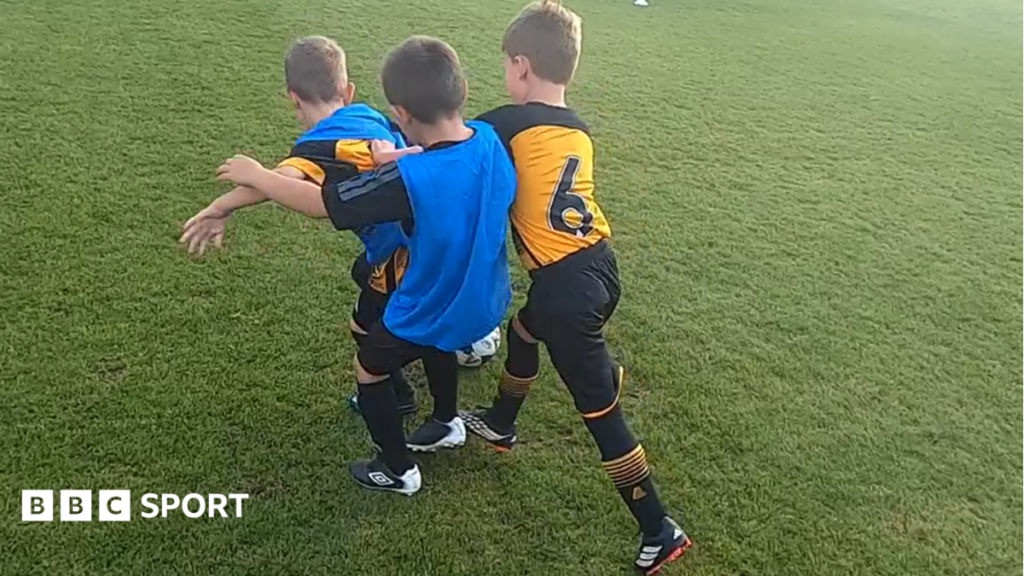
Not in Our DNA: Could 3‑v‑3 Reshape English Football?
By Gary Rose, BBC Sport journalist
Published 19 October 2026
After England’s disappointing loss to Argentina at this summer’s World Cup, manager Thomas Tuchel explained why the Three Lions have struggled in major tournaments. “I think ball possession plays a crucial role,” he said. “It’s maybe not in our DNA like it is in the Spanish DNA or Argentinian or Brazilian DNA to take the ball, control the game and the ball, which is also a big problem.”
In scientific terms, DNA refers to the genetic blueprint for life, but in football the concept is used to describe the foundational traits that are instilled from the grassroots level. This season the Football Association (FA) introduced a change to youth football that could reshape the DNA of the English game.
For decades children of all ages have played 11‑a‑side matches on full‑size pitches. In 1999 the FA launched “mini‑soccer” for under‑10s, a small‑sided version designed to give youngsters more touches on the ball. Until the end of last season the smallest format for children under seven was 5‑v‑5. Last month the FA reduced that further to 3‑v‑3.
The new 3‑v‑3 format removes goalkeepers and referees, with the aim of giving each player more ball contact and more scoring opportunities. The change follows two years of research by the FA and Liverpool John Moores University, which examined over 400 games from under‑6 to under‑14 level. John Folwell, the FA’s head of grassroots coach development, told BBC Sport: “All of the research done demonstrates that those players having more touches of the ball are more engaged in the game. They are also making more decisions and are engaged in more physical activity, so that is the thinking behind it. There are no goalkeeper and no substitutes, so everyone is active in the game. They are not sitting on the side watching their mates play, or they are not standing in goal watching their friends play. They are actually involved in the game.”
Coaches are still adapting, as the format was only introduced a few weeks ago. The smaller games create logistical challenges, requiring more pitches, coaches and volunteers. BBC Breakfast visited Collingham FC in Nottinghamshire to see how local coaches are coping. “We have three pitches going on at once and all it needs is one parent to be at work and you are trying to keep an eye on three games and nine children at once,” said Michael Bland, coach of Collingham’s under‑7s. He added that the self‑officiating nature leads to “dangerous tackles flying in and trying to teach the kids what a safe tackle is.”
Mick Goodwin, a youth coach since the 1990s, noted the shift from 11‑a‑side to small‑sided formats. “My concern is you will get one dominant player in the 3‑v‑3 where the not‑so‑good players will not get a touch of the ball,” he said. “What we’ve seen is the dominant player has been shooting from the halfway line. We can absolutely see the concept, I just think it needs a bit of finessing and it will be fine.”
Parents and children generally welcomed the new set‑up, which the FA says should emphasize enjoyment rather than tactics or competition for youngsters under seven. At Collingham, a child remarked, “They are open goals and you can score more,” while another added, “There are fewer players so it is easier to dribble around them.” Parent Dean said, “Before my son was just in goal but now he is learning to pass to other players, block stuff and be a better defender as well.” Another parent, Hannah, explained, “My son has an older brother so he is used to playing in the more traditional format, so for him it has taken a bit of adapting.”
One criticism of the new format is the absence of goalkeepers and the potential impact on their development. The 3‑v‑3 stage lasts only twelve months, after which children return to 5‑v‑5 at under‑8 level. Folwell responded, “When you make decisions like this, there are obvious trade‑offs but we don’t believe it is going to be detrimental to the development of future goalkeepers. Obviously playing 3‑v‑3, players can’t use their hands but they are still going to be developing skills of blocking, sliding across, needing to get between the ball and the goal. They will also improve their ability on the ball, which we know for goalkeepers now is an increasing technique they need to have. We don’t believe that goalkeeping is an early specialisation position. There are lots of examples of players who have come through and ended up being goalkeepers at a later age – England goalkeeper Hannah Hampton, for example, first played outfield for a long time.”
It will take several years to determine whether the new format improves the development of English footballers. England is not alone in adopting 3‑v‑3 at under‑7 level; the approach is already part of the youth structures in Germany, the Netherlands, Norway and other nations.