
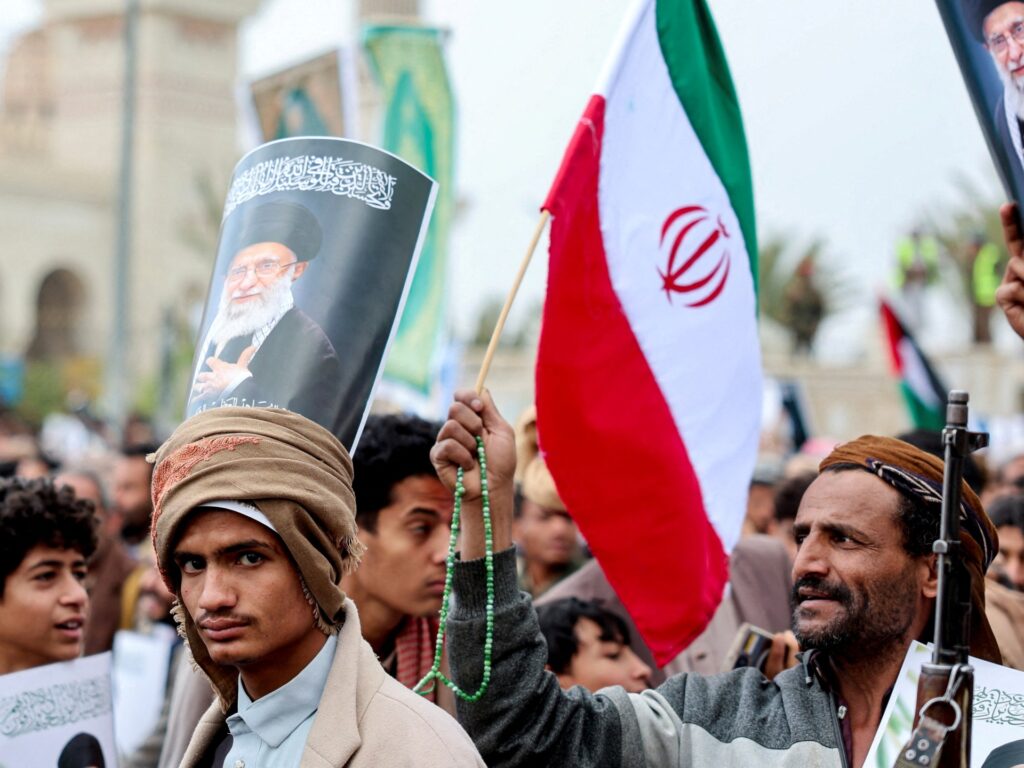
Iranian aid to Houthis under scrutiny as Yemen conflict flares and Saudi cities are struck
New reports and official statements are bringing fresh attention to the murky partnership between Iran and Yemen’s Houthi movement. Media outlets claim that Iran’s Islamic Revolutionary Guard Corps (IRGC) has been providing the Houthis with training, intelligence, tactical advice and assistance in targeting drones and missiles as the rebels advanced across western Yemen and launched their most sophisticated attacks yet on Saudi Arabia, which backs the internationally recognised Yemeni government.
If the allegations are correct, they could heighten tensions between Tehran and Riyadh. In recent weeks the kingdom has endured dozens of Houthi drone and missile strikes, including a raid on King Khalid International Airport in Riyadh that killed 13 people, as well as attacks on Saudi energy infrastructure and oil tankers.
According to the reports, Iranian support helped fuel a September offensive in which the Houthis captured large sections of the Red Sea coast and the strategically vital Bab al‑Mandeb strait. The Wall Street Journal said that Iran’s Mahan Air transported IRGC officers, drone components, missile guidance kits and impact detonators to the Houthis, and that IRGC personnel were present on the front lines directing attacks.
Saudi‑led coalition spokesman Major‑General Turki al‑Maliki acknowledged that an external state actor was behind the Houthis’ expanding arsenal, but did not name the country. He noted that the rebels, who have fought the Yemeni government since 2014, have obtained advanced technologies with regional assistance, making them the first non‑state group to field ballistic missiles, offensive and suicide drones, and high‑speed boats packed with explosives. He added that other Iranian proxies such as Hezbollah also possess similar weapons.
The Houthis insist they act independently of Iran, yet both share a common ideology and have been repeatedly accused of close military coordination, a point underscored by the sophistication of the Houthis’ missile stockpile.
Analysts consulted by Al Jazeera all pointed to the IRGC as the likely source of the “regional assistance” the Houthis are receiving, despite denials from Tehran and the rebels. One clue, they said, was the July bombing of Sanaa International Airport that occurred just before an Iranian aircraft carrying a Houthi delegation from Tehran was scheduled to land. The Yemeni government, which claimed responsibility for the strike, accused the Iranian plane of violating its airspace.
Ibrahim Jalal, a Yemen specialist, told Al Jazeera, “Recent reports confirm what experts have known for years: the Revolutionary Guard and Hezbollah have been involved in planning battles against the Yemeni government and neighboring countries, including Saudi Arabia.” He cited the killing of former Iranian ambassador Hassan Irlu in Yemen after the 2021 Marib campaign and the use of Mahan Air flights to move experts as further evidence.
Military and strategic security analyst Ali al‑Dahab agreed that the advanced weaponry used by the Houthis points to Iranian involvement. “The leaked information about Iranian support does not reveal anything new, except that weapons smuggling—especially precision missile and UAV technology—now takes place via small submarines,” he said. He noted that previous smuggling operations relied on traditional dhows, while the use of submarines mirrors tactics employed by organized crime groups in the Americas.
Al‑Dahab argued that Iran views the Houthis as a central military and security asset south of the Red Sea, supplying them with arms, ammunition, expertise and intelligence in anticipation of a possible clash in the Strait of Hormuz. “The Houthis therefore serve as a supporting force for Iran in the Bab al‑Mandeb strait,” he added.
He warned that the Houthis’ control of Bab al‑Mandeb could have broader repercussions for global shipping. “The greatest danger now is that substate entities in the southern Red Sea and Gulf of Aden region unite under Iran’s leadership to confront the United States, Britain and Europe in general if a battle breaks out in the Gulf of Aden,” al‑Dahab cautioned.