
Cost of living protests spread across Belgium, Italy, Portugal and France
Hundreds of thousands of Europeans took to the streets on Saturday in separate, uncoordinated demonstrations to denounce soaring living costs. The unrest, which unfolded in Belgium, France, Italy and Portugal, is adding pressure on governments throughout the European Union.
In France, more than 550,000 people joined protests, according to the Ministry of the Interior, making it one of the country’s most turbulent days in decades. Demonstrations, which followed weeks of student protests, turned violent as fringe groups looted shops, set fires and attacked police vehicles and officers. Prime Minister Sébastien Lecornu reported 1,200 arrests and 150 injured police officers, calling it “a miracle the toll wasn’t higher” when he visited officers in central Paris. Dozens of stores were looted in Paris, Marseille, Nice, Nantes, Bordeaux, Limoges, Lille, Toulouse and Strasbourg, AFP said. Paris mayor Emmanuel Grégoire described whole streets in the capital as “devastated”. A fire set by masked protesters in Limoges largely destroyed the 140‑year‑old town hall, while city halls in Marseille and Lille were broken into and vandalised. In Lyon, the tourist office was torched. President Emmanuel Macron posted on X that those responsible would be “prosecuted and punished”.
In Belgium, police in Brussels used tear gas and water cannon to disperse demonstrators, accusing them of launching missiles and starting fires. Similar tactics were employed in Liège, a smaller city east of Brussels, though police did not disclose attendance figures.
Lisbon saw an estimated tens of thousands of protesters march against the cost‑of‑living crisis, low wages and a housing shortage. House prices in Portugal have more than doubled since 2017, and rents for new leases have risen almost as much. Parliamentary Affairs Minister Carlos Abreu Amorim said on Friday that the government “will not yield to shouts from the street”. Protesters accused leaders of being out of touch with their problems.
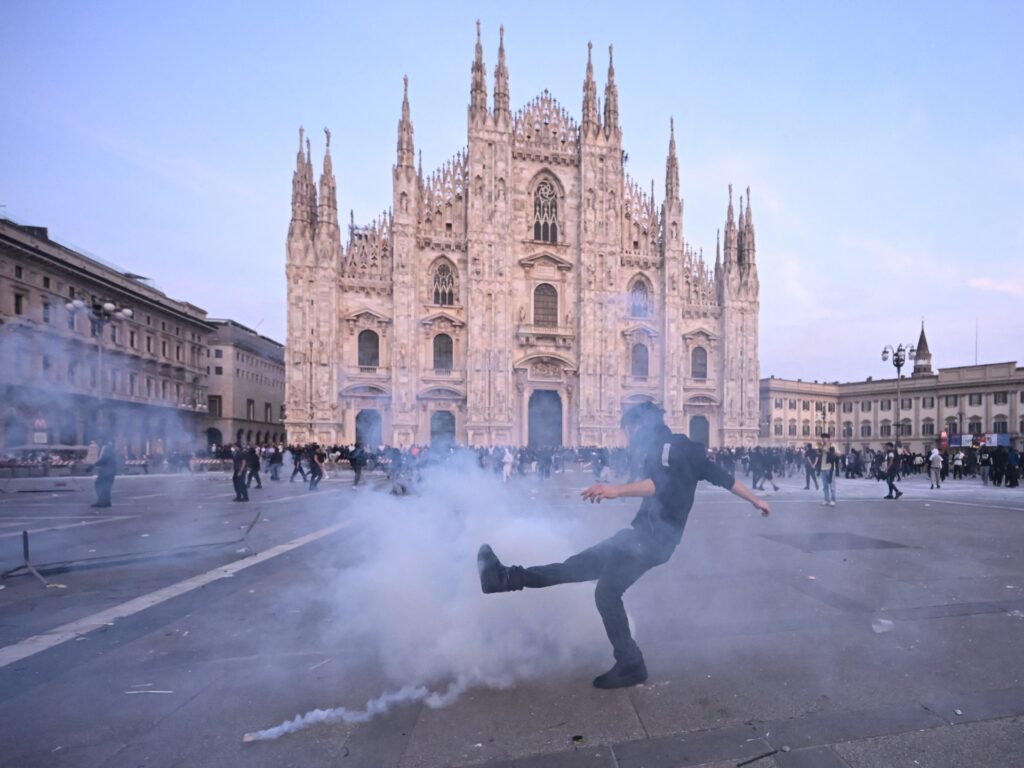
In Milan, rioters clashed with police, looted stores and set property ablaze in the city centre, emptying Piazza del Duomo and a luxury arcade that usually teems with shoppers. A march that began peacefully against wars and rising living costs turned chaotic when masked protesters threw stones, paving blocks and other objects at riot police and ignited barricades made from bar tables. Police responded with water cannon and tear gas. At least two officers were injured and about 50 demonstrators, many minors, were detained, according to the Italian news agency La Presse. Prime Minister Giorgia Meloni condemned the violence, writing on X that “demonstrating is a right. Setting our cities ablaze is not,” and blamed “hooligans who exploit demonstrations to sow chaos”. Milan’s centre‑left mayor Giuseppe Sala said the reasons for the protests were understandable, but the violence and damage were unjustifiable. In Bologna, police reported that peaceful rallies were accompanied by stone‑throwing and clashes with officers.
Although the protests in Belgium, Italy and Portugal were not as large as those in France, experts see them as a sign that discontent is spreading. Alberto Alemanno, a professor of EU law and policy at HEC Paris Business School, told Al Jazeera that France is the epicentre of the movement and that similar grievances are emerging in Greece, Germany and Austria, where “early stages” of mobilisation are expected in the coming week. He noted that the protests share concerns such as underfunded education, rising living costs and, for students, uncertain job prospects after graduation.
The unrest arrives at a critical moment for Europe, as the continent prepares for an unprecedented series of national elections over the next twelve months, with votes scheduled in Spain, France, Italy and Poland. Alemanno warned that the protests and mobilisations will dominate the political conversation in the months ahead.