
Best images of F1 in the US through the years
By Alan Jewell, BBC Sport – 19 October 2026
Formula 1 returns to the United States this weekend for the United States Grand Prix at Austin’s Circuit of the Americas, a race that has become a staple on the calendar since its debut in 2012. Austin joins two other American venues: Miami, which hosts a Grand Prix in May, and Las Vegas, which will stage a night race in November.
The sport’s profile in the United States has risen sharply in recent years, a surge many attribute to Netflix’s “Drive to Survive” series. Nevertheless, the history between F1 and America has been uneven, with some events remembered fondly and others regarded as failures. From Indianapolis, Watkins Glen, and Long Beach to the streets of Dallas and the Caesars Palace parking lot, we revisit some of the most striking photographs from the eleven U.S. cities that have hosted a Grand Prix.
The first United States Grand Prix was held at Sebring, Florida, in 1959. Australian Jack Brabham secured his inaugural drivers’ championship by nudging his Cooper across the line after the car ran out of fuel on the final lap; a fourth‑place finish was enough to edge out Britons Tony Brooks and Stirling Moss for the title.
In 1960, British rider John Surtees tackled the Riverside circuit in California, but his race ended early when he spun off on lap three, becoming the first retirement. A fourth‑place finish still helped Jack Brabham claim his second championship, ahead of Bruce McLaren.
The 1961 Watkins Glen race saw Innes Ireland’s Lotus emerge from a brush‑filled off‑track excursion to win the event, the first Grand Prix held at the upstate New York circuit, which would continue to host the United States Grand Prix until 1980.
Two years later, Jim Clark of Britain stood on the grid at Watkins Glen, a season that would deliver his second drivers’ title. In 1967, a jubilant Clark celebrated a victory while fans pressed against barriers for a glimpse; six months after that triumph, he lost his life in a Formula 2 race.
An early‑morning church service took place in the Watkins Glen pits on a Sunday in 1973, a poignant moment that followed the death of Tyrrell driver François Cevert during qualifying the previous day.
The final United States Grand Prix at Watkins Glen in 1980 featured Alfa Romeo’s Bruno Giacomelli leading the field as Williams driver Alan Jones slid off the racing line, kicking up dust. Jones recovered, won the race and clinched the world championship.
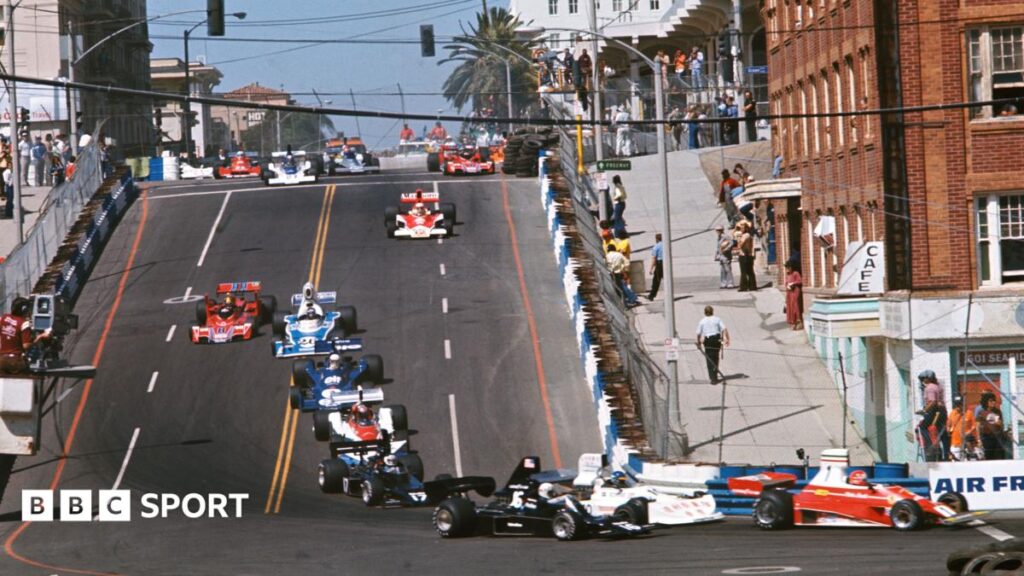
Long Beach, California, hosted the inaugural United States Grand Prix West in 1976, with the field roaring down Linden Avenue behind Ferrari’s Niki Lauda. The scene captured everyday life continuing around the circuit as the race unfolded.
Two‑time champion Emerson Fittipaldi made headlines in 1976 by leaving McLaren for his brother’s Fittipaldi team. A crash during Long Beach practice damaged his car, yet he managed to finish sixth and claim the final point.
In 1977, James Hunt’s McLaren was launched into the air after colliding with John Watson’s Brabham at the start of the Long Beach race. The venue proved popular with fans, but the promoter switched to IndyCars in 1984.
F1’s first foray into Las Vegas proved difficult. The 1981 and 1982 Caesars Palace Grands Prix served as season‑finale showdowns, but drivers disliked the scorching daytime heat and the featureless, anti‑clockwise layout that strained their necks. A photo from 1981 shows Williams’ Alan Jones leading into the first corner.
The Dallas Grand Prix took place only once, in July 1984, and was plagued by extreme heat that broke up the track surface. Eighteen of the twenty‑six starters retired, fourteen after striking the wall. Keke Rosberg emerged victorious, followed by Ferrari’s René Arnoux and Lotus’s Elio de Angelis; actress Linda Gray, known for playing Sue Ellen on “Dallas,” joined them on the podium.
Detroit’s Motor City hosted a street circuit Grand Prix from 1982 to 1988. In 1986, Ayrton Senna is seen on the grid speaking with his Lotus crew before winning the race from pole position.
From 1989 to 1991, the series moved from Detroit’s streets to Phoenix. The 1990 race is remembered for Senna’s double overtaking of Jean Alesi’s Tyrrell to secure victory. Low attendance led to the event’s removal from the calendar.
After an eight‑year hiatus, F1 returned to the United States in 2000 at the Indianapolis Motor Speedway. About 225,000 spectators watched a 2.6‑mile layout that combined a new road course with the famous banked oval. Ferrari’s Michael Schumacher won the inaugural race, taking control of that year’s drivers’ championship.
Relations between F1 and the United States deteriorated dramatically after the 2005 United States Grand Prix. A dispute over safety standards involving Michelin‑shod teams resulted in only six cars taking the start, as fourteen drivers withdrew after pulling into the...