Pakistan FDI Rises 22% to $936 Million, but the Money Comes From Only a Few Places
Pakistan attracted $936 million in net foreign direct investment in the first four months of this fiscal year, up 22.4 per cent from a year earlier, according to State Bank data cited by the finance adviser’s office on Wednesday. The headline is encouraging. But the detail underneath shows a recovery that is narrow, lopsided and still waiting for the investors Pakistan talks about most.
Net FDI reached $935.7 million in July to October, against $764.4 million in the same period last year. October alone brought in $216 million, up nearly 32 per cent year on year, though below September’s $219.5 million and August’s $321.6 million. Gross inflows rose to $1.27 billion from $1.07 billion, while outflows also edged up to about $330 million. Total foreign investment of every kind hit $4 billion, up from just $226 million a year earlier, though most of that jump came from $3.13 billion of foreign public debt inflows, not direct investment.
Three countries do the heavy lifting
Canada, China and the United Kingdom supplied nearly three quarters of the net FDI between them. Canada led with $318 million, about a third of the total, followed by China at $237 million, up 73 per cent, and the United Kingdom at $130 million, up about 76 per cent. The concentration is the story. When three countries carry the total, a slowdown in any one of them shows up immediately in the national figures.
The Gulf money is still missing
The gap that stands out is the Gulf. Saudi Arabia and the United Arab Emirates dominate the government’s investment announcements, yet the actual flows tell a different story. The UAE contributed $63 million in the four months, and Saudi Arabia’s net investment was barely $0.5 million. Pledges and memorandums are not investment, and until the Gulf money arrives in the data, the government’s Gulf narrative remains an aspiration rather than a fact.
Banks and mines win, factories wait
The sector split is just as uneven. Financial business drew the most at $260 million, mining took $169 million, power attracted nearly $160 million, and trade surged from $2.5 million to $154 million. The sectors that employ the most Pakistanis got the least: textiles received $6 million, food $15 million and information technology $14.5 million. Investment that builds factories and creates jobs is arriving far more slowly than money chasing financial returns.
What the adviser is, and is not, saying
Adviser to the Finance Minister Khurram Schehzad pointed to the FDI growth, stronger exports and rising private-sector credit in a statement on Wednesday, and highlighted a landmark $500 million MIGA-backed transaction with Commerzbank, J.P. Morgan and Standard Chartered. He also urged faster reforms and more predictable regulation. Analysts agree the improvement is real, driven by stronger fresh inflows rather than lower repatriation. But they warn the base is narrow, and Sana Tawfik of Arif Habib notes that predictable tax policies and lower borrowing and energy costs would help Pakistan keep the money it attracts.
What to watch
The test for the rest of the fiscal year is breadth. Does Gulf money move from pledges into the data? Do textiles, food and technology start attracting the kind of investment financial services already gets? And does the government deliver the predictable regulation its own adviser is calling for? A 22 per cent rise is a good headline. A broader one would be a better economy.
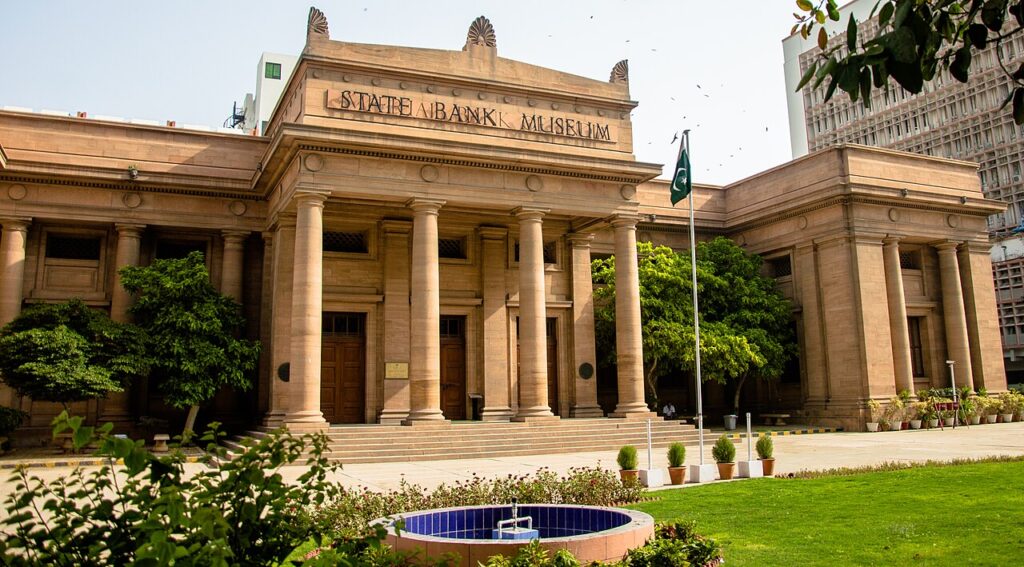
Photo: The old State Bank of Pakistan building in Karachi, now the State Bank Museum. Credit: AsimIftikharNagi, via Wikimedia Commons (CC BY-SA 4.0).
Sources: The News, Business Recorder, PKRevenue, UrduPoint, Arab News, 26 November 2026.