Makkah Pact Trio Meets in Islamabad to Turn a Defence Promise Into a Working Alliance
Pakistan, Saudi Arabia and Turkiye open two days of talks in Islamabad on Thursday, the first meeting of the Makkah pact’s top security committee since all three countries became legally bound by the agreement. The Strategic Political and Defence Committee meets on 26 and 27 November to review how the collective defence pact signed in Makkah on 7 August will actually work in practice.
The question on the table is practical rather than ceremonial. The agreement commits each country to treat an armed attack on one as an attack on all, and it covers military assistance, intelligence sharing, air defence cooperation, joint exercises and defence production. Turning that promise into standing arrangements, who commands what, who shares which intelligence, and how quickly forces can move, is what the committee has been set up to decide.
Why this meeting matters now
The timing is pointed. Turkiye’s ratification law took effect on 14 November, making this the first committee session held with all three signatories fully bound. The pact has already been invoked once, on 5 October, after Houthi attacks on Saudi targets, and in October the three countries agreed to deploy military forces and capabilities in the kingdom. Houthi strikes have since hit King Khalid International Airport, the Aramco headquarters in Dhahran and the PIF Tower in Riyadh, so the committee meets while the threat the pact was written for is still active.
The delegations underline the weight of the session. Pakistan’s side includes Deputy Prime Minister and Foreign Minister Ishaq Dar, Defence Minister Khawaja Asif and Field Marshal Asim Munir, alongside their Saudi and Turkish counterparts, with retired Lieutenant General Nauman Mahmood attending as the alliance’s first secretary general.
What the committee has to build
A defence pact is only as strong as its machinery. The committee must agree on the institutional framework: a joint command structure or liaison system, rules for sharing intelligence, air defence coordination and the logistics of moving troops and equipment across borders. The agreement also envisages personnel exchanges and cooperation in defence production and technology, areas where Turkiye’s defence industry and Pakistan’s military experience both carry weight.
The harder question is the one no member has answered in public: what collective deterrence means when attacks keep coming and none of the three has carried out an offensive operation in response. The Islamabad session is where that gap will either narrow or become harder to ignore.
Islamabad braces for three days of disruption
The talks bring heavy security to the twin cities. Heavy traffic is banned from 6pm on Thursday until 12:30am on Saturday, Faizabad Bus Terminal stays closed over the same period, and metro and electric bus services between 7th Avenue and Pak Secretariat are suspended from 10pm on Thursday. Hiking trails 3 and 5 in the Margalla Hills close on Friday. A Bangladeshi parliamentary delegation led by Speaker Hafiz Uddin Ahmad is also in the capital until 28 November, adding to the diplomatic traffic.
What to watch
The test of this meeting is not the joint statement but what follows it. A published framework for joint air defence, a schedule of exercises, or a named command arrangement would show the pact moving from paper to practice. Without that, the Makkah agreement risks remaining a strong sentence waiting for a structure. For Pakistan, which hosts the session, the stakes are direct: the credibility of the region’s newest alliance will be judged in large part by what leaves Islamabad on Friday.
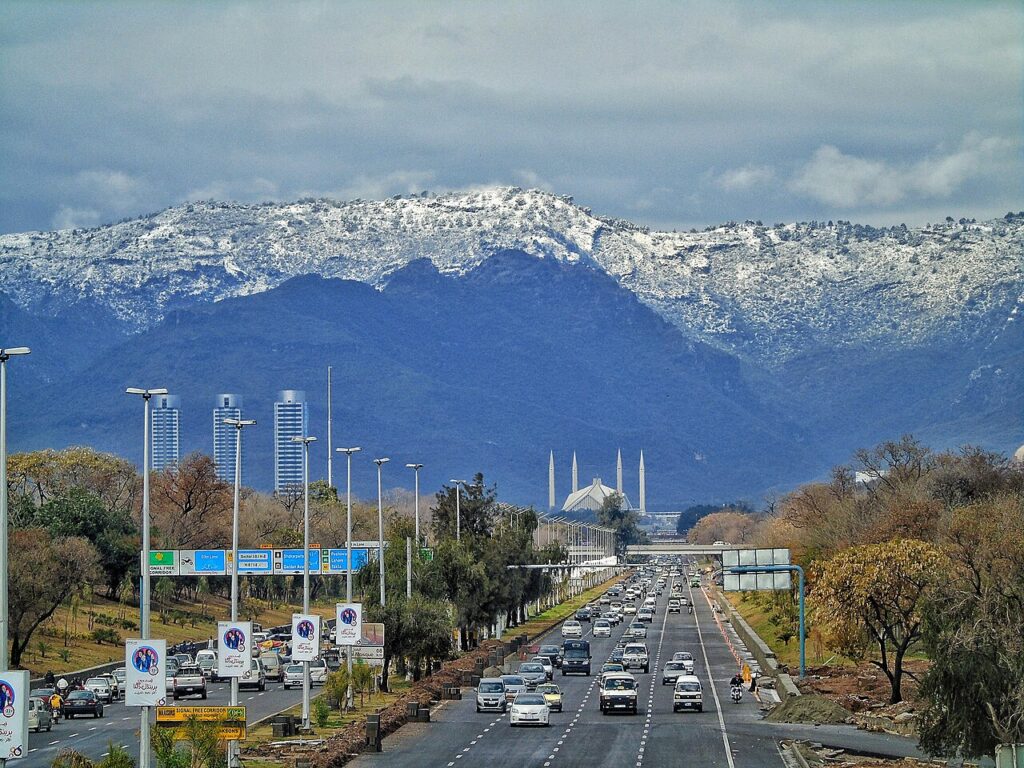
Photo: Faisal Mosque, Islamabad. Credit: Fassifarooq, via Wikimedia Commons (CC BY-SA 4.0).
Sources: The Express Tribune, 24NewsHD, Daily Pakistan, 26 November 2026.