
Yemen: A Decade of Shifting Frontlines Mapped
Over the past twelve years of war, maps of Yemen reveal a constantly changing mosaic of control, shifting alliances and fragmented coalitions, all while the nation grapples with widespread poverty and malnutrition. The Houthi movement, also called Ansar Allah, captured the capital, Sanaa, on 21 September 2014 after moving southward from its stronghold in Saada in northern Yemen. The group, aligned with Iran, tapped into anti‑government anger that surged after fuel subsidies were cut in July 2014. Mobilising protests against the government’s decisions, the Houthis helped force the resignation of President Abd‑Rabbu Mansour Hadi.
Allied with forces loyal to former President Ali Abdullah Saleh, the Houthis seized military sites and state institutions. In February 2015, Hadi fled to Aden, and when Houthi‑Saleh forces advanced toward the southern port city, he sought refuge in Riyadh, Saudi Arabia. The Saudi kingdom launched a military campaign in March 2015 to restore Hadi’s internationally recognised government.
The following decade saw alliances crumble and front lines move. AJ Labs presents seven maps that illustrate how Yemen has been divided and why no side has managed to control the entire country.
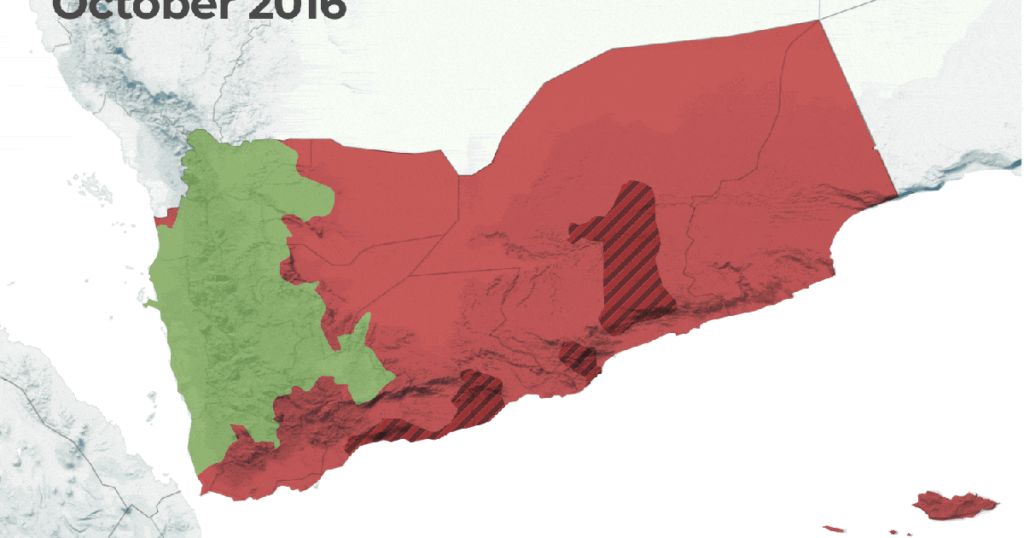
By late 2016, two years after the Houthis took Sanaa, the country was split into competing zones. The Houthi‑Saleh bloc held Sanaa and much of the north‑west, the region where most Yemenis live. Pro‑government forces, backed by Saudi Arabia and the United Arab Emirates, controlled swaths of the south and east. Al‑Qaeda in the Arabian Peninsula (AQAP) also contested government authority in parts of the south.
In December 2017 the anti‑government alliance fractured dramatically when Saleh appeared ready to switch sides, prompting a brief clash with the Houthis. The Houthis responded by killing the former president in Sanaa, leaving them as the sole power in northwestern Yemen, including Sanaa and the crucial port of Hodeidah. Some former Saleh loyalists changed allegiance, while pro‑government and anti‑Houthi forces retained control of the south and east, and AQAP held onto isolated pockets. After nearly three years of a heavy air campaign, the Saudi‑led coalition had not succeeded in restoring Hadi’s government to the capital.
By March 2019 the Houthis still dominated Sanaa and the northwestern highlands. Government‑aligned troops held extensive territory in the south and east, and AQAP continued to operate in limited areas. The December 2018 Stockholm Agreement halted a government offensive on Hodeidah, a vital entry point for food, fuel and aid, but neither side achieved a decisive breakthrough. Internal divisions among the Houthis’ opponents further weakened attempts to re‑establish central authority.
In 2022 the United Arab Emirates‑backed Southern Transitional Council (STC), which had seized Aden in 2019, controlled territory separate from government forces. Although formally part of the anti‑Houthi coalition, the STC clashed with the government on several occasions. President Hadi transferred his powers to an eight‑member Presidential Leadership Council, ending his presidency without regaining the capital. Saudi‑led coalition air raids on Sanaa continued, as illustrated by a March 2022 incident that damaged two houses.
Saudi‑Houthi talks in early 2022 raised hopes for a settlement and produced a truce in April, yet Yemen remained divided. The Houthis kept hold of the northwest, while the STC persisted in undermining the internationally recognised government, seeking greater influence in the south as a stepping stone toward an independent state. Government forces maintained broad zones in the east, which separatists also eyed for a future state. The UAE‑backed Hadrami Elite Forces controlled the coastal Hadramout region, and the National Resistance Forces, led by Saleh’s nephew Tareq Saleh and supported by the UAE, held part of the Red Sea coast.
By March 2025 the Houthis had retained Sanaa and most of northwestern Yemen for more than a decade. Government‑aligned troops operated across the south and east. Houthi attacks on shipping, claimed as solidarity with Palestinians in Gaza, provoked responses from Israel, the United Kingdom and the United States. Yemen’s coastline and the Bab al‑Mandeb strait became focal points of a wider confrontation with regional and global implications. Supporters of the STC displayed South Yemen flags in an Aden rally on 25 December 2025.
In January 2026 government forces recaptured Hadramout and al‑Mahra from the STC, which had taken those governorates in December 2025. Saudi air strikes and a government advance fractured the STC’s leadership. A Riyadh delegation announced the council’s dissolution, but coalition officials on the ground rejected the claim, and STC leader Aidarous al‑Zubaidi fled the country. The latest map shows a patchwork of contested authority across Yemen.