
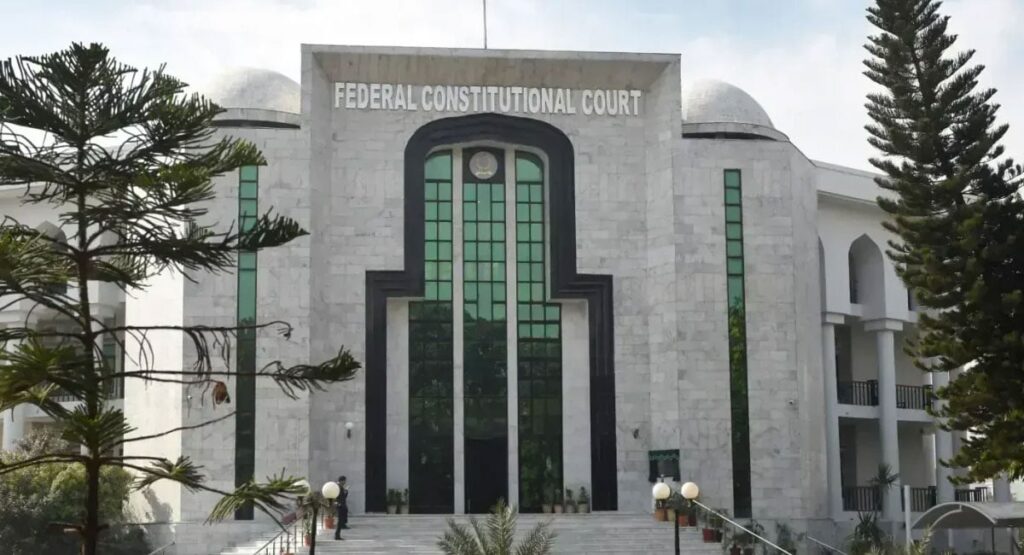
Federal Constitutional Court restores three ATC judges dismissed by Sindh government
ISLAMABAD – On Wednesday the Federal Constitutional Court of Pakistan reversed the removal of three Anti‑Terrorism Court judges who had been dismissed by the Sindh government after the Anti‑Terrorism Act, 1997 was amended to set a maximum age of 65 for such judges. The court overturned a decision of a division bench of the Sindh High Court’s Circuit Court in Hyderabad and ruled that the provincial notification ordering the judges’ removal had no legal authority.
The petition was filed by Muhammad Yameen, Ubaidullah Khan and Syed Zakir Hussain, who contested the application of the Anti‑Terrorism (Sindh Amendment) Act, 2025 to judges who had been appointed for fixed terms before the amendment took effect. The amendment, which altered Section 14 of the Anti‑Terrorism Act, requires judges and presiding officers of Anti‑Terrorism Courts to step down upon reaching the age of 65. It was published in the official Gazette on September 2, 2025.
Following the amendment, the Sindh government issued a notification demanding that the three judges vacate their posts immediately, even though their terms had not yet expired. The judges sought relief from the Sindh High Court, asking to remain in office until the end of their tenures. The high court rejected their pleas, holding that the new age limit applied to both current and future judges. The judges then appealed to the Federal Constitutional Court.
Counsel Salahuddin Ahmed argued that the amendment could not be applied retroactively to appointments made under the earlier law. Representing the province, Additional Advocate General Sindh Barrister Sandeep Malani and Additional Prosecutor General Sindh Siraj Ali Khan Chandio maintained that the new provisions also covered judges already serving.
The Federal Constitutional Court examined whether the newly introduced age ceiling could truncate the fixed‑term appointments granted under the previous statute. In its judgment, the court found that the amendment contained no explicit clause nor any necessary implication that would shorten the tenure of judges appointed for a set period. It noted that judges appointed for a defined term had a vested right to serve for that duration, subject only to the conditions governing continuation or early termination.
The court added that when an amended provision can be read in two reasonable ways, the interpretation that preserves an existing right should be preferred. Accordingly, it held that the new age limit could not be imposed on existing fixed‑term appointments to reduce the remaining period of service. The Sindh High Court’s order was set aside, and the provincial notification was declared unlawful and without effect.
As a result, the petitioner Muhammad Yameen is considered to have remained in office despite the notification and will continue as Judge and Presiding Officer of Anti‑Terrorism Court‑IV in Karachi until the conclusion of his two‑and‑a‑half‑year term, subject to the conditions of his appointment.