
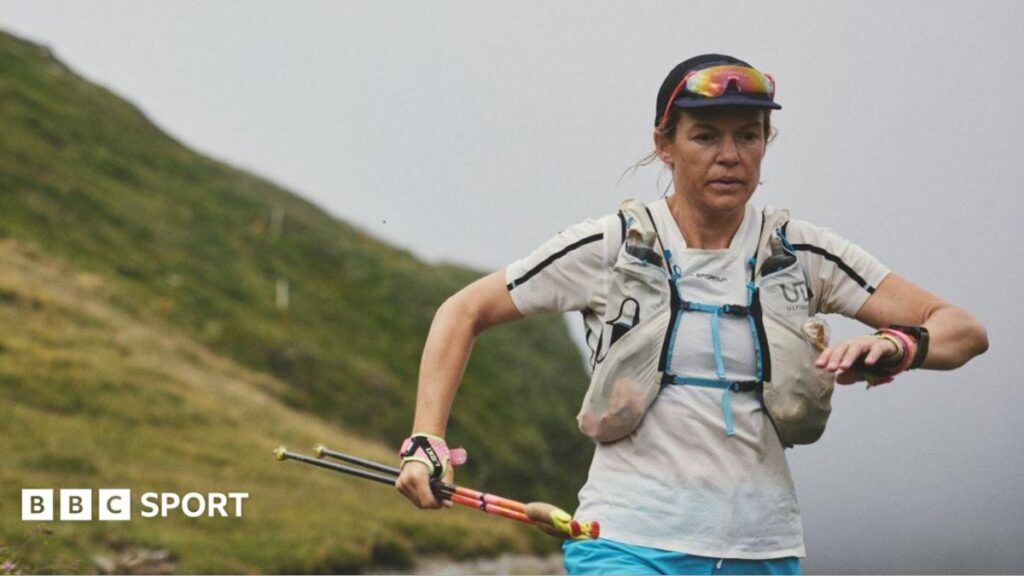
Women may have the edge in ultra‑endurance running, new evidence suggests
By Sarah Dawkins, BBC Sport senior journalist
Lazarus Lake, the director of the Barkley Marathons, once declared that the race was “too hard for women. They are simply not tough enough to do it.” The Barkley Marathons is famed as one of the planet’s toughest ultramarathons; out of roughly 1,000 starters, only about 20 have ever finished. In 2015 Lake made his challenge, daring anyone to prove him wrong. It took nine years before a British ultra‑runner rose to the occasion. Jasmin Paris of Midlothian crossed the 100‑mile course with just one minute and 39 seconds left before the 60‑hour limit, securing a place in ultra‑running history.
Paris is no longer an isolated case. Last summer the Montane Summer Spine Race, which runs from Derbyshire to Scotland, saw a women’s one‑two finish for the first time. Rachel Entrekin broke the course record, and earlier in May she became the first woman to win the Cocodona 250 in Arizona. In March, Sophie Woods shattered the overall record for the Via Alpina, finishing six days faster than the previous best. These achievements show that female athletes are not only participating in ultra‑endurance events, they are challenging men, setting new records and, in some instances, taking outright victories. The trend has sparked speculation that women might actually be better suited to such grueling challenges.
Is there scientific backing for this idea? Do women possess physiological or psychological advantages in endurance activities that last longer than six hours, and could we expect more record‑breaking performances in the future?
For distances up to a marathon, men typically outperform women by about 10 to 12 percent, reflecting greater strength and a larger aerobic capacity. As the distance extends, those advantages appear to diminish. A study that examined more than two decades of amateur ultra‑race data, conducted by RunRepeat in partnership with the International Association of Ultrarunners, found that the “gender pace gap” shrinks to just 0.25 percent in 100‑mile races. Beyond 195 miles, women may even have the potential to be faster than men.
Professor Andy Jones, an endurance‑performance specialist at the University of Exeter, outlines three physiological reasons why women might excel over very long distances. First, women store more body fat and can metabolise it efficiently, providing a steady energy supply. Second, they possess a higher proportion of slow‑twitch muscle fibres, which are more oxygen‑efficient and suited to endurance work. Third, women tend to retain strength longer during prolonged exertion, showing greater fatigue resistance. Jones, who helped design Eliud Kipchoge’s sub‑two‑hour marathon attempt, cautions that research in this area is still developing. “There isn’t as much hard evidence as there would be for shorter distances, which have been studied for a long time in quite detail,” he says.
Dr Richard Burden, co‑lead of female athlete health and performance at the UK Sports Institute, echoes that sentiment. “At the moment we are speculating … there are definitely some physiological adaptations that you see more in women than men that are favourable for ultra‑type events. But those need to be better established and more studies would need to be done,” he explains.
Physical factors alone do not tell the whole story. Ultra‑endurance races often span multiple days, involve sleep deprivation, harsh terrain and extreme weather, making mental resilience as crucial as physical fitness. Sophie Woods believes that mental toughness gives women an advantage. “It’s not necessarily about being the fastest person at the start,” she says. “It is about preparation, it is about mental strength and being able to continue to persevere when things go wrong.” During her record‑breaking Via Alpina run, Woods faced unexpected obstacles such as wildfires that lengthened the route and swarms of horseflies. “I was so tired and there were so many of them and I wanted to have a complete meltdown and just cry, but I couldn’t because if I stopped moving, they started biting me,” she recalls. “I think women are really good at adapting and continuing and just knowing that once we start something, you’ve just got to keep moving until you get to the finish.”
Yngvild Kaspersen, who became the first woman to win the Ultra‑Trail Mont Blanc CCC race in the Alps twice, also attributes her success to mental preparation. The Norwegian, who works as a GP alongside her running career, stresses the importance of community support. “We’re competitors but we’re also motivating each other, inspiring each other, pushing each other to do better in the races,” she says. “If you see the podiums for the women this year at UTMB, how close we are and how we’re running together out there – that’s very special and I’m very proud to be a part of that community and that group of women.”
Sports dietitian Renee McGregor, who focuses on athlete nutrition and hormonal health, points to the female body’s hormonal fluctuations as a possible factor. “The moment women step into puberty, we are dealing with a fluctuating hormonal system,” she notes. “We never give ourselves credit for that; it’s just an accepted part of being female.” She suggests that adapting to those hormonal changes may contribute to the resilience seen in ultra‑endurance female athletes.