
What It’s Like to Be a Casting Director in 2026
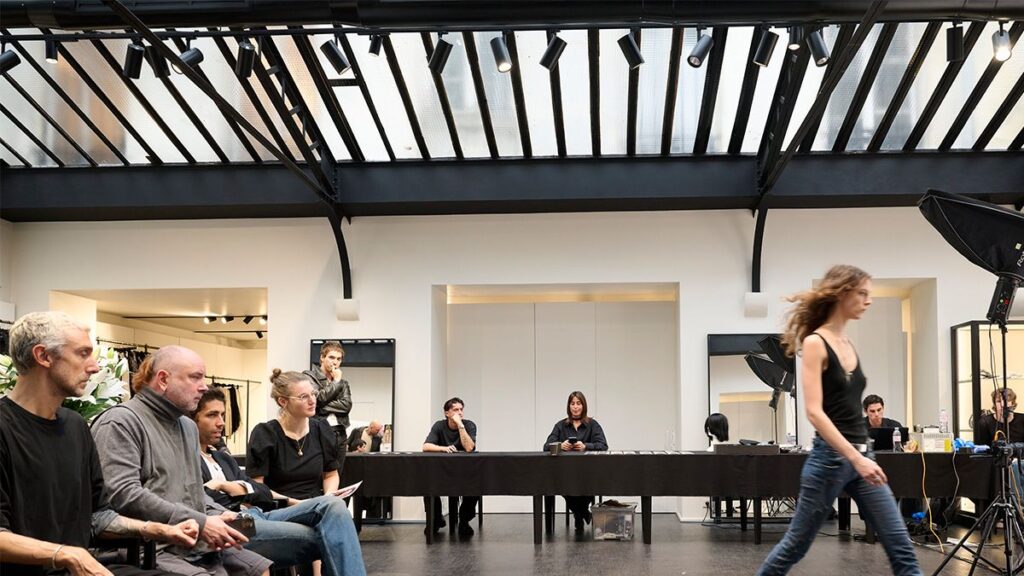
A few days before the Ann Demeulemeester runway at Paris Fashion Week, hopeful models line the foyer of the brand’s Marais studio, each clutching a printed photo. Casting director Ben Grimes sits with creative director Stefano Gallici and their team, greeting each model as they step forward, hand over their picture, take a brief walk across the room and leave. Some appear timid, others more confident. Small piles of “yes,” “no,” and “maybe” photos accumulate on the floor for Grimes and Gallici to review later. Those who move on to the second round walk again, get their looks adjusted, and after many more steps the final cast is set for the show.
“When someone walks toward you, you have two reactions,” Grimes explains. “One is personal, and the other is analytical, thinking about what’s right for my client.” He oversaw eight other shows for the Spring/Summer 2027 season, including Jil Sander, Victoria Beckham, Missoni, MM6 Maison Margiela and Erdem. While the live casting moment feels intense, the decisions that determine who walks are the visible end of a process that begins long before any model steps into the room.
Julia Lange’s workflow stretches across 18 shows in New York, London, Milan and Paris. She founded her own casting agency in 2011 and now leads a team of 17. We meet her in a Milan bar opposite the Fendi show venue, the day before the runway. With an upcoming meeting with executives, she rushes through questions while her schedule sees her hopping between clients on a motorbike, checking in with several team leaders. “We have five team leaders who we split among all the shows,” she says, pointing to Max Märzinger, who is with her. “Sometimes it’s two clients a day. On two days of Paris Fashion Week I’m juggling five clients. You just have to be efficient. Efficiency is practically my middle name.”
Ten years ago, most brands chose their own runway and campaign models. “Casting has changed because brands are doing more projects,” Grimes notes. “You can’t run a magazine campaign for four months and then move on. People are scrolling all day, so they need fresh images constantly.” Luxury houses now mount five or six runway shows a year and launch near‑monthly campaigns for accessories, eyewear and other categories.
Lange agrees that casting has become a full‑time profession. “When I started, there were only a few casting directors and clients did a lot of the work themselves,” she recalls. She began her career as the youngest bookings director at Vogue Germany in the early 2000s, at age 21, organizing shoots and securing talent. Over the past 15 years she has built a roster that includes Fendi, Hermès, Versace, Phoebe Philo, Alexander McQueen and newer names such as August Barron. Her favorite moment was casting Dario Vitale’s iconic Versace show. “Working with someone with such a strong vision was wonderful,” she says. “It was a long, interesting process that took at least six months and we built a language together.”
Grimes, who modeled as a teenager, entered casting from the other side before launching her own agency in 2013. “People know so little about casting because it’s a tricky subject,” she admits. “You are judging people by how they look, because that’s the job. I constantly question myself and try to understand what beauty really means.”
Today, brands look for a mix of fresh faces, established models and occasional celebrity cameos. That wasn’t always the case. “When I started, everyone wanted the same top 50 girls,” Lange says. Unable to secure those names, she turned to small agencies, scouted on Instagram and even hit the streets. “We broadened our search beyond traditional model agencies.”
Julia Lange Casting now has a dedicated scouting unit that hunts for new talent that fits each brief. “We scouted all over Italy and beyond for Dario’s Versace,” she explains. “We ended up with a German actor, an OnlyFans star who is also a ballerina, and Niki Pauls, who performs at the Cicciolina parties in Paris.” Over the season her 17‑person team evaluated roughly 800 models, survived countless matcha drinks and even googled the Pope’s Paris itinerary 18 times to anticipate traffic disruptions.
Casting a show always begins with a meeting with the designer to discuss the collection’s inspiration, the target audience, the narrative and the budget. After that, casting directors research who fits the vision, check availability and sometimes discover new talent before presenting their proposals. “Models aren’t available for every brand,” Lange notes. “It’s not that every girl a designer wants is automatically free. The process requires a keen eye, a deep understanding of the brand and the ability to make the right models available.”