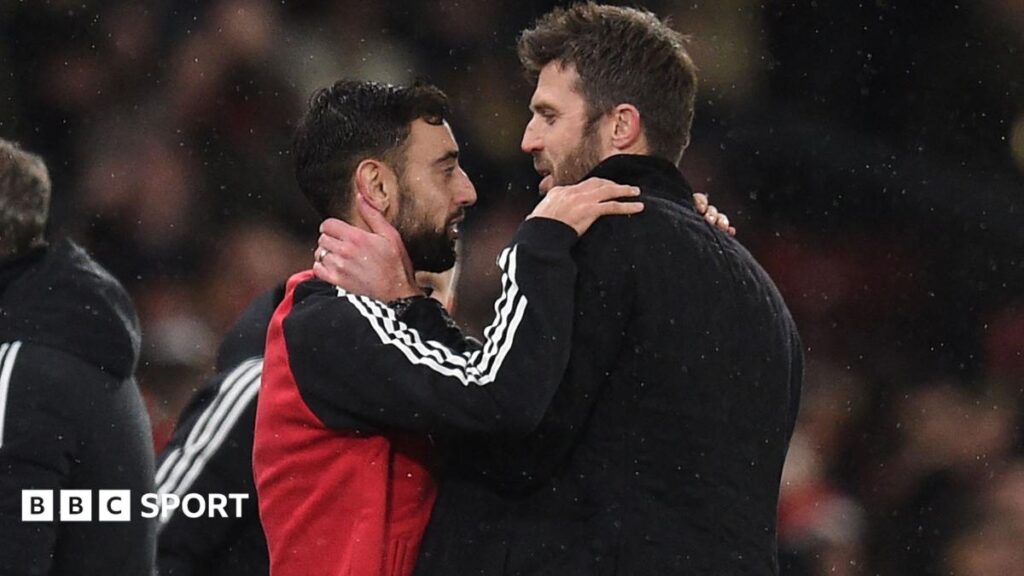
United captain Fernandes critiques team’s tactics after heavy loss
By Umir Irfan, football tactics correspondent – Published 22 October 2026
Manchester United captain Bruno Fernandes appeared to question the side’s tactical set‑up following Wednesday’s 4‑1 Champions League defeat to Como. “We started off on the wrong foot,” the Portuguese said. “They scored very early, we had not much pressure on the ball. It’s a decision from the staff to not press man‑to‑man and sometimes leave some space behind, to try and get the ball in the first moment by waiting for them, giving them the ball. Sometimes when you give too much of the ball to these teams, they get confidence. They have so many bodies behind the ball, they make you run a lot, people get frustrated.”
Fernandes’ comments are dense with tactical nuance, so let’s break them down. Since Michael Carrick took over as United manager in January, the team has largely operated from a zonal 4‑2‑4 or 4‑4‑2 shape that can shift into a press at certain moments. When he mentioned United “leaving some space behind, to try and get the ball in the first moment,” he was referring to the decision not to press across the pitch in a strict man‑to‑man fashion. By holding a slightly deeper 4‑2‑4 line, United give opposition defenders time and space, hoping to lure them into traps before springing the press. The idea is that four players positioned narrow and high can capitalize on turnovers if the ball is won back quickly.
The approach produced positive results at times during Carrick’s caretaker spell last season. A notable example was Bryan Mbeumo’s goal in United’s 3‑2 comeback win at Arsenal in January, just two weeks after Carrick’s appointment. United did not press Arsenal man‑to‑man, but they recognised the right moment to press, turning a two‑against‑two situation into a scoring chance for Mbeumo.
This season, however, the same strategy has yielded mixed returns. On the same night as the Como loss, defender Lisandro Martínez criticised United’s recruitment after a 2‑0 defeat to Atlético Madrid and warned that the club could not rely on last season’s methods. “You can’t stay with what you did last season,” he said. “Teams know you, how you play, know every detail, and if you don’t change, next season is a big problem.”
Last year, the 4‑2‑4 defensive shape caught several opponents off guard, making it a potent weapon. Pep Guardiola and Pep Lijnders employed a similar system at Manchester City, a tweak that helped them win the Carabao Cup final against an unprepared Arsenal. After Guardiola’s departure, Enzo Maresca used the shape for the Community Shield in August, but Arsenal manager Mikel Arteta quickly found solutions, and the Gunners prevailed. Within a handful of games, Maresca abandoned the 4‑2‑4 and reverted to a more man‑to‑man defensive style.
Manchester City’s recent Champions League match against PSG illustrated a shift toward tighter, man‑to‑man defending, with defender Guehi stepping out of the back line to track his opposite number. That may be the kind of adjustment Fernandes hopes United will make, acknowledging that the current defensive set‑up is losing its effectiveness, a weakness that has been evident since pre‑season.
Former United boss Rubén Amorim, now in charge of AC Milan, has repeatedly exploited the 4‑2‑4 by fielding a back five that outnumbers United’s front four. United’s two central attackers often try to block passes into Milan’s midfield duo before pressing the central defenders. The positioning of one of Milan’s centre‑backs forces a United winger to drift wide, while the Milan wing‑back drops deep and wide, providing an easy outlet. United’s full‑back then has to cover a large distance to close down the wing‑back, and by the time pressure is applied the ball is usually already gone.
Similar problems surfaced in the loss to Atlético Madrid. The Spanish side took a risk by employing a back four that split its centre‑backs, creating an extra attacker high up the pitch. As United’s front two attempted to block passes into the central midfielders, the wide position of the centre‑backs drew United’s wingers out, leaving left‑back Alejandro Grimaldo in space on the flank. This forced Diogo Dalot, or if he was pinned back by winger Alex Baena, Youri Tielemans, to chase large distances in an effort to pressure Grimaldo.
Thus, while Fernandes may have been speaking about his own frustration when he said “they make you run a lot, people get frustrated,” his comments also reflect the challenges faced by his teammates under the current system.