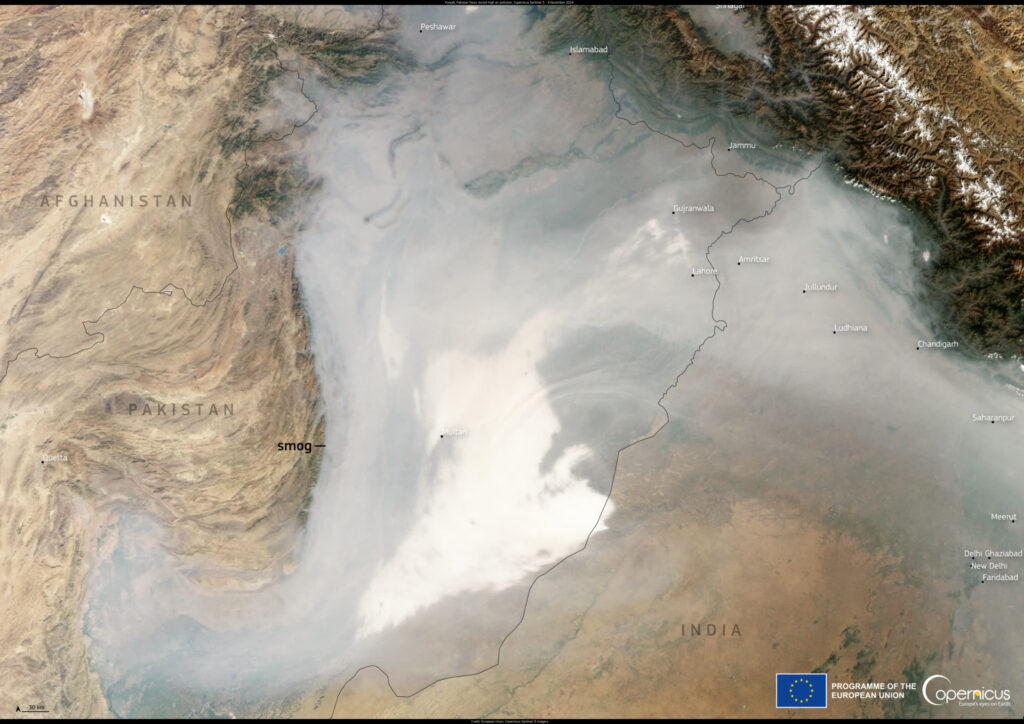
Suparco Warns Smog Will Worsen Across Punjab Over Next Three Days as Lahore Tops World Pollution Ranking
LAHORE: The Pakistan Space and Upper Atmosphere Research Commission (Suparco) has warned that smog will get worse across Punjab over the next three days, with satellite data showing hundreds of active fires feeding the haze while Lahore once again topped the list of the world’s most polluted major cities. The warning, published on Thursday morning, puts seven districts on high or severe alert as the smog season peaks.
The picture on the ground is already grim. Lahore recorded an Air Quality Index (AQI) of 339 on Wednesday morning, and other Punjab cities read even worse: Faisalabad at 686, Gujranwala at 550, Kahna Nau at 516, Multan at 437 and Kasur at 371. Above 300, the air is considered dangerous for everyone.
What Suparco found
Suparco’s smog assessment for 17 November, based on VIIRS and MODIS satellite observations across 36 districts, detected 690 active fire incidents in Punjab and adjoining transboundary areas in the preceding 24 hours: 386 inside Punjab and 304 across the border. Seven districts face high or severe smog: Jhang, Narowal, Sheikhupura, Sialkot, Hafizabad, Gujranwala and Dera Ghazi Khan.
The commission’s model, run by the Copernicus Atmosphere Monitoring Service, projected PM2.5 of around 51 to 71 micrograms per cubic metre. But Suparco cautioned that model estimates generally run lower than ground-based readings during winter, so the air people actually breathe is likely to be worse than the model suggests. Lahore’s own readings confirm it: the city’s AQI fell to 167 by 5pm on Wednesday, then climbed to 178 by 6pm.

Why the air is not clearing
Smog in Punjab is not one problem but two arriving together. The first is the smoke itself, much of it from crop residue burning in fields across Punjab and across the border, with 690 fires detected in a single day. The second is the weather that traps it: as winter sets in, cool, still air holds the smoke and exhaust close to the ground, which is why mornings and evenings read worst.
The authorities are chasing the fires rather than waiting for the wind. Punjab’s Environmental Protection Force has deployed a 750-member quick-response unit, and in a single 24-hour period this week it received 679 field fire reports and extinguished 650 of them. But the fires keep coming, and one unit cannot cover 36 districts. Until the burning slows and the weather changes, the haze will keep rebuilding each day.
What it means for daily life
The Pakistan Meteorological Department has forecast fog and smog at isolated places in Lahore, Sialkot, Narowal, Sheikhupura, Okara, Kasur, Faisalabad, Jhang, Khanewal, Multan and nearby areas during the morning and night over the next 48 hours. That means poor visibility on the roads at the start and end of the day, and air hardest on children, older people and anyone with asthma or heart trouble.
The advice is familiar by now: keep outdoor exercise short on the worst days, wear a proper mask outside, keep windows shut in the morning when the smog is thickest, and check official advisories before sending children out for long periods.
What to watch next
The next Suparco bulletin will show whether the fire count is falling or climbing, the best early signal of what the weekend will bring. If the count stays near 700 a day, the three-day warning is likely to stretch further. Lahore’s morning AQI is the other number to watch: Wednesday’s peak of 339 was the highest among major world cities that morning.
Featured image: satellite view of smog over Punjab, Pakistan. Photo: European Union, Copernicus Sentinel-3 imagery, Wikimedia Commons.
Sources: Dawn, 19 November 2026; Pakistan Meteorological Department forecast; IQAir city rankings; Copernicus Atmosphere Monitoring Service.