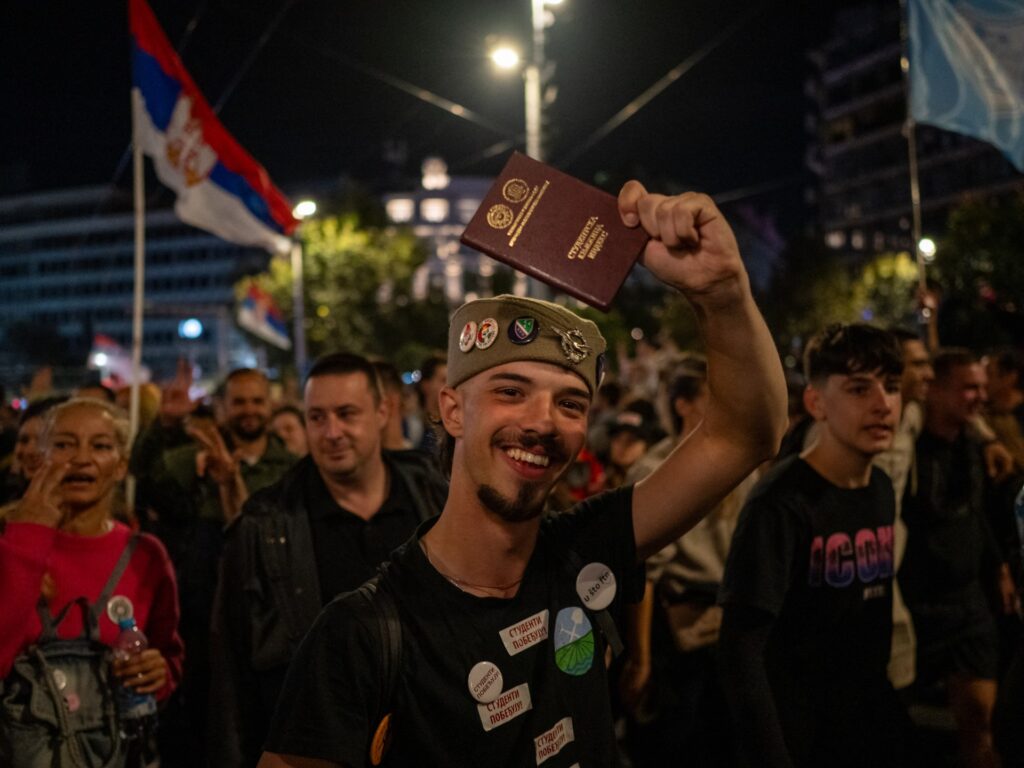
Serbian students march from streets to ballot in hope of election victory
Students gathered in central Belgrade on October 21, 2026, after walking for several days to attend the final major rally of their movement ahead of the snap elections scheduled for October 25, according to AFP. The protest began on the streets and has grown into the most serious challenge to the long‑standing rule of the Serbian Progressive Party (SNS) and its leader, Aleksandar Vučić, as the country heads to the polls on Sunday.
Over the past two years, a broad coalition of citizens, teachers, professors and other experts has joined a student‑led protest group that has evolved into a political movement called “Student List – Students Win” (Studentska lista – Studenti pobeđuju). The catalyst was the collapse of a concrete canopy at the renovated Novi Sad railway station on 1 November 2024, which killed sixteen people and sparked public outrage over alleged corruption, construction safety, and government oversight.
Kosta Golubović, a law student at the University of Novi Sad who has been involved since the beginning, told Al Jazeera: “Change is clearly necessary. The state must belong to its people, not to the mafia and criminals.” He added that the way the judiciary is treated, the catastrophic conditions at the local level, mayors resorting to violence, dying villages, dubious privatisations, money laundering, the erosion of every single institution, police being replaced by thugs, and an education system vanishing before our eyes are among the reasons why change is needed.
The demonstrations have grown into the largest protest movement in Serbia in years, drawing tens of thousands of participants. The students have not called for the overthrow of Vučić, but their persistence has created one of the biggest threats to the president’s long grip on power. Vučić became prime minister in 2014 and was elected president in 2017, a role that is traditionally ceremonial but which he has reinforced by maintaining influence over the SNS.
Opposition parties and rights watchdogs accuse Vučić and his party of bribing voters, stifling media freedom, using violence against opponents and maintaining ties with organised crime. Vučić and his allies deny the allegations, yet Serbia’s rating on Transparency International’s global corruption index has gradually worsened in recent years. Golubović said: “Vučić is clearly afraid of us – it’s obvious. He knows that, for the first time in 16 years, the SNS is no longer the most popular political option in the country.”
The movement’s effectiveness is partly due to its structure. The former student parliament at the University of Belgrade has been replaced with plenums—daily assemblies where each group votes on its course of action. Working groups focus on strategy, donations and security, while universities in different cities coordinate to keep demands broadly aligned. One rule is to remain leaderless, making it harder for authorities to disrupt the protests. Demonstrations must stay peaceful, any debris must be cleaned up, and all decisions are made democratically during hour‑long plenary sessions in university faculties.
Natasa Kandić, a Serbian peace activist, sociologist and founder of the Humanitarian Law Center in Belgrade, said: “Even though the authorities mobilised criminal groups against the students and citizens participating in the protests, the students have remained focused on their goal: to oust a government they view as authoritarian and deeply corrupt.” She added that for the first time in Serbia the protests have been entirely non‑violent, describing the daily video clips as a new culture defined by irony, laughter and a deliberate disregard for primitivism and political depravity.
State‑affiliated media have attacked the students, with some officials claiming the group lacks a programme and Vučić labeling them “terrorists”. Yet the movement’s leaders, drawn from various professional backgrounds, say they have a plan. The platform, officially titled the “Student Plan”, is divided into three sections and contains eleven points. Ilija Srdanović, a cardiologist and the lead candidate for the Student List, explained that the platform deliberately avoids fixed deadlines because timelines can only be set once contributors understand the full current state of affairs. “We plan many things – too many to list – but the goal is to change the system,” he told Al Jazeera in a brief call.
During debates, topics such as the creation of a special prosecutorial police unit, a law on the origin of assets, transitional justice and the renovation of rural medical clinics have been frequent. Kandić remains skeptical about the movement’s capacity to deliver transformative change, questioning whether it can break with the past and alter a political climate where convicted war criminals are celebrated, Kosovo is treated as part of Serbia, and politicians from neighboring countries are welcomed.