
Netanyahu’s New Security Doctrine: Strategic Shift or Election Gambit?
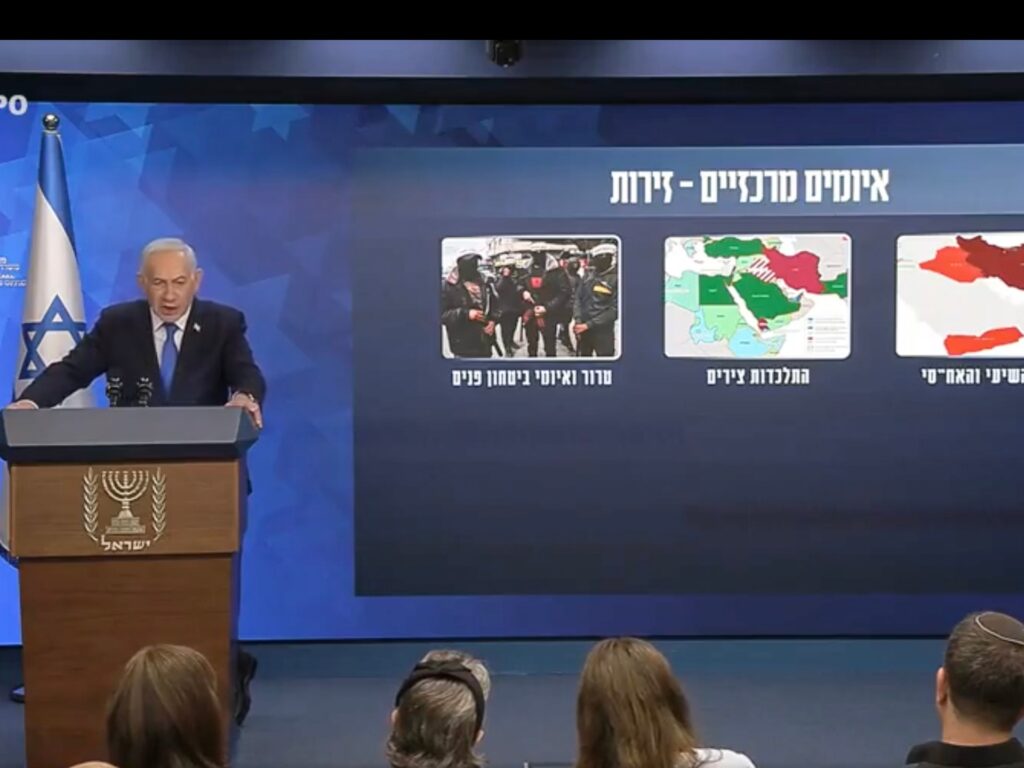
Prime Minister Benjamin Netanyahu presented an updated national security doctrine on Sunday, accompanied by a map that charts rival regional blocs. The paper, drafted with input from Israel’s National Security Council and released by the prime minister’s office, comes just nine days before the parliamentary election that could end Netanyahu’s long tenure.
The doctrine marks a clear move toward pre‑emptive military action, the creation of buffer zones and the pursuit of new alliances across the Middle East and parts of Africa. It replaces a strategy of containment with one that seeks to neutralise perceived threats before they materialise, a stance that has already been reflected in Israel’s recent wars and cross‑border strikes.
The timing of the announcement is politically charged. Netanyahu faces criticism over his handling of the October 7, 2023 attacks, the subsequent wars, and an ongoing corruption trial. As the October 27 vote approaches, he is positioning himself as Israel’s “Mr Security” in hopes of attracting voters who may be uneasy about other aspects of his leadership but still view him as the most reliable defender of the nation.
During the briefing, Netanyahu noted that a change in Washington could leave Israel with a less friendly U.S. administration in two years, after President Donald Trump’s term ends. “In two years, a president… who is extremely hostile to Israel could come to power,” he warned, adding that Israel must “expand our network of alliances and develop capabilities that make us a valuable asset” to other countries.
Analysts say the prime minister is trying to cast his leadership as indispensable for navigating both regional military challenges and diplomatic isolation, while reassuring an anxious electorate. Mohanad Hage Ali, deputy director for research at the Malcolm H Kerr Carnegie Middle East Center, described the presentation as focused on competing regional blocs and buffer zones that stoke existential fears, prompting Israeli voters to seek a decisive, familiar leader. He suggested that Netanyahu is presenting himself as “the devil you know” to a public reluctant to embrace change at a volatile moment.
Opposition figures have dismissed the doctrine. Gadi Eisenkot, a leading challenger, called the document “two hollow pages, full of slogans that have nothing to do with a security concept.” Former prime minister Yair Lapid labelled it “superficial.”
The map shown during the briefing was originally published in May by the German foundation Friedrich‑Ebert‑Stiftung. It divides the Middle East and adjoining African regions into competing alliances, highlighting states, unrecognised entities and non‑state actors. One block groups Israel and the United Arab Emirates in a “Hexagon Alliance.” Another brings together Egypt, Turkey, Pakistan and Saudi Arabia—whose leaders signed the Mecca mutual‑defence pact in August—under the label “Sunni Diamond Alliance.” Iran and its regional partners appear as a separate axis.
The illustration underscores the doctrine’s emphasis on expanding “buffer zones,” a concept that would involve occupying territory beyond Israel’s current borders. Critics point to Israel’s ongoing illegal occupation of Gaza and southern Lebanon as examples of the risks inherent in such a strategy. Hage Ali warned that a policy focused on enlarging military control could generate further conflict and ethnic cleansing under the pretext of security.
A notable feature of the map is the explicit identification of non‑state actors as friendly partners. It marks areas controlled by Sudan’s Rapid Support Forces and Khalifa Haftar’s self‑styled Libyan National Army as aligned with Israel and the United Arab Emirates. While Israel sees these groups as pragmatic collaborators within a broader strategic framework, publicly linking them to Israel could undermine their standing in the Arab world.
The doctrine and its accompanying map reveal Netanyahu’s immediate priority: projecting a security narrative that resonates with Israeli voters, even if it risks complicating Israel’s regional relationships and its international reputation.