
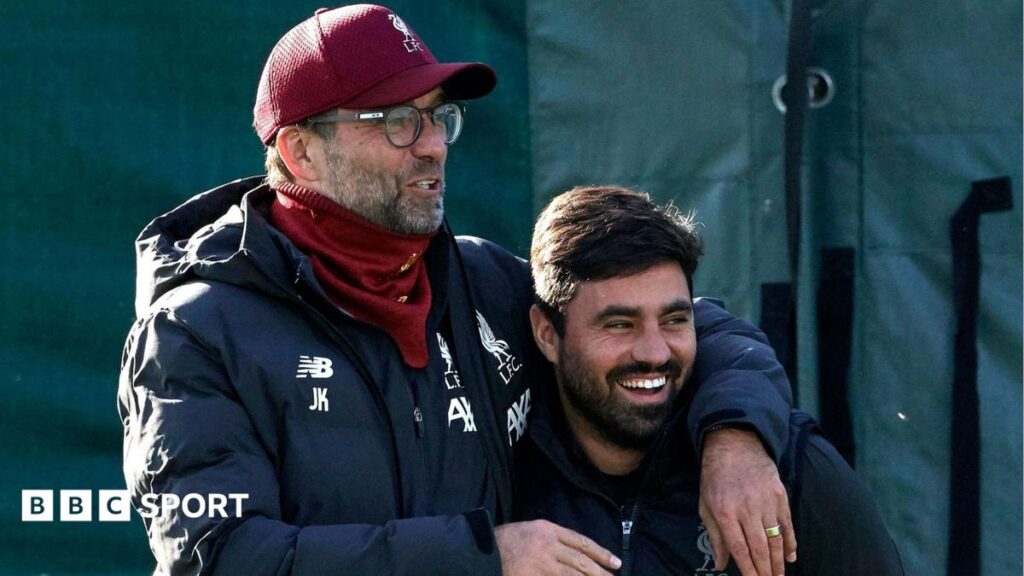
Matos on tactics, Klopp’s influence, and taking Swans to top of league
When Vitor Matos arrived at Swansea in November 2025, many feared a relegation battle. Almost a year later, the Swans lead the Championship ten games into the campaign. The appointment now looks like a coup, especially given that Matos had overseen just twelve senior matches before taking the Swansea job, all in Portugal’s second tier.
Those twelve games sit on a coaching résumé that stretches over 23 years and spans several continents. The 38‑year‑old spent five seasons at Liverpool as an elite development coach under Jürgen Klopp, then moved to Red Bull Salzburg to serve as Pep Lijnders’ deputy. Before his brief spell at Marítimo, he also worked in Portugal and China, gathering a wide range of influences.
In a recent interview I asked Matos about the ideas that shape his approach. “Liverpool influenced me a lot in terms of counter‑pressing, pressing, intensity, and what makes you grow as a team,” he explained. “The most important thing is how much you believe in your idea and this style is how I see football. That’s why I wanted this to be the foundation for our team.” He added that his coaching philosophy is not a simple copy of Klopp’s: “I started at a really young age wanting to be a coach and was influenced by many different styles.”
The blend of those influences is evident in Swansea’s current game model, which draws on concepts he absorbed at FC Porto, Shandong Taishan and Liverpool. When he replaced Alan Sheehan, Matos said his first priority was to restore confidence. “The most important thing was to make the team feel confident again, to make the players fall in love with playing with each other,” he said. “For that, we wanted to take steps first on making the team much more aggressive without the ball.” He believes that a high‑pressing, aggressive approach lifts morale after a successful tackle or a quick regain.
Matos also made a tactical decision to settle on a back four. “Before I arrived there was some switching between a back four and a back five. I thought the squad was built for a back four at that time and to give consistency to the players, sticking with that was another priority,” he noted. In his preferred 4‑3‑3 formation the aim is to be a pressing, counter‑pressing side willing to take risks.
He stressed that his principles must be adapted to the players at his disposal. “We want to press but where will we set up in terms of starting positions? Who should start the press? Which are the triggers? Who are the players who buy in more or are more ready for this type of style in a short period of time?” he asked. By building the system around the existing squad, Matos says the players gain confidence, which in turn helps the ideas take root.
Matos traced his understanding of positional play back to his time with FC Porto’s youth teams. “We used a very positional 4‑3‑3, understanding the spaces, the timings, waiting for the ball to arrive to you at the right time. Players moved the ball until gaps started opening.” Those concepts have become the backbone of this season’s Swansea side, which has already secured seven wins from ten league games.
When facing a zonal defence, Matos explained, the goal is to move the opposition to create a free player. “The most important thing is that you understand that you need to move them. By moving the opposition, you create spaces, you create a free player.” Against man‑to‑man pressure, however, he looks to his experience in China for solutions. “In China, I understood that to arrive at a more positional game, you could have different steps beforehand. There is a benefit to having more players close to each other, rather than spreading them over space,” he said.
By merging lessons from Liverpool, Porto, and his Asian stint, Matos has crafted a flexible, high‑intensity style that has propelled Swansea to the top of the table and promises an exciting season ahead.