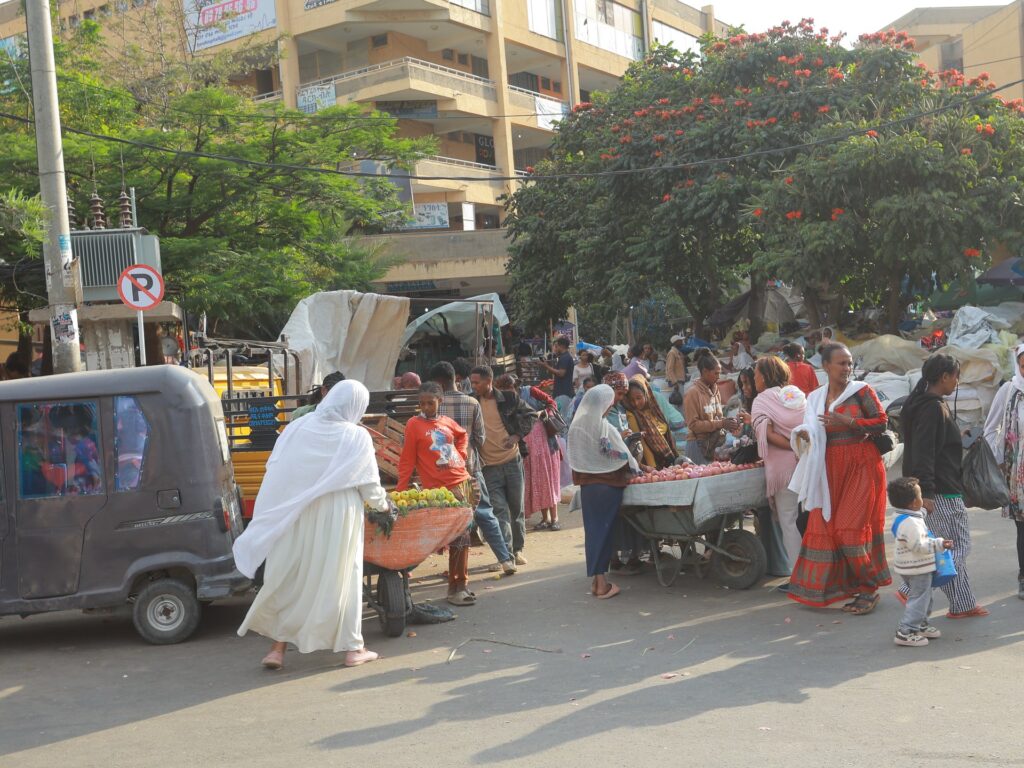
Life returns to Tigray amid growing war fears
In Mekelle, shops are opening again and banks are back in operation, yet many residents remain uneasy about what lies ahead. Ethiopian federal troops and allied fighters retook the Tigray regional capital on October 4, sparking concerns that the region’s fragile recovery could be set back once more.
Tigray, in northern Ethiopia, is still trying to rebuild after the 2020‑2022 conflict between federal forces and the Tigray People’s Liberation Front (TPLF), the dominant political movement in the region. The renewed fighting has added fresh uncertainty for locals, affecting jobs, schooling, security and the overall outlook.
Daily routines are slowly restarting, but hardship persists. Businesses and financial services are gradually reopening in Mekelle, yet many families struggle to afford basic needs. Delayed salaries have left public employees unable to cover food, rent and school fees, while years of war have drained household savings.
“Things may be reopening, but that does not mean our problems are over. We still have expenses every day, and without our salaries, it is difficult to know how we will manage,” said Gebregziabher, a public servant in Mekelle.
The funding shortfall has also hit the wider public sector. In March, Tigray’s interim administration announced it could no longer pay monthly wages to roughly 137,000 civil servants because expected federal budget transfers had not arrived. In April, the regional finance bureau reported an 8.5‑billion‑birr (about $52,000) deficit affecting salary payments and development projects.
For many residents, the reopening of shops offers only a partial return to normalcy. Without reliable incomes and greater security, everyday expenses remain a heavy burden.
Students fear another loss of school time. The renewed fighting has revived worries that education could be disrupted again, adding to the time already lost during the previous war. In Adigrat, Shewit, a grade‑10 student, said the uncertainty about classes and safety has left him anxious about his future.
“I have already lost so much time because of the war. I am afraid that if our education is disrupted again, I will lose another year and fall further behind,” he said.
Some university students have left Tigray for Addis Ababa, Ethiopia’s capital, seeking transfers to other public universities. The Ministry of Education announced temporary placements at universities elsewhere for students enrolled in Tigray institutions. More than 5,000 returning students had applied by September 17‑18, according to ministry reports.
Abel, a third‑year student at Axum University, traveled to Addis Ababa to request a transfer. “I didn’t want to leave, but I also can’t keep putting my education on hold. I came to Addis to see if I can transfer to another university and continue my studies. I just want to finish what I started,” he explained.
For those who have already lost years to conflict, the uncertainty threatens not only interrupted classes but also delayed graduations and a tougher path to employment.
Border communities fear a wider conflict. Near the Eritrean border, military movements and conflicting reports of troop deployments have heightened worries that fighting could spill beyond Tigray. On October 8, the Associated Press reported claims by a commander allied with Ethiopia’s government that Eritrean troops entered Adigrat earlier that week and Idaga Hamus the next day, though the AP could not independently verify the accounts. The conflict‑monitoring group ACLED separately reported Eritrean forces crossing the border at Zalambessa.
On October 13, Reuters reported that Ethiopian government forces had advanced into Zalambessa, citing sources familiar with residents. The report said it remained unclear whether Eritrean troops or Tigrayan opposition fighters were still present in the town. The differing accounts highlight the difficulty of establishing control as the fighting shifts.
These developments unfold against worsening relations between Addis Ababa and Asmara. On October 8, Ethiopia’s foreign minister Gedion Timothewos accused Eritrea of sending troops up to 60 km (37 miles) into Ethiopian territory in several parts of Tigray and called on the United Nations Security Council to act. Eritrea denied the allegations, saying Ethiopia’s accusations amounted to a declaration of war and urging the Security Council to take action against Ethiopia. The competing claims have raised fears that renewed fighting in Tigray could trigger a direct clash between the two neighbours.
During the 2020‑2022 Tigray war, Ethiopia and Eritrea fought on the same side, with Eritrean forces supporting the federal government against the TPLF. Their deteriorating relationship now adds a regional dimension to the renewed conflict.
In Zalambessa, residents watch the situation with concern. One local, who asked to remain unnamed, said the uncertainty makes it hard to know what to expect in the coming weeks.
On October 16, Ethiopian Prime Minister Abiy Ahmed announced a six‑month caretaker administration for Tigray, tasked with restoring stability while the broader outlook remains uncertain.