Italy Approves Tough New Rules to Curb Violent Demonstrations
The centre‑right government led by Prime Minister Giorgia Meloni has signed a decree that introduces a series of security measures aimed at stopping youth‑led unrest that turned violent over the weekend. In a post on social media on Tuesday, Meloni wrote, “There is nothing revolutionary about vandalising and stealing. Vandalism and theft are not protest, they are criminality,” as she presented the new rules.
The cabinet has ordered the deployment of five hundred soldiers to Milan until the end of the year. Their task will be to guard strategic sites, increase surveillance of sensitive locations and boost overall monitoring in the city, according to a statement from the Defence Ministry. The decree does not give the troops additional policing powers, a decision that reflects President Sergio Mattarella’s objections. In Italy, the army’s remit remains national defence, while law‑enforcement duties stay with the police.
A new criminal offence, “violent participation in public demonstrations,” takes effect immediately. It targets groups of more than five people who use objects such as stones, sticks or fireworks that could cause harm. Conviction can lead to up to five years in prison and a fine of up to twenty‑thousand euros. The decree also invokes the principle “you break it, you buy it,” allowing authorities to hold the parents of minors financially responsible for damage caused by their children, either by seizing assets or by deducting public subsidies the family receives.
Young people aged fourteen to eighteen may now face administrative detention even if they have not committed a crime, provided there is evidence they pose a danger. This expands a measure that previously applied only to adults. The law also raises penalties for anyone who uses social media or other online tools to organise violent public gatherings, with prison terms that can reach twelve years.
University of Palermo historian Gregorio Sorgona said the package ignores the growing frustration of young Italians, which he attributes to a “fundamental contradiction” between a culture that glorifies wealth and a deepening economic crisis. “For youths living in poverty, the inability to access those symbols of success can spark violent behaviour and looting,” he told Al Jazeera. “Before tackling the effects, one should act on the causes, starting with growing social inequality.”
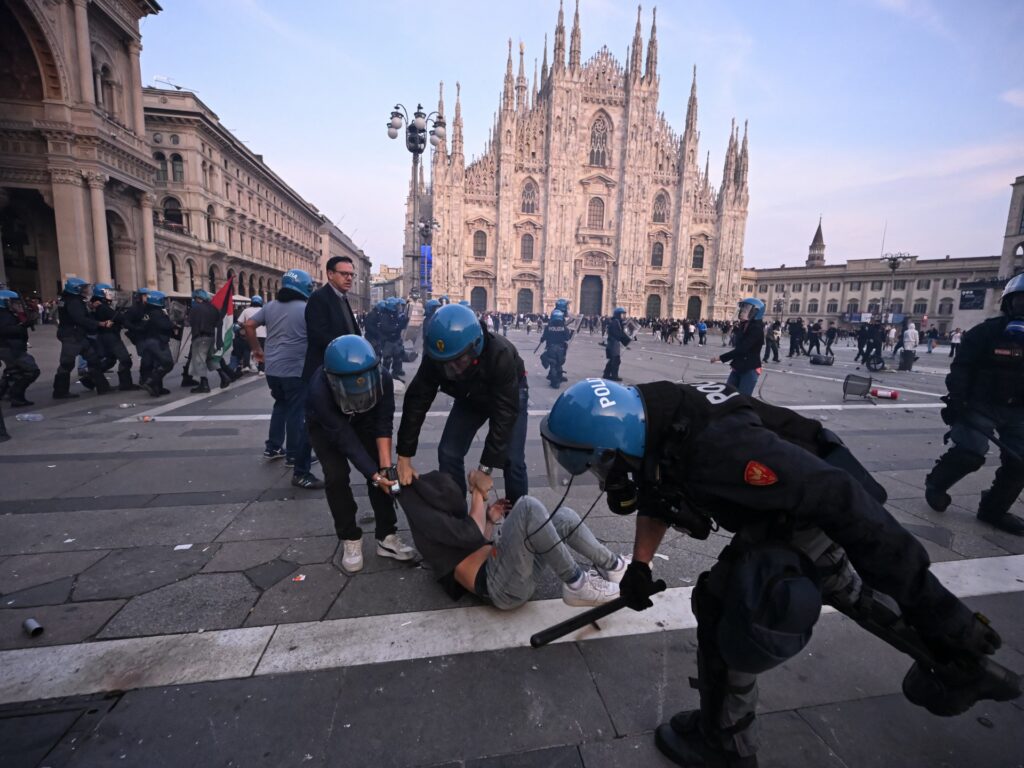
The weekend’s unrest unfolded across several cities. In Milan, a peaceful march against rising living costs and poor school conditions turned chaotic when masked participants hurled stones, paving blocks and other objects at police, set up makeshift barricades and ignited fires in the city centre, including Piazza del Duomo and a luxury arcade. Police responded with water cannons and tear‑gas. Two officers were injured and around fifty demonstrators, many of them minors, were detained, according to the Italian news agency La Presse.
Similar scenes were reported in Bologna, where peaceful rallies were accompanied by stone‑throwing and clashes with police, and in Turin, where hooded protesters built barricades from bins and outdoor furniture, and tossed firecrackers, sticks and stones at officers.
Critics say the new measures fail to address the underlying drivers of the disorder. Protesters argue that soaring prices, a shortage of affordable housing, rising household costs and deteriorating public services are pushing families into poverty and leaving young people with little hope of improving on their parents’ situation. Inflation in Italy averaged about two percent a year, but spiked to 8.7 percent in 2022 after energy prices surged following Russia’s invasion of Ukraine. From 2000 to 2025, the cost of everyday items such as food, energy, transport and utilities rose by 68 percent, while average full‑time wages fell by nearly five percent.
Genoa mayor Silvia Salis warned that while young voices must be heard, the violence seen in Milan and Turin was aimed solely at destruction. “The response, however, should be inclusion,” she told La Repubblica. NGOs, including Associazione Antigone, have also condemned the decree, calling for policies that address economic hardship rather than expanding punitive powers.