Iran Widens Gulf Attacks to Kuwait and Bahrain as US Blockade Squeeze Deepens
Iran widened its attacks across the Gulf on Wednesday, firing on a United States air base in Kuwait and launching several attacks on Bahrain, in what appeared to be retaliation for American strikes the day before. The strikes mark a new phase in a months-old conflict that keeps spilling into new countries.
What happened on Wednesday
Early Wednesday morning, the Iranian Army fired at air defense systems and drone and missile launch platforms at Ali Al Salem air base in Kuwait, according to Iran’s state broadcaster. Kuwait’s Army said its air defenses intercepted drone attacks and did not immediately report any damage. The Foreign Ministry condemned the attacks as criminal.
In Bahrain, the Interior Ministry issued two early morning alerts urging people to take shelter, then gave the all clear a short time later. The military said it intercepted a number of attacks but gave no information on damage or casualties. The small island kingdom hosts the headquarters of the United States Navy’s Fifth Fleet.
A pattern, not a one-off
The attacks were not an isolated outburst. After about two months without such attacks, Iran has repeatedly targeted American facilities in Bahrain in recent days. The attacks followed a chain of tit-for-tat strikes: a United States fighter jet hit a Revolutionary Guard missile launch site on Tuesday on Qeshm Island, after Iran struck an American radar installation in Bahrain earlier that day. Iran said the strikes answered American drone surveillance and an attack on its communications towers.
Ali Al Salem itself is no stranger to this war. During the fighting it has been struck at least 30 times by Iran, damaging or destroying at least 15 aircraft hangars, numerous warehouses and 10 buildings near a residential area, according to an Associated Press report. The UAE state oil company ADNOC said one tanker crew member was missing and 11 others were injured after an attack in the Strait of Hormuz the day before.
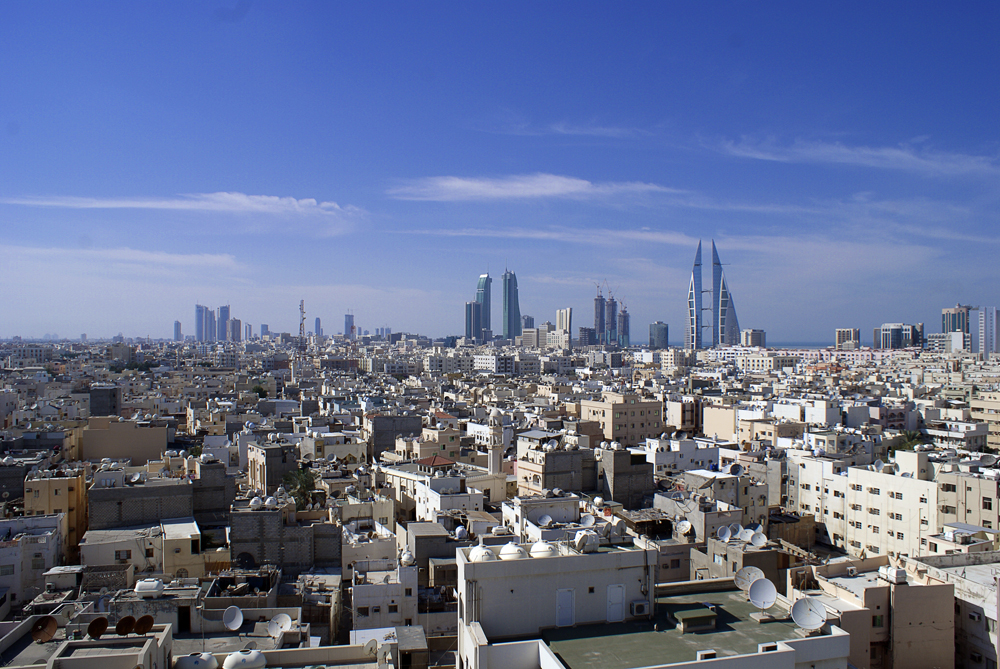
Manama, Bahrain. Photo: Jacobs, Creative Bees, Wikimedia Commons, CC BY 2.0.
Why Tehran is widening the fight
With its economy suffering under an American naval blockade, experts say the attacks suggest Tehran may be growing weary of the status quo.
Danny Citrinowicz, a researcher at Israel’s Institute for National Security Studies, described an increasingly clear pattern of attacks by Iran on shipping and American facilities in the Gulf. Iran, he wrote, appears to be pursuing a strategy of deliberate, calibrated escalation. The objective is not necessarily to trigger an all-out war, but to steadily increase the military, economic and political costs of maintaining the blockade. Kuwait and Bahrain are hosts of American power, and striking them raises the price of that presence.
What happens next
The danger now is the slow accumulation of incidents. Hamidreza Azizi, a senior Iran analyst at the International Crisis Group, warned that even if neither side intends a broader confrontation, the incidents increase the risk of miscalculation and escalation beyond what either side intended.
President Donald Trump has sent mixed messages, saying new strikes are highly unlikely while also sending a third aircraft carrier and thousands more troops to the Middle East. Citrinowicz argues Washington faces a dilemma: a limited response may encourage Iran to push further, while a stronger response risks accelerating the escalation it is trying to avoid. He sees two paths to de-escalation: a negotiated agreement, or an American decision to lift the blockade. For the Gulf states caught in the middle, the message of Wednesday’s attacks is plain: the war is no longer something happening somewhere else.
Sources: Associated Press, Reuters.