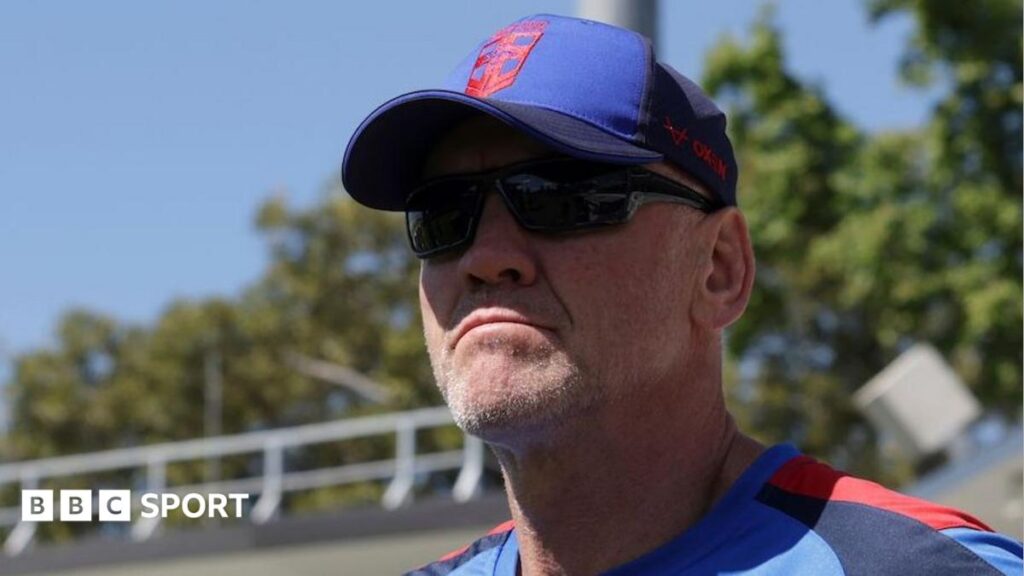
England boss McDermott calls for Super League to accept NRL investment
England head coach Brian McDermott, who also serves as an assistant coach with the Gold Coast Titans, has urged the Super League to welcome investment from Australia’s National Rugby League. The call comes as talks continue after Super League clubs turned down a £35 million package offered by the Australian Rugby League Commission, and a second deadline of 15 October passed without a deal.
Formalising a partnership between the two premier competitions is seen as a crucial step toward boosting the European league’s revenue. “I think the NRL’s investment in Super League could be very, very positive,” McDermott said. “The product’s brilliant. It has always been brilliant. The product’s never been the problem. The players have never been the problem. The coaches have never been the problem. It’s just how it’s marketed and how it’s presented to people. I think there are some dominoes that could start falling our way if the NRL invests and we accept their investment.”
Super League has yet to secure a new title‑sponsor, finalise broadcast agreements, or confirm its 2027 fixture list, and the status of the London Broncos remains uncertain. The Broncos finished 16th on the yearly grading list, below Championship side Barrow Raiders, despite a season in which they captured the second‑tier Grand Final, the 1895 Cup and the regular‑season title. They were omitted a year ago when Bradford Bulls, York Knights and Toulouse Olympique joined the expanded 14‑team competition.
Backed by Australian businessman Grant Wechsel and former Brisbane Broncos great Darren Lockyer, and boasting a squad full of internationals, the Broncos still hope to earn a place in Super League for 2027. Sources say any agreement would likely require the Australian governing body to push for the Broncos’ inclusion in the top flight in the near future.
The financial gap between the hemispheres was highlighted when the NRL secured a record A$5.3 billion (£2.78 billion) television deal over seven years in July. By contrast, Super League’s TV contract with Sky Sports, which expires at the end of 2026, is worth roughly £21.5 million a year.
“I know there are some positive notes around Super League at the moment, especially with crowds,” McDermott added. “It’s been a really interesting competition this year and Wakefield winning the Grand Final puts a brilliant marker down that all the teams can win it. It would be a real positive validation of Super League if the NRL were to invest.”
Earlier commentary, such as the 28 October 2025 piece titled “Super League in danger of ‘crash’, says V’landys,” and a 2 September article on the benefits of NRL investment, have underscored the league’s challenges.
McDermott also argued that an infusion of money would broaden the talent pool available to future England coaches. He noted that NRL clubs oversee players across multiple age groups up to first‑grade level. “The TV deal that the NRL’s just signed is enormous and, with that, you get preparation, the facilities and the teams coming through that support each NRL club,” he said. “I don’t think Super League clubs could populate three teams underneath them with a genuine six, seven, nine and one. So you end up playing a version of rugby league in the UK at junior level, which is good, it’s well coached, it’s dedicated and it’s full of commitment. But you don’t have the genuine six, seven, nine and one influence over a game. This is not a new opinion. It’s been going on for a long time. If you’re asking me, is there a big divide between the competitions? Yeah, there is. It’s nothing to do with commitment, nothing to do with good‑quality coaching or commitment from players. It’s just the size of the competitions and the standing in their country.”