
Contact Sport: How Much Eye Contact Is Too Much?
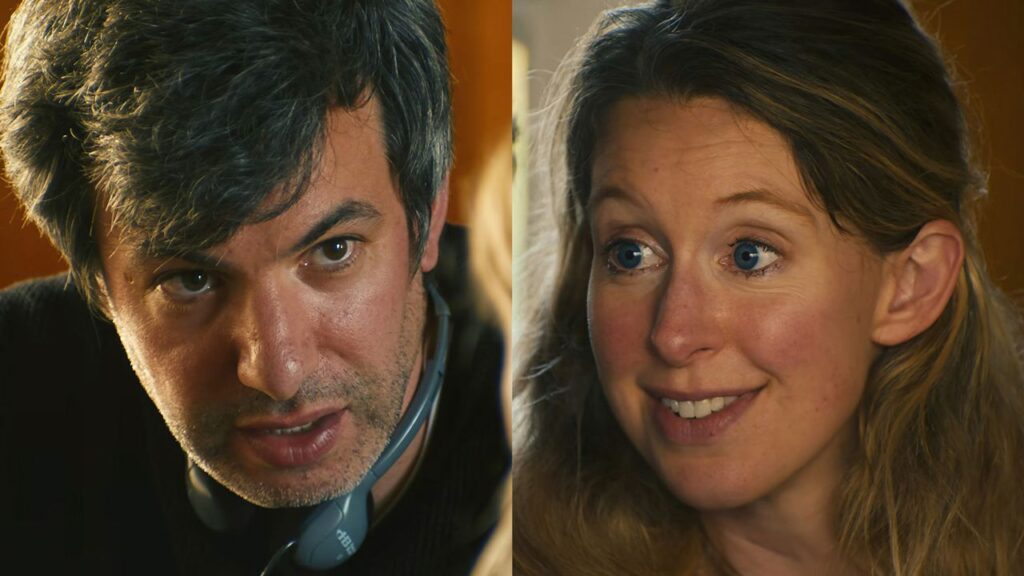
You Can See Everything, the perplexing new documentary about Elizabeth Holmes by Nathan Fielder and Lance Oppenheim, debuted unexpectedly at the Telluride Film Festival on September 6. The same day, the film’s first teaser trailer was released and quickly became the talk of the internet. In the clip, a still‑free Holmes—just weeks from beginning a prison sentence for fraud—sits in a beach house very close to Fielder.
“I can promise you that. I don’t have anything to deceive you on. Of course I’m not deceiving you,” Holmes says. “I’m engaging with you as a human being. Why would I deceive you? There’s no reason for me to do that.”
“Okay. Alright. Okay, good chat,” replies Fielder. After a pause he asks, “You’re being real right now?” Holmes answers, “I’m always being real.”
Throughout the minute‑long teaser the two lock eyes as intensely as two territorial bald eagles in a deadly spiral. The video has already amassed 8.5 million views.
Seeing the teaser for the first time, I found myself unable to look away from their unbroken gazes. I was raised attending Texas cotillions, where I learned that steady eye contact is a hallmark of Southern charm. What I witnessed, however, felt almost aggressively uncomfortable.
Etiquette specialist and author Elaine Swann explains that the key difference lies in how long the stare lasts. “The golden rule I share with my clients when it comes to eye contact is to always use it in moderation,” she says. “Look at the person, but don’t stare too deeply, because then you can come off as creepy. But don’t look away for too long, because you may be perceived as elusive.”
Scientists agree that eye contact is rooted in evolution. Studies show that mutual gazes can raise heart rate and trigger arousal, but when the look extends beyond roughly three seconds—according to a 2015 study—it shifts from engaging to potentially threatening, suggesting a struggle for dominance.
“If a person holds eye contact without breaking it for an uncomfortable amount of time, it might reveal a couple of things,” Swann notes. “They might lack social awareness and not recognize that their long gaze is impacting someone negatively.” At other times, “they may be intentionally using that long stare to intimidate an individual or assert power over them.”
A central question of Fielder and Oppenheim’s film is whether Holmes is genuinely naive or a calculated manipulator. The broader project leaves the answer to the audience, yet the opening teaser alone may already convey a lot.
Have a beauty or wellness trend you’re curious about? We want to know! Send Vogue’s senior beauty & wellness editor an email at beauty@vogue.com.