
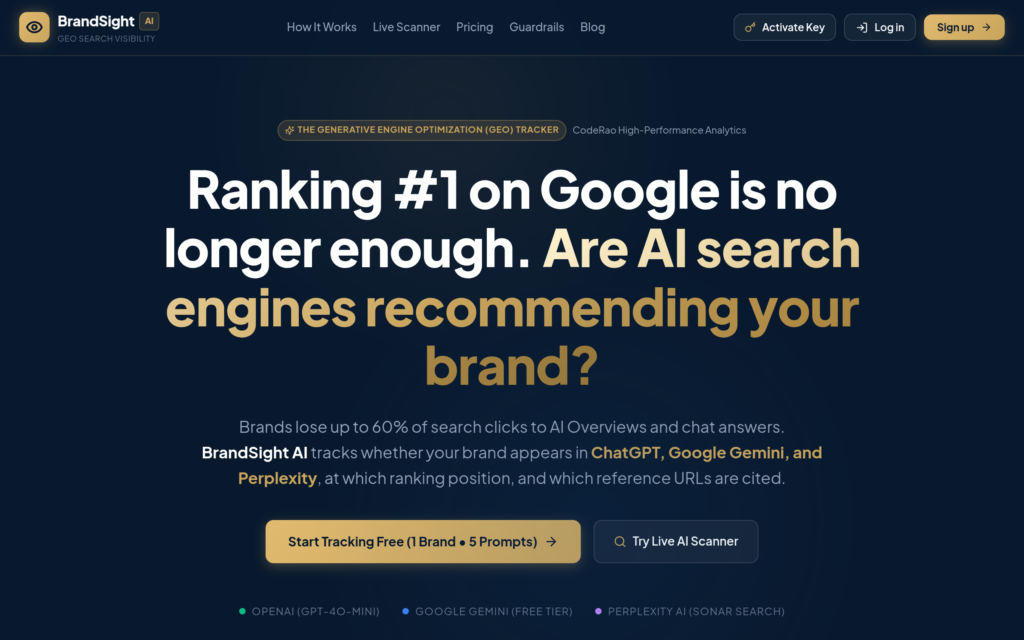
BrandSight AI vs Traditional Rank Trackers: What Google Rankings Miss About AI Search
For twenty years, the question every business asked about search was simple: where do I rank on Google? Traditional rank trackers answered it well, reporting your position for keywords, week after week. But customers no longer only search that way. They now ask ChatGPT, Gemini, and Perplexity for a recommendation, and get a single answer instead of a page of links. A business can rank first on Google and still be invisible in the answer a customer actually reads. That gap is what BrandSight AI was built to measure.
What Traditional Rank Trackers Still Do Well
Classic SEO tools track positions on search result pages, follow competitors, and report which keywords bring traffic. That work still matters: Google remains a huge source of visitors, and knowing your ranking helps a business plan content and spot a sudden drop. The problem is not that these tools are wrong. It is that they measure only one kind of search, while a growing share of discovery now happens somewhere else entirely.
What AI Answers Actually Do With Your Brand
When someone asks an AI assistant for the best accounting software or a reliable clinic, the answer is a shortlist, often with sources cited, some brands mentioned and others left out completely. There is no page two to climb. You are either in the answer or you are not, and a mention without a citation is weaker than a mention as a recommended source. A traditional rank tracker cannot see any of this: whether ChatGPT mentioned you, whether Gemini cited your site, or whether Perplexity recommended a competitor instead.
The Comparison, Side by Side
Put the two side by side and the difference is one of coverage. A rank tracker answers: where do I sit on a results page? BrandSight AI answers: what do the AI assistants say about my brand? It checks mentions, position, and cited sources across ChatGPT, Gemini, and Perplexity, so a business can see not just whether it appears, but how: mentioned, recommended, or ignored, and with what evidence. One tool protects your position in the old search world. The other shows you your position in the new one.
Who Feels the Gap First
The gap bites first for businesses whose customers research before they buy: agencies, software companies, clinics, and professional services, where one AI recommendation can decide a shortlist. A small agency that wins clients through referrals may discover AI assistants never mention it at all, because its expertise lives in proposals and calls rather than pages the models cite. Tracking AI mentions turns a vague worry into a concrete list: these prompts mention us, these do not, these cite a competitor.
The Verdict for Businesses Watching AI Search
Traditional rank trackers are not obsolete, but they are no longer the full picture. Search has split into two worlds, the results page and the answer, and measuring only the first leaves a business blind to the second. BrandSight AI, built by Pakistani developer Nauman Rao, covers the new world with a free plan for one brand and Pro plans from $19 a month for businesses that want ongoing tracking. If your customers are already asking AI assistants for recommendations, the question is no longer whether to track AI visibility. It is how long you can afford not to know what the answer says about you.
Find out what ChatGPT, Gemini, and Perplexity say about your brand: brandsight-ai.coderao.com and try BrandSight AI today.