AI tools challenge ownership of India’s textile heritage
Bitupan Deka was out shopping for a traditional “gamusa” scarf with his mother in Meghalaya when he noticed that every shop displayed the same handful of patterns. “Every shop selling the scarf had the same handful of patterns repeated over and over,” he told Al Jazeera from Shillong, the state capital. He learned that weavers in Sualkuchi, a district in neighboring Assam, receive a one‑time payment of about 2,000 rupees (roughly $21) for each design they create, rather than earning royalties. Manufacturers cut the number of designs to save costs.
The discovery led Deka, an assistant professor of computer technology at Shillong’s MIT University, to develop a system that can generate endless new designs for these fabrics. “My work isn’t meant to replace the traditional designers. I hope, instead, that it will become a tool in their hands to create new and modern motifs more easily, so the consumers can have variety,” he said. He is applying for a patent through his university’s research and development department and plans to commercialise the system as a design‑service for the textile sector once the patent is granted.
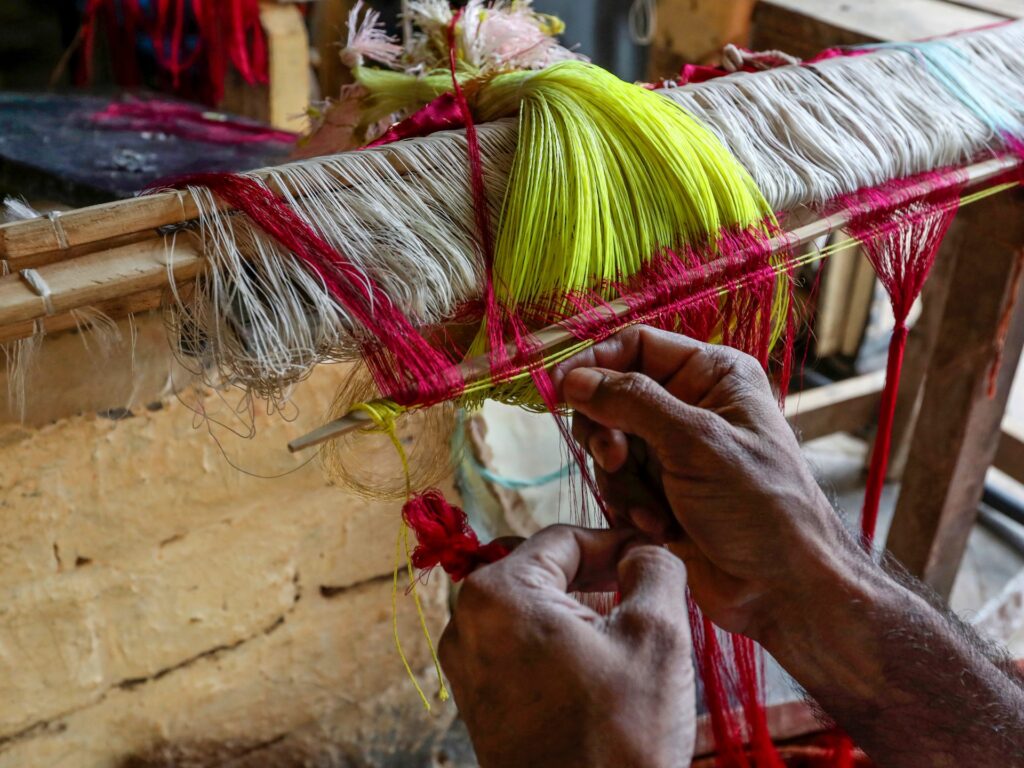
In India’s diverse textile traditions, patterns and motifs carry the memory of places, myths and even migration histories. Weavers draw inspiration from their surroundings, paint with locally sourced colours, and use carved clay or wooden frames. Their work is not a simple reproduction; it is an inheritance passed down through generations, with each hand hesitating where a grandmother’s hand once did, and each flower oriented in a specific direction for a reason. A computer lacks such inheritance or hesitation. It learns by analysing images and reproducing them in countless variations, yet Deka’s system can now draw and weave the same flower.
A similar project, the Rekh Sanganeri Dataset, was created for hand‑block printed textiles from Rajasthan’s Sanganer region. The collection contains high‑resolution images of printed patterns, annotated down to ink bleed and slight misalignment – the imperfections that mark handmade work. Its developer, Reddy Sai Nivas C, says the dataset should serve research and artistic purposes, not replace artisans. The paradox remains: tools meant to preserve a craft also make its visual language easier to reproduce digitally without the craftsperson.
Dinesh Chhipa, who belongs to one of the oldest Chhipa families known for dyeing and block printing, works as a Bagru designer and textile businessman in Rajasthan. “Traditional craft is slow to produce. Even if someone offered us a fortune, we wouldn’t be able to produce these pieces in mass numbers, so I don’t fault those using digital technology and AI to fill the gap,” he told Al Jazeera. “But don’t borrow craft and regional names like Bagru and Jaipuri. These designs and motifs were born out of a culture and necessities of the communities they come from.”
India has been digitising its textile heritage for years, from the Botanical Survey of India’s historic collections to the Bharatiya Vastra Shilpa Kosh, a national portal built by the National Institute of Fashion Technology and the Centre for Development of Advanced Computing. Documentation helps prevent fragile traditions from disappearing, but it also provides AI systems with the raw material to reproduce these crafts at scale.
At the India AI Impact Summit in New Delhi in February, Tata Consultancy Services showcased Bridgital Loom, an AI platform that translates textile designs into loom‑ready instructions. LED lights on the loom guide weavers through the thread sequences of intricate Banarasi and Kanchipuram patterns, named after the cities where these arts originated. TCS says the technology helps weavers execute complex designs faster and with fewer errors, acting as a bridge between artisans and technology. A pilot project using the loom is already underway in Kanchipuram, Tamil Nadu.
Muthulakshmi Nellaiappan, head of AI strategy for Bridgital Loom, told the online platform Digit at the summit that a new weaver traditionally takes more than 15 years to master the craft. “With the technologies we have in hand … the younger weaver who has just entered the skill can become a master much sooner,” she said.
These developments flatten the traditional master‑apprentice hierarchy that has long governed knowledge transmission in Indian textiles. The weaver no longer needs to conceive or remember patterns, colours and codes; instead, he follows the machine’s guidance, raising fresh questions about who truly owns a culture when it is reduced to data.