
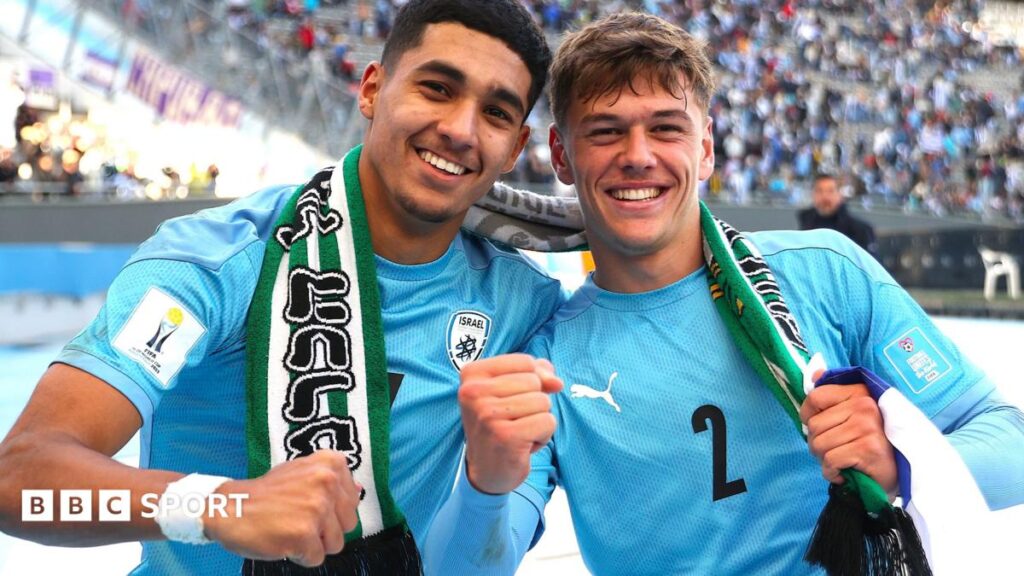
A team that sparked hope, then months later faced war
By Mike Henson, BBC Sport senior journalist
Ido Rakovsky likened the story to “science fiction” rather than sport. Israel’s under‑20 side, which has only once qualified for a senior World Cup, stunned the world by defeating Brazil in the quarter‑finals of the 2023 tournament. The Israeli television commentator promised that viewers would recount the night to their children and grandchildren, and the sentiment resonated. Five days later the semi‑final against Uruguay became the most‑watched program of the evening in Israel, capturing a 23 percent share, and politicians rushed to congratulate the squad.
“It was June 2023. Everyone was watching under‑20 football, everyone knew the players,” Rakovsky, who covered the team for Haaretz, recalled. “The whole country fell in love with these kids.” Their appeal went beyond the pitch. After scoring a stoppage‑time winner against Uzbekistan in the round of 16, striker Anan Khalaili gave an interview in which he thanked Israeli viewers for staying up late to watch the victory. He used the Hebrew phrase “Am Yisrael,” meaning “People of Israel,” a term steeped in Jewish religion, culture and history. “That an Arab player used that phrase said something about the identity of that team,” Rakovsky said. “It showed that football can truly bring people together – Muslim players representing the Jewish state, creating something better for today and tomorrow.”
Just over four months after Khalaili’s interview and the win over Brazil, Hamas launched an assault on Israel that killed about 1,200 people and took 251 hostages. Israel responded with a large‑scale offensive in Gaza, and the United Nations estimates that more than 70,000 Palestinians have died in the ensuing conflict. As the war drags on, observers wonder whether the promise of Israel’s “golden generation” of footballers can ever be fulfilled.
Israel’s run at the tournament was no fluke. The same core group, with a few changes, had already impressed in Europe. They finished runners‑up at the 2022 Under‑19 European Championship, losing to England in extra‑time, and reached the semi‑finals of the 2023 Under‑20 Euros. Historically, Israel has produced notable talents such as Eyal Berkovic and Yossi Benayoun, but the depth of the current cohort stands out. Khalaili was one of the most coveted prospects in Europe this summer; after a £21.5 million move to Inter Milan fell through, Crystal Palace secured his services from Union Saint‑Gilloise for a comparable fee. Playmaker Oscar Gloukh, now 22, earned a transfer to Ajax after shining at Red Bull Salzburg. Left‑back Roy Revivo joined Spanish side Elche on deadline day, while Twente defender Stav Lemkin, also 23, is highly rated. Dor Turgeman, Ilay Feingold and Idan Toklomati are making their mark in Major League Soccer. All have earned full senior caps and were shaped into a cohesive unit by age‑grade coach Ofir Haim.
“It isn’t an issue at all here,” Haim said of the diverse backgrounds on his squad during the 2023 Under‑20 World Cup. “We have players who put on tefillin, and Anan, Hamza and Ahmed perform the Muslim prayers. We don’t even talk about it. We unite everybody, and I wish the country were as united as this team.”
Football has long served as a meeting point for Israel’s varied communities. Historian Dr Omer Einav notes that many Jews who arrived during the British Mandate period came from Europe and shared little with the local Middle Eastern culture except a love of the game. British administrators encouraged teams from different groups to compete, creating a common language on the field. When the state of Israel was founded in 1948, a sizable Arab minority remained and continued to identify as Palestinians. Today they make up about 20 percent of the population but account for roughly 35 percent of elite football participants. The first Arab player to represent Israel was Rifaat Turk in 1976, and in 2018 Bibars Natcho became the first Muslim to captain the national side. Both men faced controversy during their careers.