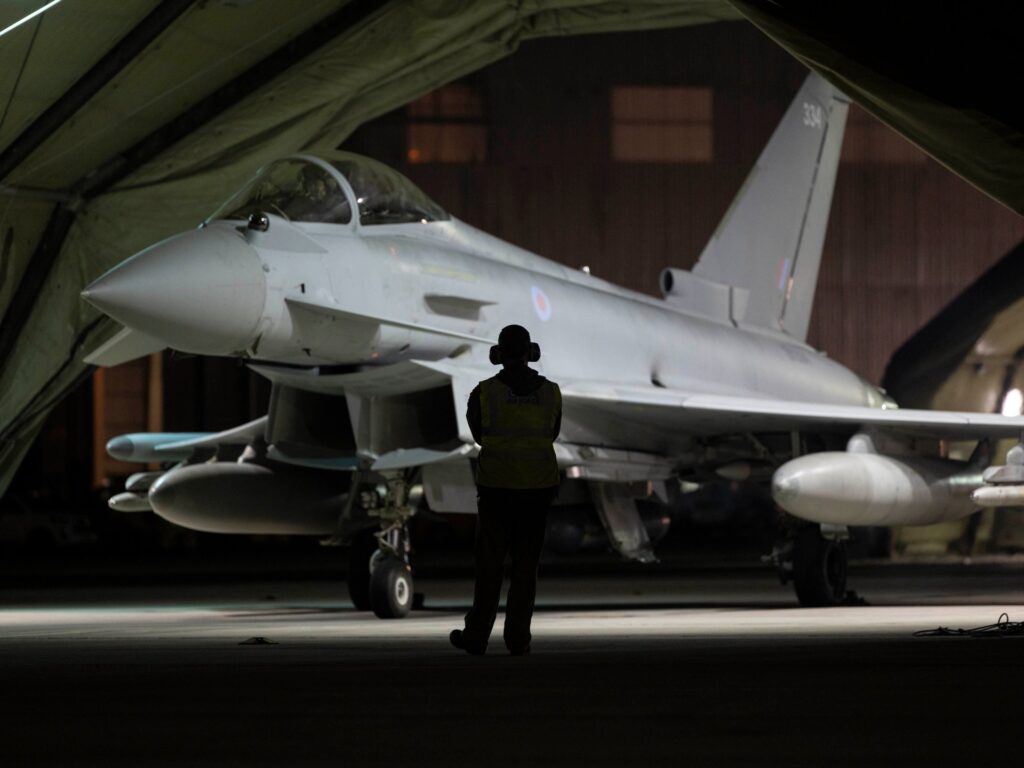
British Typhoons to defend Saudi Arabia echo century‑old military ties
The United Kingdom announced that Royal Air Force Typhoon fighter jets will be sent to Saudi Arabia to protect the kingdom from missile and drone attacks launched by Yemen’s Houthi rebels, also known as Ansar Allah. In a statement on Tuesday, the Ministry of Defence said the aircraft will serve a defensive role and will not be used to strike the Iranian‑backed group.
The deployment comes as fighting intensifies between the Houthis and Yemen’s internationally recognised government, which receives backing from Saudi Arabia. In recent weeks the rebels have targeted Saudi oil installations and Riyadh’s main airport, while the Saudi‑led coalition has responded with air strikes on Houthi positions.
The decision follows a partnership that stretches back more than a century, to a treaty signed during the First World War, long before the modern Saudi state was established. The United Kingdom will send Typhoon fighters, an A400M transport aircraft and a team of advisers, and it will extend the air‑to‑air refuelling support it already provides for Saudi air operations against Houthi targets in Yemen.
Britain’s ties with Saudi Arabia began in December 1915 when Sir Percy Cox, a senior British official in the Gulf, concluded the Treaty of Darin with Abdulaziz Ibn Saud, then ruler of Nejd. The agreement pledged Saudi support against the Ottoman Empire in exchange for British financial and military aid. A further treaty was signed in May 1927 at Jeddah, and Abdulaziz founded the Kingdom of Saudi Arabia in 1932.
Arms sales started in the 1960s. In May 1966 Saudi Arabia placed orders for 40 Lightning fighter jets, 25 jet trainers and a radar system from the British Aircraft Corporation. At that time Yemen was already a factor in regional politics: a 1962 coup toppled the Mutawakkilite Kingdom, creating the Yemen Arab Republic, which was supported by Egypt, while Saudi Arabia and Jordan backed the royalist faction. By 1966 the civil war had stalled, and Britain was withdrawing from its Aden base, completing the pull‑out in 1967.
In 1966 Saudi defence minister Prince Sultan asked the United Kingdom to provide an RAF squadron to operate under Saudi colours if the Yemen conflict reignited. Britain offered to supply Lightning jets flown by British pilots, and Saudi Arabia accepted the aircraft and civilian pilots, so the RAF squadron was never deployed. BAE Systems, then part of the British Aircraft Corporation, traces its relationship with Saudi Arabia to that year, and a 1973 memorandum of understanding named the company as the prime contractor for future sales.
The 1980s saw the signing of the Al‑Yamamah oil‑for‑arms agreement, which granted Saudi Arabia Tornado and Hawk jets in exchange for up to 600,000 barrels of oil per day. Reuters described the deal as the largest export contract in British history. A UK Serious Fraud Office investigation into alleged corruption was closed in December 2006 on national‑security grounds.
British forces have operated from Saudi soil before. After Iraq invaded Kuwait in August 1990, King Fahd invited allied nations to help. On 11 August, twelve RAF Tornado fighters flew from Cyprus to Dhahran, and additional detachments were established at Tabuk in October and at Dhahran in January 1991. One Tornado was lost during the conflict, the fourth British aircraft lost in action. British jets continued to patrol the southern‑Iraq no‑fly zone from Saudi bases until 2003.
Saudi Arabia agreed in September 2007 to purchase 72 Typhoon fighters from the United Kingdom, a deal intended to replace older Tornado aircraft. The contract was valued at £4.43 billion. The latest deployment of Typhoons therefore adds a new chapter to a relationship that has endured for more than a hundred years.