
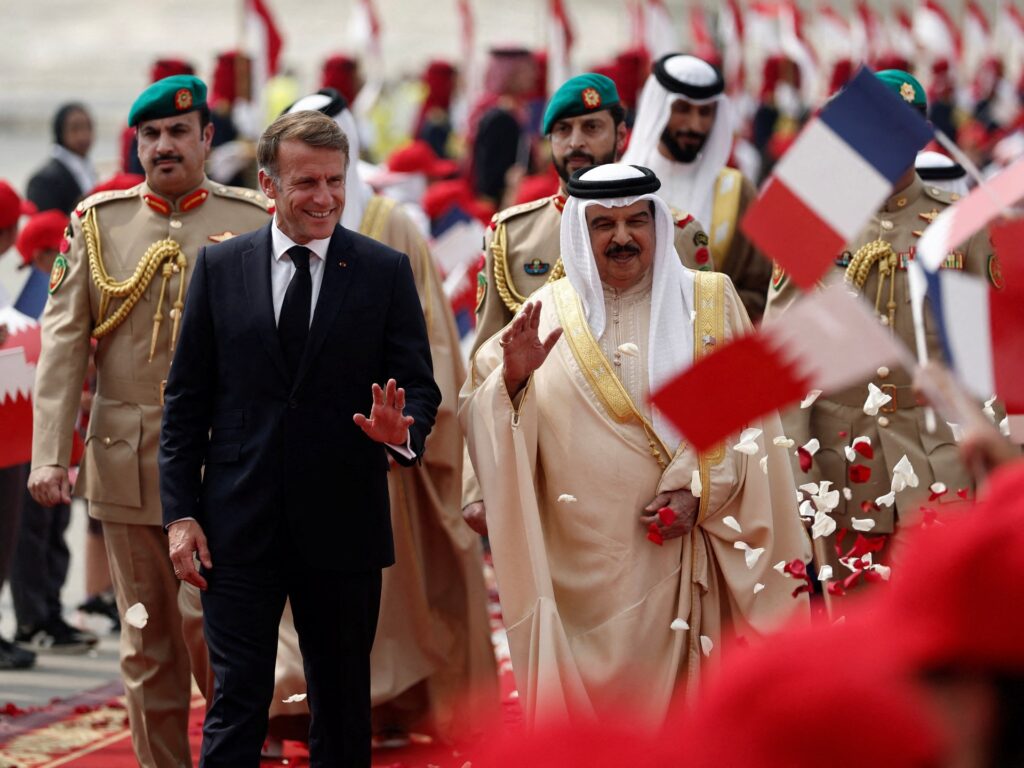
Macron’s Gulf tour aims to secure new energy supplies and deepen defence ties for France
President Emmanuel Macron arrived in Bahrain on Oct. 20 as part of a three‑day tour of the Gulf that also includes stops in Kuwait, the United Arab Emirates and Qatar. The trip comes while France wrestles with widespread street protests over a budget plan that seeks deep cuts to public spending and a freeze of civil‑service wages.
In Kuwait, French officials signed eight agreements covering defence, artificial intelligence, investment and other sectors. The following day, Macron met UAE President Sheikh Mohamed bin Zayed Al Nahyan in Abu Dhabi. Both leaders pledged to expand cooperation in energy, advanced technology and AI. The French foreign ministry notes that the UAE was France’s biggest Gulf trading partner in 2025, with bilateral commerce valued at €10.8 billion ($12.1 billion). According to the Stockholm International Peace Research Institute, France accounted for 18 percent of the UAE’s arms imports that year, second only to the United States, which supplied 42 percent.
Andreas Krieg, a senior lecturer at King’s College London’s School of Security Studies, said Macron’s visit reflects a broader shift in regional geopolitics. “We are witnessing the gradual emergence of a post‑American Middle East in which Washington remains militarily powerful but increasingly struggles to exercise the political leadership it once enjoyed,” he told Al Jazeera. He added that both Europe and the Gulf are learning that heavy reliance on U.S. security decisions carries significant economic and political costs.
Back home, France faces an energy crunch that has intensified public anger. The war sparked by the United States and Israel’s strike on Iran has disrupted fuel shipments through the Strait of Hormuz, leading to shortages of petrol and diesel. At various points since the conflict began, up to 20 percent of French petrol stations have run dry. Oil prices have hovered above $100 a barrel, prompting Macron to travel to the Gulf accompanied by senior executives from TotalEnergies and Engie in search of new supply sources.
The effort appears to be bearing fruit. Bloomberg reported that the UAE has agreed to deliver 100,000 tonnes of diesel – roughly 746,000 barrels – to France each month for an unspecified period. Bahrain has offered the same volume, while Saudi Arabia will provide 95,000 tonnes in both October and November, shipments that will be handled by TotalEnergies.
In addition to securing fuel, France hopes to boost its defence exports to the Gulf, a priority as the country grapples with record national debt, the highest since the aftermath of World War II. Recent months have seen France deepen its military partnership with Saudi Arabia, which is confronting attacks from the Iran‑backed Houthi rebels in Yemen. In September, Macron announced that French troops and defence systems would be sent to protect the Red Sea port of Yanbu, a key hub for Saudi oil exports. He later clarified in a televised interview that soldiers, radars and other defence equipment would be deployed, though he did not disclose exact numbers.
The move has been described by Le Monde as a geopolitical shift, marking a transition from a historically low‑key defence relationship to a more visible and coordinated partnership. As Macron continues his Gulf itinerary, the outcomes of these negotiations could shape France’s energy security and strategic posture for years to come.