
Rising Living Costs Across France, Italy, Spain and Portugal Over Two Decades
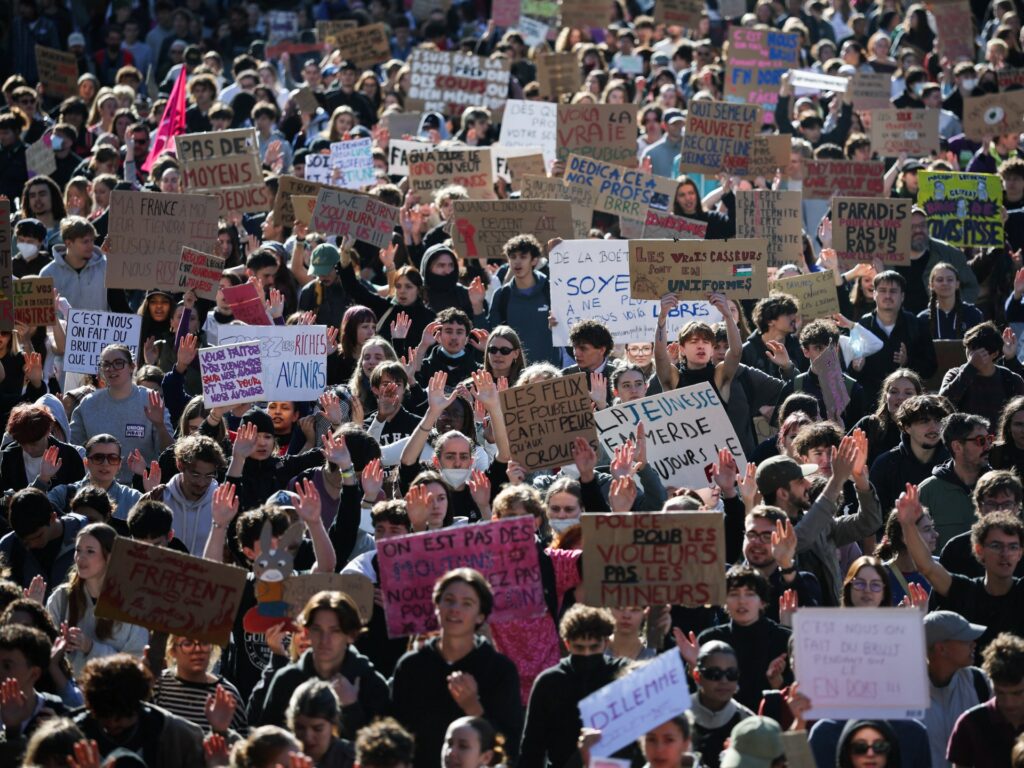
Student demonstrations that began in France in September have now spread across Europe, turning a protest about crowded classrooms and teacher shortages into a broader outcry over soaring living costs and looming cuts to public services. The unrest has reached Albania, Belgium, Greece, Italy, Portugal and Spain, where young people are taking to the streets to demand affordable housing, lower prices and better public services, saying they no longer expect to be better off than their parents.
Leaders such as French President Emmanuel Macron, Italian Prime Minister Giorgia Meloni, Spanish Prime Minister Pedro Sanchez and Portuguese Prime Minister Luis Montenegro are all facing growing discontent. Sanchez leads a left‑wing government, Meloni heads a right‑wing administration, while Macron and Montenegro are seen as centrist conservatives. Despite their differing political outlooks, each must confront the reality of rising costs that are affecting their citizens.
Eurostat’s harmonised index of consumer prices shows that everyday items – food, energy, transport and utilities – have become 59 to 78 percent more expensive since 2000 in the four countries. Spain recorded the sharpest rise at 78 percent, followed by Portugal at 71 percent, Italy at 68 percent and France at 59 percent. In practical terms, a basket that cost €100 in 2000 now costs roughly €178 in Spain, €171 in Portugal, €168 in Italy and €159 in France. Prices have risen at an average of about 2 percent per year, but 2022 saw a spike as inflation reached 8.7 percent in Italy, 8.3 percent in Spain, 8.1 percent in Portugal and 5.9 percent in France – the highest rates in each country since the turn of the millennium. The surge was largely driven by energy prices, which jumped after Russia’s invasion of Ukraine in February 2022; by October that year, energy costs across the eurozone were almost 42 percent higher than a year earlier, and food prices were also climbing sharply. Between 2021 and 2023, prices rose another 12 to 15 percent, while wages have struggled to keep pace, leaving many households still feeling the pressure.
When inflation is taken into account, the average full‑time salary in Italy fell by nearly 5 percent between 2000 and 2025. In the same period, real wages grew by 7 percent in Spain, 11 percent in France and 20 percent in Portugal, according to OECD data adjusted with Eurostat’s price index. In Spain, many new jobs have been in tourism and services, often seasonal and low‑paid, journalist Jaime Velazquez told Al Jazeera’s Inside Story. Julius Fintelmann, co‑founder and editor‑in‑chief of The European Correspondent, added that ageing societies are squeezing opportunities for younger workers and that the pay gap between older and younger employees has been widening in high‑income economies for decades, undermining the promise that each generation would be better off than the last.
Housing affordability has also deteriorated, as shown by the OECD’s price‑to‑income ratio, which compares house prices with household incomes. Spain’s ratio is now 56 percent higher than it was in 2000, even after a sharp decline following the 2008 financial crisis. France’s ratio is 39 percent higher than in 2000, though it has eased slightly since a peak in 2022. Italy is the only country where house prices have largely kept pace with incomes, with the ratio only 5 percent above the 2000 level. Portugal experienced the most dramatic recent shift: after a steady decline that made homes more affordable for fifteen years, the ratio has risen by 67 percent since 2015. The OECD uses 2015 as its reference year for the price‑to‑income ratio; to align with the wage and price data that start in 2000, Al Jazeera has reset the figures so that 2000 equals 100.
Education spending has become a focal point of the protests in France, where demonstrators first rallied against overcrowded classrooms and a shortage of teachers. While in Belgium and Albania, demonstrators ...