
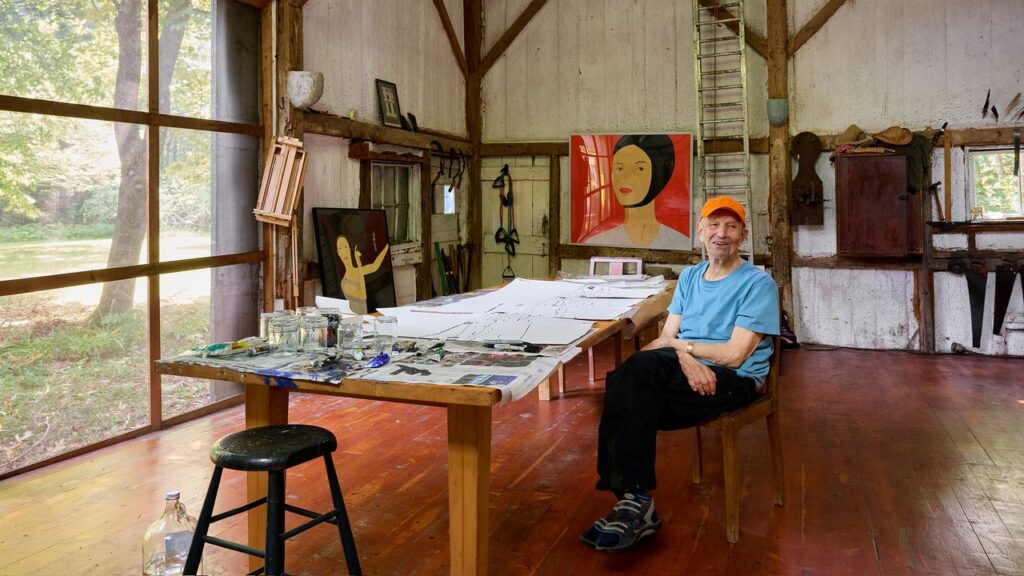
Visiting With Alex Katz, the 99-Year-Old Artist Who Doesn’t Stop
Being with Alex Katz in Lincolnville, Maine feels unlike any other experience. The town sits just ten minutes from Camden’s picturesque harbor, offering a landscape that feels rural without being isolated—woods are close, yet the sea is only a short drive away. A winding road lined with the tall, straight pines that appear in many of Katz’s canvases leads to a small beach where, eight years ago, the writer, her late husband Tad, Alex (then 99) and his wife Ada shared lobster rolls, laughter, and conversation. This visit is different. Tad is no longer there, and Ada does not travel up from the city, though her presence seems to fill the air.
The writer returned to Maine hoping to see Alex and the bright‑yellow house he and Ada have visited almost every summer since their 1958 marriage. Arriving at eleven on an August morning, she finds Alex seated at a round wooden table set on the green grass outside, wearing an orange baseball cap, sipping coffee and enjoying an “elevenses” with his poet son Vincent, Vincent’s wife Vivien who runs the studio, their 27‑year‑old twin sons Isaac and Oliver, the twins’ girlfriends Anna and Kaylie, and a dachshund named Eno after Brian Eno. It is a family gathering that could easily be mistaken for one of his paintings, if only Ada were present.
Joining the group feels as if no time has passed since the last conversation. Alex smiles and says, “The thing about being up here is, we don’t have to worry about the parties we’ve missed. I sleep and work.” His remarks are as concise as his paintings, a touch Hemingway‑like, and he delights in the unexpected. He confides, “I tried a hearing aid, lost it on the way home. Tried another, lost that one too. They’re bad for painting.” When asked why, he replies simply, “You don’t have to hear to paint.”
A short walk across the property brings the writer to Katz’s studio, which looks out over Coleman Pond—a view that has appeared in many of his works. Today he paints in a bright‑blue barn attached to the house rather than the original studio. The artist’s relationship with primary colors feels harmonious. The writer thinks of the iconic portrait of Ada against a vivid red background now in the Whitney Museum, and notices another close‑up of Ada in a black bathing cap on a red field hanging in the barn.
Alex explains that he spent a great deal of time rescuing the house, which was on the verge of collapse. He bought it for $1,200, a price that made the neighbors think he had been ripped off. He acquired the property with fellow artists Lois Dodd and Jean Cohen, his wife at the time. The building was originally a rum store two miles away, owned by a blacksmith, and was dragged to the site and set on a new foundation that never quite fit. Only after about twenty years did a grown man finish the foundation; until then the structure leaked.
Unlike many celebrated artists, Alex lives without the trappings of his commercial success. He sleeps in a twin bed in a modest, monastic room off a tiny living area. He built the kitchen cabinets himself decades ago, and the entryway wallpaper—made from potato prints—is a collaborative effort with Lois Dodd. Very little has changed in this house or in the SoHo loft he and Ada have occupied since the 1960s; the space is the same one the writer remembers from 1982, when she first met him. A poster for a 2009 show still hangs above a tool cabinet, and the living room displays wall decorations that Katz added with Dodd. A small cabin also sits on the property.
“The past couple of years have been the biggest production of my life,” Alex says. “I did 150 paintings, good size