Pakistan Test-Fires Fatah-3 Supersonic Cruise Missile, Its Third New Weapons Test in Six Weeks
Pakistan’s military announced on Wednesday that it had successfully test-fired the Fatah-3 supersonic cruise missile, the latest in a run of weapons tests this autumn. The launch was carried out by the Army Rocket Force Command, according to a statement from the military’s media wing, the Inter-Services Public Relations (ISPR), which described it as another significant milestone in strengthening the country’s national defence capabilities.
No range, speed or test location was disclosed. But the timing, the third launch of a new Fatah-series weapon in about six weeks, tells its own story about the pace at which Pakistan is building its conventional missile force.
What we know about the Fatah-3
According to the ISPR, the Fatah-3 carries advanced navigation and propulsion systems and can engage targets at long range with high precision and lethality at supersonic speed. The military says it will enhance the operational flexibility and strike reach of the Army Rocket Force Command, strengthening the country’s conventional deterrence and defence posture. The missile was first shown to the public in May 2026, when the ISPR released a video presenting it as a ramjet-powered supersonic cruise missile.
The launch was witnessed by the commander of the Army Rocket Force Command, senior officers of the armed forces, and the scientists and engineers who developed the system. President Asif Ali Zardari, Prime Minister Shehbaz Sharif and Field Marshal Syed Asim Munir congratulated the armed forces, scientists and engineers on the successful launch.

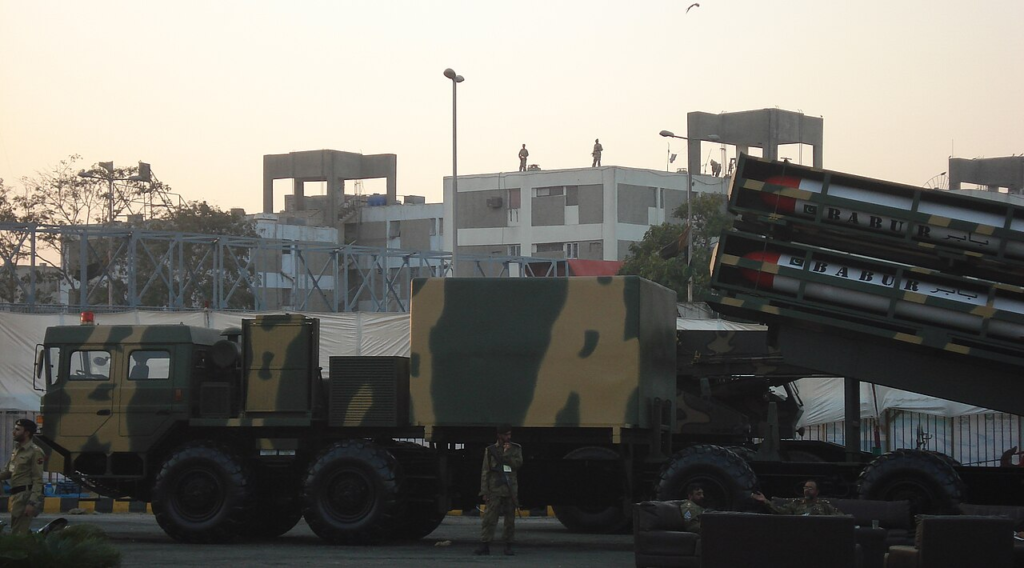
A Pakistani cruise missile on display at the IDEAS defence exhibition in 2008. Photo: Wikimedia Commons (CC BY-SA 3.0).
A busy autumn for the missile programme
The Fatah-3 test does not stand alone. On 13 October, the military carried out a successful test launch of the Fatah-2 extended-range hypersonic ballistic missile. A week earlier, on 6 October, an extended version of the Fatah-4 ground-launched cruise missile was successfully test launched. Three new systems in six weeks is a deliberate tempo, not a coincidence.
All three sit under the Army Rocket Force Command, the conventional missile force Pakistan created in August 2025. The creation of a dedicated command, followed so quickly by a series of tests, suggests the programme has moved from developing individual weapons to building a standing capability with its own doctrine, training and command structure.
What the test signals
The most immediate signal is aimed at India. A mobile, ground-launched supersonic cruise missile gives Pakistan a faster conventional strike option against defended targets, and it adds another layer to a deterrence relationship shaped as much by perception as by hardware. Pakistan’s military has been careful to frame the Fatah series in conventional terms, as a strengthening of conventional deterrence rather than anything to do with the nuclear arsenal.
The timing matters regionally too. With a spreading conflict in the Gulf and militant violence at home, a public demonstration of strike capability is a reminder that the military’s modernisation programme continues regardless of the crises of the moment.
What remains unanswered
For all the ceremony, the public knows very little about the Fatah-3 itself. Without a disclosed range or speed, independent analysts can only note that the missile closely resembles China’s HD-1 design and that circulating estimates of its performance remain provisional. There has been no announcement about when the system will be formally deployed or what its next stages of testing will be. That gap is normal for missile programmes, and it is also the point: the test itself is the message, that Pakistan’s conventional missile force is growing, testing regularly and organised under a dedicated command.
Sources: The Express Tribune, Dawn, Inter-Services Public Relations (ISPR)