White Evangelical Backing for Trump Falls Yet Stays Robust Ahead of Midterms
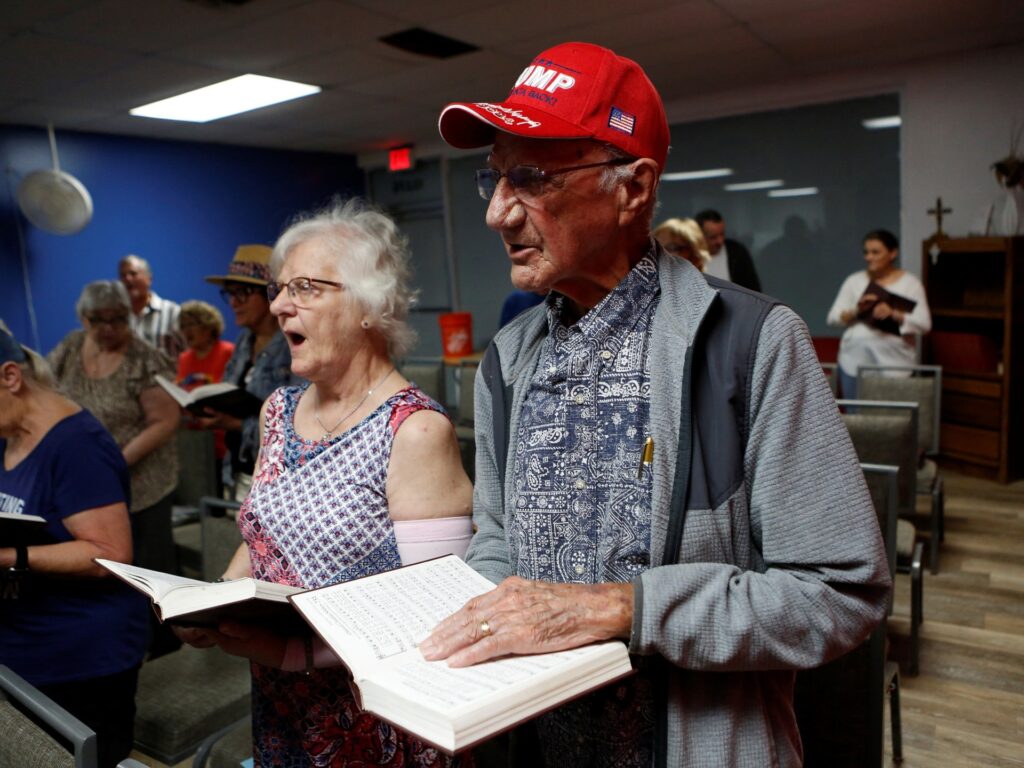
Support for President Donald Trump among white evangelical Protestants remains high, though it has slipped since he resumed office in January 2025, according to a recent poll. Reuters and research firm Ipsos released a survey this month showing that backing from this group dropped to 63 percent, down from 77 percent recorded at the time of Trump’s second inauguration.
The decline comes as Trump’s overall approval rating has sunk to a historic low of 31 percent. White evangelicals have long been a cornerstone of the Republican base, and the dip could matter in the November 3 midterm elections, where the GOP hopes to hold its congressional majorities. Democrats are widely expected to capture the House and are gaining ground on the Senate amid growing concerns over cost of living and the U.S.-Israel conflict over Iran.
Republicans are still banking on their core supporters to offset any Democratic gains. On Wednesday, Trump held a rally in South Carolina, a state deep in the “Bible Belt” where exit polls showed that six out of ten Republican primary voters in 2024 identified as white evangelicals. Trump won South Carolina by nearly 18 points in the 2024 presidential race, but recent polls indicate that Republican Senate hopeful Darline Graham holds only a slim edge over Democrat Annie Andrews just two weeks before the midterms.
During his South Carolina appearance, Trump zeroed in on social issues that resonate with conservative Christians, especially policies affecting transgender individuals. He labeled Andrews with a derogatory term for transgender activists, calling her “a fanatical transgender activist,” even though she is considered a moderate on the issue within the Democratic Party. He also questioned how she could run in South Carolina, asking, “Am I in a different state?”
White evangelicals made up almost a third of Trump’s winning coalition in 2024, according to a Public Religion Research Institute study and a validated‑voter analysis by the Pew Research Center. Despite facing numerous scandals that clash with conservative values—such as accusations of sexual misconduct and extramarital affairs, which he denies—Trump has kept the endorsement of many evangelical leaders. Roughly 80 percent of white evangelical voters chose him in the 2024 general election, and this group represents about 13 percent of the nation’s total population.
Beyond South Carolina, evangelicals in Midwestern states like Iowa and Kansas and in Texas could prove decisive for Republicans seeking to retain Senate seats. Christian clergy are challenging GOP candidates in several high‑profile races, including United Methodist pastor Adam Hamilton in Kansas and Presbyterian seminary student James Talarico in Texas. Both belong to mainline Protestant denominations rather than evangelical ones. White evangelical voting patterns differ from those of other evangelical groups; for instance, Black Protestant evangelicals, a historic force in the civil‑rights movement, continue to support Democratic candidates.
Even with the recent dip, Trump’s support among white evangelicals remains stronger than among most other demographic groups. It is still uncertain how the shift in attitudes will influence conservative voter turnout in a midterm cycle that does not feature the president on the ballot. Reuters noted that white evangelicals were the only group it tracks that still gave Trump over 60 percent support in the final stretch toward the midterms. The decline in evangelical backing—14 percentage points—was slightly less steep than the 16‑point drop in Trump’s overall approval rating among all Americans.