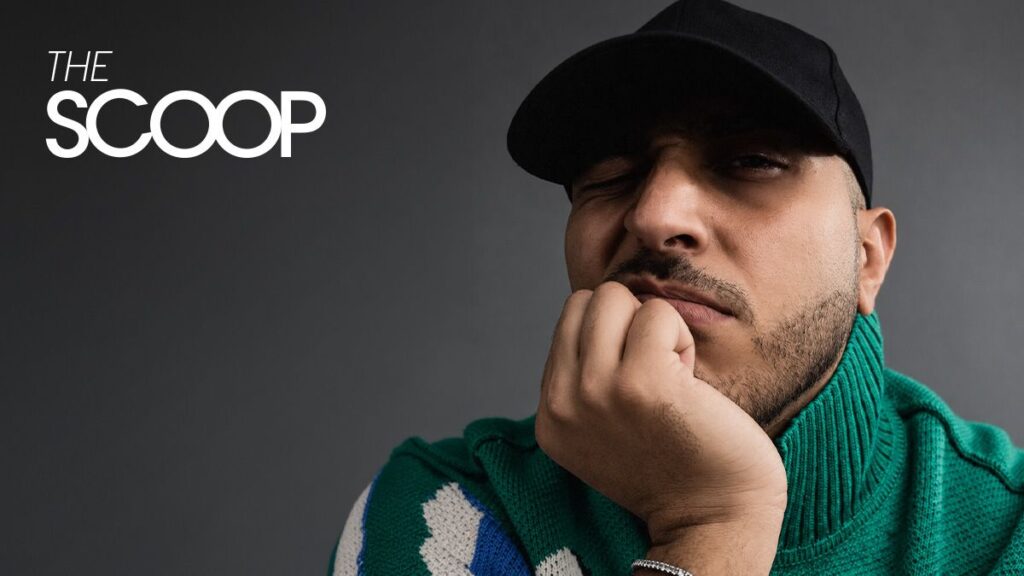
The Scoop With Osama Chabbi: On Directing His First Fashion Documentary
Welcome to the Scoop, a weekly email where I ask fashion insiders about the biggest stories of the week. It gives the Vogue Business community a chance to digest headlines and get a behind‑the‑scenes look every Friday. This edition features Osama Chabbi, one of the few post‑pandemic Instagram fashion commentators who actually has something substantive to say. Born in France, he moved to Dubai in 2018 and soon began working for Farfetch, first as a stylist for the platform’s Middle East campaigns and later on the private client side of the business.
Chabbi says the role never felt right for him; he felt too close to the company’s sales targets to truly enjoy the work. Yet his time among the elite consumers of fashion gave him insights that are hard to come by, such as how to break a collection into regional and age‑specific product ranges and what will actually sell.
While still at Farfetch, he started posting fashion‑show reviews on Instagram Stories alongside Vogue Runway images. The content attracted a following, and soon he landed two on‑camera interviews—first with Haider Ackermann and then with Kris Van Assche—that he filmed and shared on the platform. He discusses how those interviews happened, his thoughts on the protests in France, and his predictions for the latest designer moves in the interview below. He also reveals a new direction for his career.
**Hi Osama, what’s the scoop?**
“I’m directing my first documentary, and it is about my favorite designer. I can’t yet tell you who the designer is, but we will start filming in January, and it’s meant to come out next year. I’m working in partnership with a fashion‑centric streaming platform that’s going to be launching soon. Our film will be one of the platform’s originals.”
**I didn’t realize filmmaking was among your ambitions.**
“Me neither. Basically, I had the idea to do a sort of commemorative interview, in light of the anniversary of the designer’s death. I wanted to film a conversation with two figures who meant a lot in this person’s history. When I film my own interviews, I produce and direct them. I’m on set, involved with all the technical aspects—the shots, the framing, the lighting, the chairs, and what if the chair makes a weird noise. I was talking to someone on my team who handles our production, and she was like, ‘I think you have imposter syndrome. You’re actually a director.’ It was really nice to hear that and a wake‑up call. I decided to give it a shot and jump into something that’s longer than what I’m used to shooting, and obviously a bigger risk.”
Behind‑the‑scenes look of Osama Chabbi interviewing Loewe creative directors, Jack McCollough and Lazaro Hernandez. Photo: Courtesy of Osama Chabbi
**Can you give me a clue about who the documentary is about?**
“A little man with big ideas. I am interested in the idea of legacy. When I first started interviewing designers, the goal was really for these interviews to age well and eventually end up in exhibitions, museums, fashion schools. So I feel this is on the same path.”
**Who was your first interview?**
“I was just jobless and on Twitter, and I wrote that I really wanted to interview Haider Ackermann when he was guest designer for Jean Paul Gaultier. I received a call from the Jean Paul Gaultier PR team, and they said, ‘Haider would love to have coffee with you.’ I was in Dubai, and he was in Paris; I couldn’t afford it. But then I realized I had to make it work somehow, so I called them again and said: ‘Listen, if I can film this coffee meeting, I will come.’ I don’t know how, but he accepted.
Around the same time, I was pitching an article to i‑D, and they were asking for references and quotes. I made up that I had a quote from Kris Van Assche, who is another favorite designer of mine. I wrote to him on Instagram: ‘I’m so sorry. I literally just told i‑D I have a quote from you. Can you please send me a few words on so and so?’ I think he found it so hilarious that he actually did it. And then my next message was: ‘Apparently audacity goes a long way. Do you think I can come to your house next week to interview you?’ It’s so crazy that he said yes. And so it was two days between my interview with Kris Van Assche and the Haider interview.”
(Top) Osama Chabbi interviewing Haider Ackermann (Bottom) Osama with Kris Van Assche. Photo: Courtesy of Osama Chabbi
**What’s the lesson in this story? Do you need audacity to grow a platform?**
“The number one thing in my case was a utopian level of delusion, where you actually think that if you’re not going to ask for something, no one else is going to. Also, when you look at things from so much distance, it’s easier to take risks. Like when I messaged Kris, I genuinely was like, ‘Well, worst‑case scenario, I’ll just be left on read, or he’s going to have a laugh.’
I think my platform is a testimony to this. My focus has never been on making my Instagram the center of a scalable mass conversation. I was always fascinated by fashion’s larger‑than‑life personalities and had a precise niche of people I wanted to talk to and make sure they were fed with the right information to keep them educated and entertained. I had no interest in catering to people observing fashion from the outside as, like, this far‑fetched dystopian fantasy. I always knew I wanted to talk to people who live it, work it, breathe it. A lot of the people that follow me actually work in fashion. It makes things easier in a sense, because you start by assuming people know what you’re talking about.”
**I’m going to move to the newsy bit of the conversation. You grew up in Lyon. Do you have any thoughts on the student protests taking place at the moment in Paris?**
“I am in Dubai at the moment, so I have not witnessed the protests. But I …”