The Danse Macabre: Fashion’s Enduring Fascination With Death and Mortality
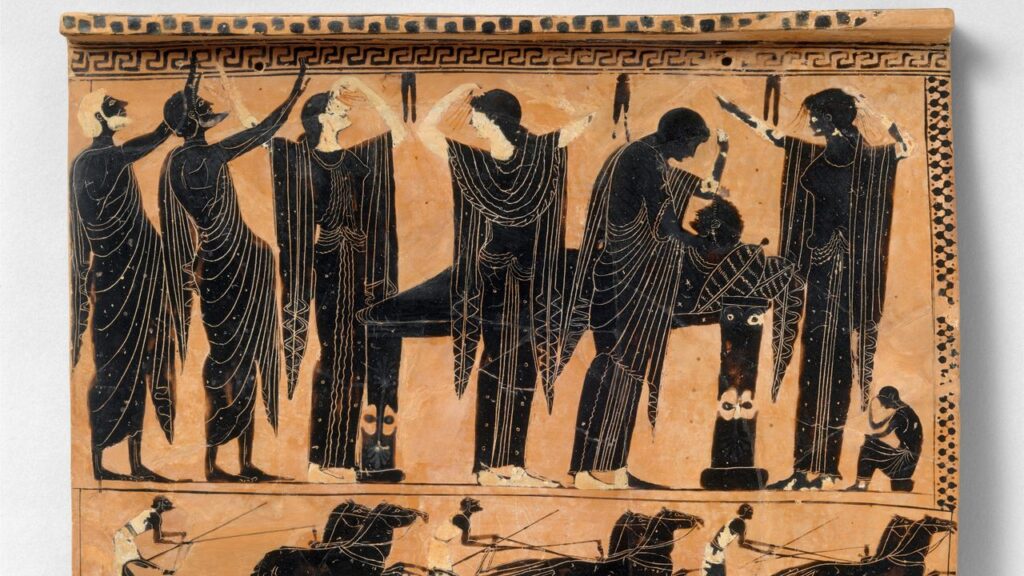
The first thing a newborn feels is the touch of cloth—a towel or blanket wrapped around its tiny body. In a similar way, textiles are among the last things that accompany us when we die, either as part of burial rites or as they decompose with the body. From mourning attire to rituals that preserve a loved one’s garments, fashion and death have been inseparably linked across cultures and ages.
“People don’t really talk about death. It makes us uncomfortable, and it’s actually one of the only guarantees in life,” says Dr. Denise Green, a fashion anthropologist, Cornell University professor, and director of the university’s Costume and Textile Collection, which holds more than 10,000 objects dating back to the 17th century. “I think that’s probably one reason why we manage our feelings related to it through the clothes we wear.”
Around the world, textiles help people navigate the transition from life to death. While studying the Hupacasath people of Vancouver Island, Green discovered a custom in which the deceased’s clothing is burned to free the spirit from the physical world. In Indonesia, the Toraja wrap their dead in layers of patterned funerary cloth, and ceremonial banners of fabric mark a path for the soul into the afterlife. In Ghana, the Asante have traditionally worn adinkra mourning cloths—large fabric wrappers stamped with symbolic designs using carved gourds and natural dyes—to express a link to ancestors.
Even after a person passes, the meaning of their clothing can shift dramatically. “I love how even in contemporary traditions, death can change the object biography of clothing, where somebody’s ratty T‑shirt that they wore every weekend then becomes the most prized possession for their grandkids or loved ones after they pass away,” notes fashion researcher Sephra Lamothe, whose doctoral work at Cornell explores fashion and death.
In Western societies, clothing developed a sophisticated visual language of mourning, using colors, fabrics, and accessories to signal grief. Ancient Romans wore dark wool togas called togae pullae, while medieval Europe cultivated a rich death culture that included the danse macabre—an image of Death leading people from all walks of life—and memento mori symbols such as skulls and skeletons. By the Renaissance, black garments, veils, and headdresses marked grieving aristocrats. As the merchant and middle classes grew in the 18th century, mourning fashions that once belonged to the elite spread more widely.
The Victorian era intensified these practices, especially after Prince Albert’s death in 1861 and Queen Victoria’s four decades of mourning. “Wearing the clothes was a way of saying that to people visually. It was a material, symbolic speech act that’s telling everyone, ‘This is where I’m at,’” Green explains. Widows first wore matte black crepe, concealed gowns, and heavily veiled bonnets, then gradually moved to silk, lace, jet jewelry, and softer shades of gray, mauve, and lilac. Mourning jewelry sometimes incorporated the deceased’s hair; Lamothe recalls Victorian hair chokers that let wearers feel “the last vestiges of the body of the deceased against your skin.” These rules could be as restrictive as they were expressive, particularly for women, who were expected to display their grief publicly according to strict social codes.
By the early 20th century, mourning attire had become a commercial industry, with ready‑to‑wear garments and accessories sold in department stores and catalogs. Yet as black entered mainstream fashion—most famously through Gabrielle Chanel’s little black dress of 1926—its association with mourning began to fade. “The appropriation of black into everyday dress has, in some way, removed the ability to identify people who are grieving out in the world,” Green says, “but it has also released people who are grieving from feeling like they have to wear black all the time.” Elaborate veils and rigid dress codes gave way to more personal expressions of loss, while black dresses and tailoring remained staple pieces.
Even as strict mourning dress rules receded, their influence lives on in Victorian‑inspired lace, veils, and the romantic darkness of modern gothic fashion. Designers continue to explore mortality on the runway, moving beyond traditional mourning to confront death, grief, and the afterlife through bold concepts such as Alexander McQueen’s 1996 “Dante” collection and Comme des Garçons’ 2016 “The Ceremony of Separation.” As Green observes, “Clothing is always about negotiating our anxieties about the future. That is what fashion is, right? That’s why fashion changes.” And what future is more certain, yet more difficult to contemplate, than death?