
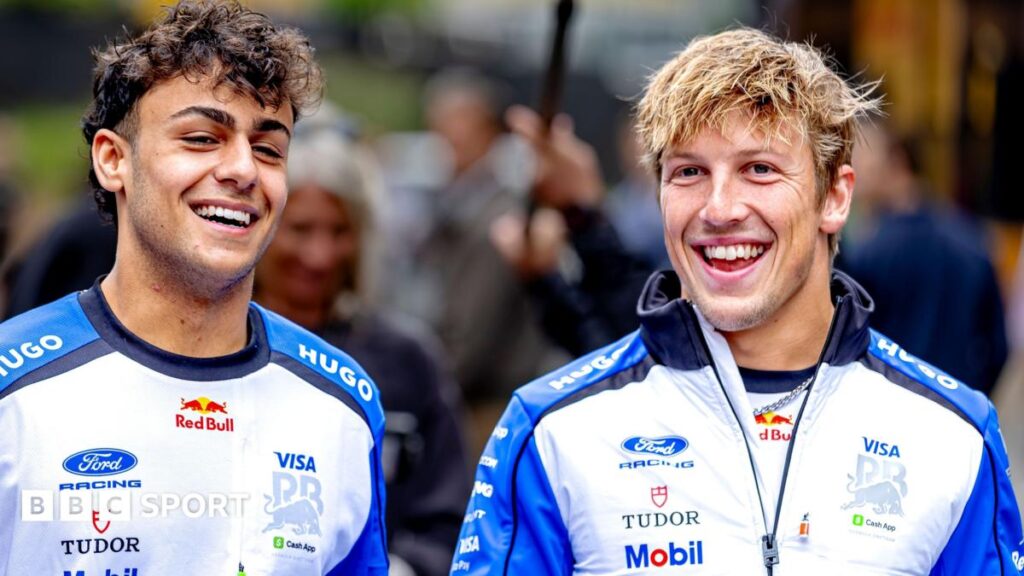
Racing Bulls’ 2027 driver line‑up still undecided, F1 Q&A tackles Lawson, Lindblad and newcomers
Liam Lawson and Arvid Lindblad sit eighth and eleventh respectively in the drivers’ championship, with 75 and 38 points, as the United States Grand Prix approaches in Austin. The race marks the first of six events that will decide the 2026 title, which Kimi Antonelli can still clinch by winning while his Mercedes teammate George Russell finishes ninth or lower and Ferrari’s Lewis Hamilton ends up fifth or lower, according to BBC F1 correspondent Andrew Benson.
**Will Liam Lawson retain his Racing Bulls seat for 2027?**
Racing Bulls is one of only two teams whose driver roster for next season has not been confirmed; the other is Haas, where Oliver Bearman’s status alongside new signing Rafael Camara remains pending. At Racing Bulls, the three‑driver dilemma involves current race drivers Liam Lawson and Arvid Lindblad and Red Bull junior Nikola Tsolov, who currently leads the Formula 2 championship. This is the first time in Red Bull’s history that Helmut Marko is not overseeing driver selection for the junior squad, leaving the team’s future approach unclear.
Historically, Marko and former team boss Christian Horner favoured a ruthless policy: give a driver a chance, and if results did not appear immediately, replace them. While that method aimed to secure world‑class talent for Red Bull, it often paired two unknowns, making performance assessment difficult. An alternative would be to keep a proven benchmark alongside a newcomer, allowing a clearer comparison.
Applying that logic, Racing Bulls could retain Lawson and Lindblad for 2027, assigning Tsolov a reserve role that includes simulator work and occasional testing in older cars to gain F1 experience. Lawson has been consistently faster in qualifying and races, while Lindblad’s debut season has shown flashes of promise. Giving Lindblad another year to consistently beat Lawson would provide a solid test of his suitability for a future Red Bull seat. Pairing Tsolov with Lindblad would create two unknown variables, which offers little insight for the senior team.
The final decision rests with shareholders Chalerm Yoovidhya and Mark Mateschitz, under the overall supervision of Red Bull CEO Oliver Mintzlaff, who oversees the Formula 1 programme.
**Why is Formula 1 moving to Rwanda despite concerns over human‑rights issues?**
Liberty Media, the sport’s owner since 2017, has long sought an African Grand Prix to complete a calendar that touches every inhabited continent and to tap a largely untapped market. Several locations have been explored, including a Tangier project in Morocco that lacked sufficient financing, and a potential return to Kyalami in South Africa that fell through due to promoter disputes. Currently, four separate South African projects—Kyalami and two in Cape Town—remain far from fruition.
Most Grand Prix events receive some form of government support, so it is not surprising that the Rwandan bid relies on state backing. The government and Formula 1 have emphasized that funding comes from a newly created development fund that blends public and private investment. Critics, however, label the move as “sportswashing,” accusing the sport of diverting attention from Rwanda’s political repression, limited press freedom and its military involvement in the eastern Democratic Republic of Congo.
Rwanda faces a case at the International Court of Justice brought by the Democratic Republic of Congo, alleging breaches of treaties covering genocide prevention, racial discrimination, women’s rights and torture. DRC Foreign Minister Therese Kayikwamba Wagner recently stated that while the DRC supports an African Grand Prix, it opposes Rwanda as the host, accusing President Paul Kagame of “fueling a devastating war” in the neighboring country, which has caused millions of deaths and ongoing suffering.