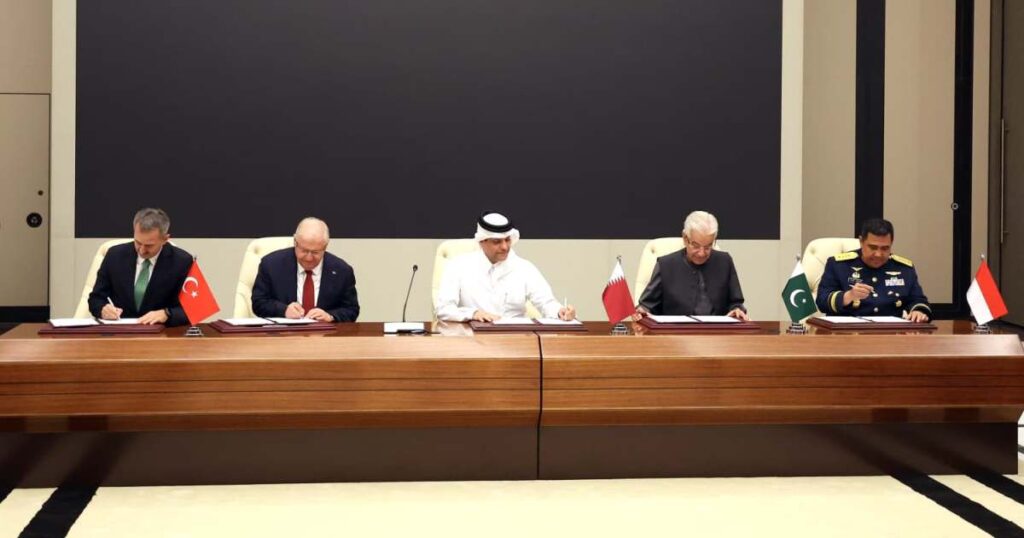
Qatar, Turkey, Pakistan and Indonesia Strengthen Defence Cooperation
Qatar, Turkey, Pakistan and Indonesia signed a memorandum of understanding in Doha on October 21, 2026 to deepen cooperation in their defence industries. The deal, known as the “Badr” project, builds on existing military collaborations and aims to create joint production lines, share technology and link supply chains more closely.
The agreement comes as the United States and Iran have failed to secure a lasting peace, prompting regional states to broaden their security networks and reduce reliance on Washington. Officials stress that the new partnership does not replace long‑standing alliances but seeks greater control over national security while reinforcing existing ties.
Arda Mevlutoglu, a defence industry analyst and managing director of Mergen Analytical Strategies, told Al Jazeera that the move could signal the formation of an interconnected web of defence and security arrangements stretching from the Gulf to South and Southeast Asia, rather than a single formal alliance.
According to a statement from Qatar’s Defence Ministry, the Badr memorandum “aims to foster cooperation in defence manufacturing, enhance capabilities among the four countries, and promote collaboration in technical training, research and development, thereby contributing to the creation of solutions and industries suited to modern defences.”
Under the pact each nation will contribute its own strengths. Turkey brings advanced technology, systems integration and a mature defence sector; Pakistan and Indonesia offer manufacturing capacity, skilled workforces and large domestic markets; Qatar adds investment potential and demand, Mevlutoglu explained. Together they could set up integrated supply chains that allow joint development, production and sustainment of defence systems. Such arrangements would let buyers play a larger role in producing and supporting their own equipment while giving manufacturers longer‑term orders and investment.
Albert Vidal, a research associate at the International Institute for Strategic Studies, noted that both Pakistan and Indonesia are prepared to buy Turkish weapons and locate part of the production locally. This could lower costs for Turkish firms, create jobs in Pakistan and Indonesia, and bring “financial depth” from Qatar, he said.
Turkey already maintains defence manufacturing links with each of the three partners separately. A bilateral defence industry memorandum between Qatar and Turkey was signed in October 2025. The new multilateral agreement, according to Vidal, reflects a strategic calculation as well as an industrial one, giving each country a stake in the others’ security. He cited Qatar’s decade‑long investment in Turkey’s defence sector and Ankara’s deployment of forces to Doha during the 2017 diplomatic crisis as examples of deepening ties.
Existing projects illustrate the growing cooperation. Pakistan’s naval manufacturing programme with Turkey includes four ships, two to be built in Istanbul and two at Karachi Shipyard. Indonesia and Turkey are jointly constructing a tank. “The rationale is to streamline these distinct defence export and joint production agreements under a more structured and resilient networked hub, rather than reinvent the wheel with each new defence agreement,” said Burcu Ozcelik, a senior research fellow at the Royal United Services Institute.
Regional security concerns have risen following the US‑Israeli conflict with Iran and recent Houthi attacks on Saudi Arabia. Reported shortages of US weapons have added urgency to efforts aimed at strengthening existing partners and boosting domestic arms‑building capacity. Mevlutoglu said diversification is a key driver, noting that recent conflicts have exposed vulnerabilities linked to dependence on foreign suppliers, technology restrictions and supply‑chain disruptions.
He cautioned, however, against reading the memorandum as a break with Washington. “Qatar is unlikely to abandon its strategic relationship with the United States, while Turkey seeks greater technological independence within NATO, not autonomy from it,” he added.
Bader Mousa Al‑Saif, an associate fellow with Chatham House’s Middle East and North Africa Programme, also highlighted the importance of these emerging collaborations in the current security environment.