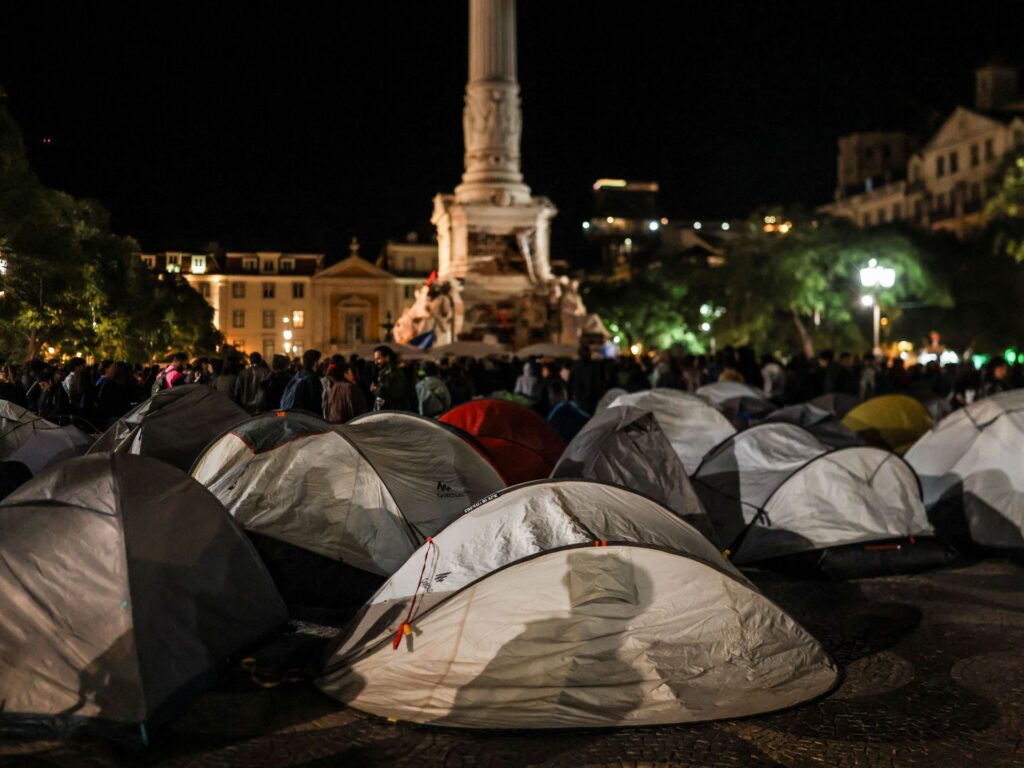
Portugal protestors return to cleared housing‑crisis camps after police evictions
Thousands of demonstrators reconvened in Lisbon’s Rossio Square and Porto’s Dom João I Square on Tuesday, hours after police dismantled their makeshift camps and arrested 55 people. The activists are demanding that the centre‑right government withdraw a bill that eases evictions and ends rent caps on new leases, a measure that has already passed its first parliamentary reading.
Organisers reported that more than 1,000 participants gathered at each location. In Lisbon, protesters have occupied Rossio Square since Saturday, erecting around 200 tents, while in Porto the encampment at Dom João I Square has been in place for roughly ten days.
Debora Miranda, a 41‑year‑old communications consultant, told Reuters she joined the Rossio protest to give voice to generations burdened by soaring costs. “If people don’t feel at home, in every sense of the word, they can’t move forward with their lives… enough is enough,” she said.
The camps echo similar housing protests in neighboring Spain and coincide with unrest over rising living expenses in France, Belgium and Italy. Shortly before 6 a.m., after warning that the settlements were illegal, police launched coordinated operations in both cities. In Porto, demonstrators complied with orders and dismantled their own tents. In Lisbon, officers cleared Rossio Square in a manner described by camp spokesperson Carla Valadao as “very aggressive.” Public Security Police superintendent Sergio Soares told reporters the eviction was “calm, proportionate and appropriate, with no police charge.” All 55 detainees were later released pending a court appearance scheduled for Wednesday in Lisbon.
Portugal is confronting one of Europe’s most severe housing‑affordability crises, with purchase prices more than doubling since 2017 and rents for new leases nearly doubling in the same period. Jorge Paixão, a 19‑year‑old history student, called the situation “a societal crisis,” adding that his generation needs “the ability to live with dignity, start families and rejuvenate Portugal.” The pressure is most acute in the major cities, where residents also oppose excessive tourism and the influx of digital nomads who work remotely while traveling.