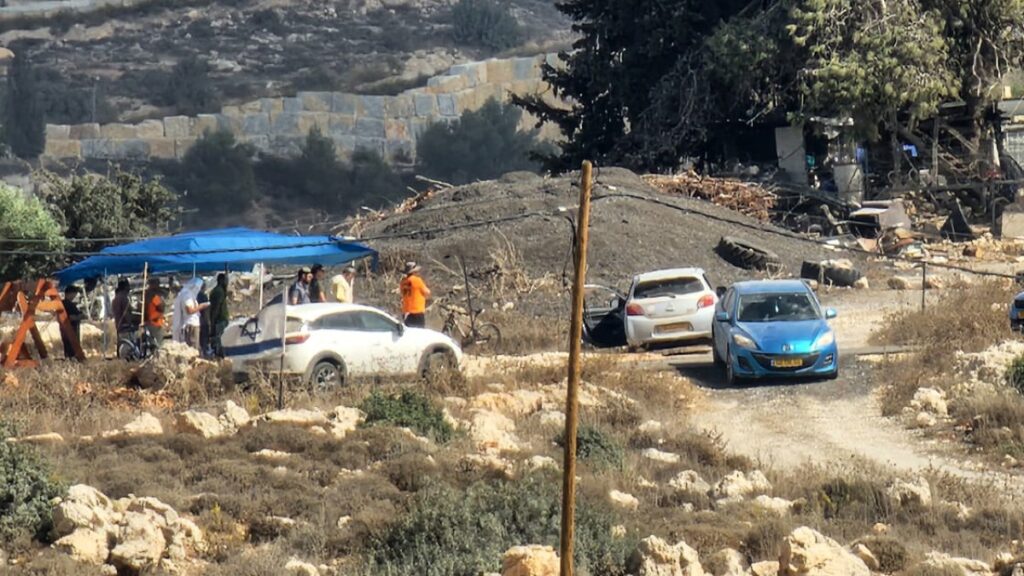
From a single house to whole villages: Israeli settlers encircle Palestinians
Yousef Shanaran, 52, dug a well beside his home in the South Hebron Hills, but since October 5 the well has been out of reach. Israeli settlers have surrounded his family’s house in Wadi Rakhim, a once‑quiet spot of limestone rocks and thorny scrub, preventing them from leaving the property even to fetch water. It took five days for the Israeli army to arrange a brief window for the family to draw water after they ran out three days earlier.
Shanaran, who built a two‑storey house in 2016 on land between the Palestinian town of as‑Samu and the village of Susiya, also planted around 70 grapevines and 30‑40 olive trees. “There is no food,” he told Al Jazeera by phone. “My well is full of water; I built it and lost money on it. They keep me away because they want to drive me out of my house.”
More than six months ago settlers set up a tent about 300 metres (roughly 1,000 feet) from Shanaran’s residence, restricting the family’s movement and exposing them to intimidation. On October 5 the tent was moved to within 30 metres of the house, and about 50 settlers attacked the family with sticks and pepper spray, marking the start of a full‑scale siege.
Nasser Nawajeh, a veteran B’Tselem field researcher who now leads the Susiya village council in Masafer Yatta, has tried repeatedly to bring aid to the Shanaran family, but most attempts have been thwarted. “When I tried to deliver supplies, the settlers attacked immediately,” he said. “They are there twenty‑four hours a day to attack.”
No one can enter or leave the home without permission from the army. “This is a displacement policy,” Nawajeh said. “If the children need to go to school we must wait for the army to escort them. If we want to bring in food or water we have to coordinate.” Since October 15 the family has repeatedly asked the army for such coordination, receiving daily excuses: “The army is busy, there are no forces, we’ll come tomorrow.”
According to Nawajeh, the settlers are organized into rapid‑response squads known in Hebrew as Kitat Konenut, while the regular army occasionally arrives, dismantles the settlers’ tent and then departs, allowing the tent to be re‑erected. Shanaran describes the soldiers posted outside his house as idle. “They sit, eat and drink at the door, relaxed,” he said.
Nawajeh argues that the soldiers’ presence effectively gives settlers a green light to continue the blockade. “Sometimes the soldiers do not stop the settlers from approaching; they even sit with them at the door,” he noted. Because the house lies in Area B, which is supposed to be under joint Israeli‑Palestinian control, the army could arrest the settlers under an existing closure order, but the law is not enforced.
The soldiers claim their role is to protect the family from violence, yet the reality, according to Nawajeh, is that the Palestinians are trapped inside a prison‑like siege. “Prison ends. Here you sit in your own house and they lock you in, and you live in fear,” Shanaran said.
Nawajeh warned that the Shanaran home is the nearest Palestinian dwelling to the expanding settler outposts, and that settlers do not differentiate between Areas A, B and C. “They start with the house on the edge. If they drive out the first house, they drive out the next,” he explained. This strategy is now being applied throughout Masafer Yatta, an area in the southern West Bank that has faced repeated settler and military assaults.
Similar sieges have occurred in other West Bank locales, such as Jalud, where the Tubasi family was forced out in July and attacked again in September when they tried to return under a court order, and Qusra, where settlers surrounded three homes, including one owned by an American citizen, before the army set up a barracks beside the houses. B’Tselem’s Yair Dvir believes the Qusra case attracted broader attention because one of the residents held U.S. citizenship, noting that “these attacks happen constantly across the West Bank.”
Settlers have now established more than 400 outposts throughout the occupied territory, using control of hilltops and roads to isolate Palestinian homes and communities. Dror Etkes, co‑founder of the settlement‑monitoring organization Kerem Navot, said that the doorstep sieges illustrate an advanced stage in the collapse of any remaining Palestinian presence in the area.