
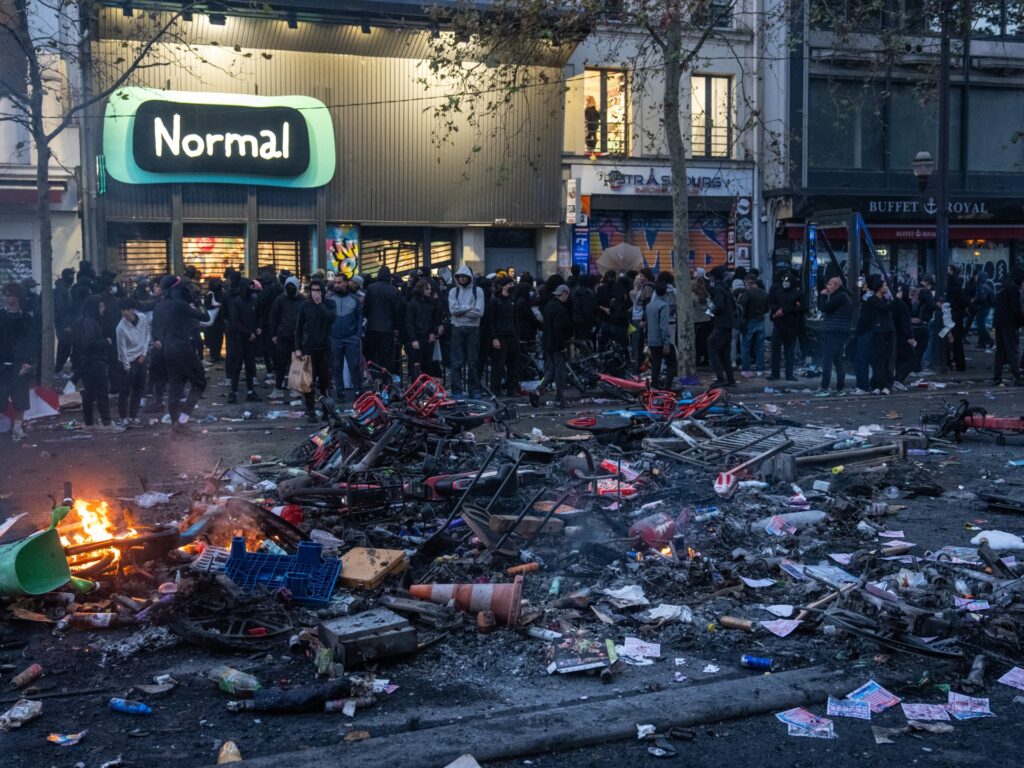
French protests threaten Macron’s centrist base ahead of 2027 election
Paris – After a wave of nationwide demonstrations turned violent, President Emmanuel Macron addressed the nation on Sunday night, trying to balance empathy for students demanding education reform with condemnation of the rioters. “Those who have destroyed property must pay. Those who have looted must reimburse their victims. Those who sought to bring down the republic will be held accountable,” he said.
The president’s remarks, however, left many young protesters unsatisfied. Yanis, a 20‑year‑old from the southeastern suburb of Ivry‑sur‑Seine, dismissed the speech as “the usual bla bla bla without anything concrete.” He added, “We’ll be back on the streets anyway. There will be one demonstration after another until something changes – every weekend, without a break.”
The unrest comes months before the 2027 presidential election and has intensified political divisions. Populist‑left leader Jean‑Luc Mélenchon has embraced the student movement, while far‑right firebrand Marine Le Pen has framed the disorder as a security crisis. Centrist Prime Minister Sébastien Lecornu has blamed the extreme left for inciting violence as a “warm‑up round” for the election.
Polls suggest that both the far left and the far right could play pivotal roles in the upcoming vote. Macron, now completing his second term, is constitutionally barred from running again and will have to step aside after the election.
“Candidates have no choice but to take a stand and address young people,” said political analyst Beligh Nabli, a professor of public law at UPEC‑Paris XII. “They have a political obligation to deliver a message that is not empty but actually answers their demands.”
Students who began protesting in mid‑September have called for better schools, more teachers and a fairer system. The movement quickly spread beyond campuses, tapping into broader social and economic concerns. Analysts note that the protests have forced these issues into the political spotlight, something that might not have happened given the traditionally low electoral participation of young voters and the focus of campaigns on older demographics and pension reforms.
“The mobilisation broke the usual business‑as‑usual attitude,” Nabli said. “Candidates would have shown relative indifference toward young people because they are not the group that mobilises most in elections, unlike those over 60.”
La France Insoumise (LFI), the left‑wing party led by Mélenchon, has strongly supported the student protests, prompting critics to accuse it of exploiting youth anger for political gain. The party’s platform already addresses many of the protesters’ demands, including increased investment in education, higher teacher salaries and the abolition of Parcoursup, the online system used for university applications that many view as opaque.
An OpinionWay poll for Les Echos released on Thursday showed Mélenchon leading among voters aged 18 to 24, with 49 percent support – a ten‑point rise since 2022.
For some demonstrators, backing Mélenchon is both a rejection of the far right and a protest against the political centre. “I’m going to vote for La France Insoumise to counter the far right, the National Rally, and the centre, which is basically going to give us a repeat of Macron’s policies,” said Lydia, a 21‑year‑old student at the École du Louvre who participated in a protest at the museum on Monday. She cautioned that she does not expect the party to solve all of France’s problems and criticized the demonisation of LFI, noting that even moderate left‑wing positions are increasingly labelled as extreme. “It’s becoming rather exceptional to have empathy; it’s becoming something extreme left‑wing,” she added.
On the opposite side, Le Pen and her National Rally have turned the unrest into a law‑and‑order issue, accusing the government of failing to maintain control and blaming Mélenchon for stoking the violence. Le Pen remains the frontrunner in the presidential race with 32 percent support, while the National Rally ranks second among voters aged 18 to 24, behind La France Insoumise.
“Yesterday, you saw our cities, our streets, and our country mistreated, battered, and looted,” Le Pen said in a video message on Sunday night. “We are experiencing a profound crisis of trust and authority – one that poses a threat to our democracy.” She added that France was “caught in a vice – effectively held hostage – between violence and powerlessness”.
Caught between these competing narratives is the centrist bloc of Macr