Federal Constitutional Court Strikes Down Sindh and KP Infrastructure Cess in Win for Importers
ISLAMABAD: The Federal Constitutional Court on Thursday struck down the infrastructure cess charged by Sindh and Khyber Pakhtunkhwa, ruling that the two provinces never had the constitutional power to tax goods moving in and out of the country. The decision, announced in Islamabad, is a major win for the importers, exporters and manufacturers who have paid the levy for years, and it settles a dispute that has run for more than three decades.
A two-member bench headed by Chief Justice Aminuddin Khan, with Justice Aamer Farooq, set aside the judgments of the Sindh High Court and the Peshawar High Court that had upheld the two cesses. The court held that the Sindh Development and Maintenance of Infrastructure Cess Act, 2017, and the Khyber Pakhtunkhwa Infrastructure Development Cess Act, 2022, along with the changes made through the KP Finance Act, 2024, were beyond the legislative competence of the provinces. The bench was deciding 568 petitions filed by private businesses.
A tax dispute that began in 1994
Sindh first imposed an infrastructure cess in 1994, and the levy was later governed by the 2017 Act, which applied with retrospective effect from July 1, 1994. When businesses challenged it, the Sindh High Court upheld the levy in a judgment dated June 4, 2021. In Khyber Pakhtunkhwa, the Peshawar High Court dismissed 157 petitions and upheld that province’s cess on November 14, 2025. Appeals against both judgments were first filed in the Supreme Court and later transferred to the Federal Constitutional Court, which announced its reserved judgment on Thursday. The court read out a short order, and the detailed judgment will follow.

Why the court ruled against the provinces
At the heart of the case was a question of who can tax trade. The petitioners argued that a cess on goods entering or leaving the country is, in substance, a customs duty, and customs duties belong to the federation alone. They said the provincial levies were disguised export duties that encroached on the federation’s exclusive domain and interfered with the movement of goods across provincial boundaries. The court accepted that argument, holding that taxing imports, exports and customs related transactions falls outside provincial powers.
That reasoning matters beyond the two provinces. It draws a firm line between provincial taxation and federal control over trade, a line that businesses say provinces have tested repeatedly. The ruling also shows the new constitutional court moving quickly on transferred cases, deciding a batch of 568 petitions that had travelled from the high courts to the Supreme Court and then to the FCC.
What happens to the money already collected
The short order answers the question of power, but the money question is still open. Sindh collected the cess for decades, and Khyber Pakhtunkhwa for years, so the detailed judgment will be watched closely for what it says about refunds and about the amounts already paid. Importers will also want to know whether collection stops immediately and whether the provinces will ask the court to review the decision.
For now, the immediate effect is clear. A charge that added to the cost of nearly every container passing through the ports has been declared unlawful, and the provinces that relied on it must find another way to pay for the infrastructure it was meant to fund. The federal government, which has long argued that trade taxes are its domain, has won the principle. The bill for the past is still to be settled.
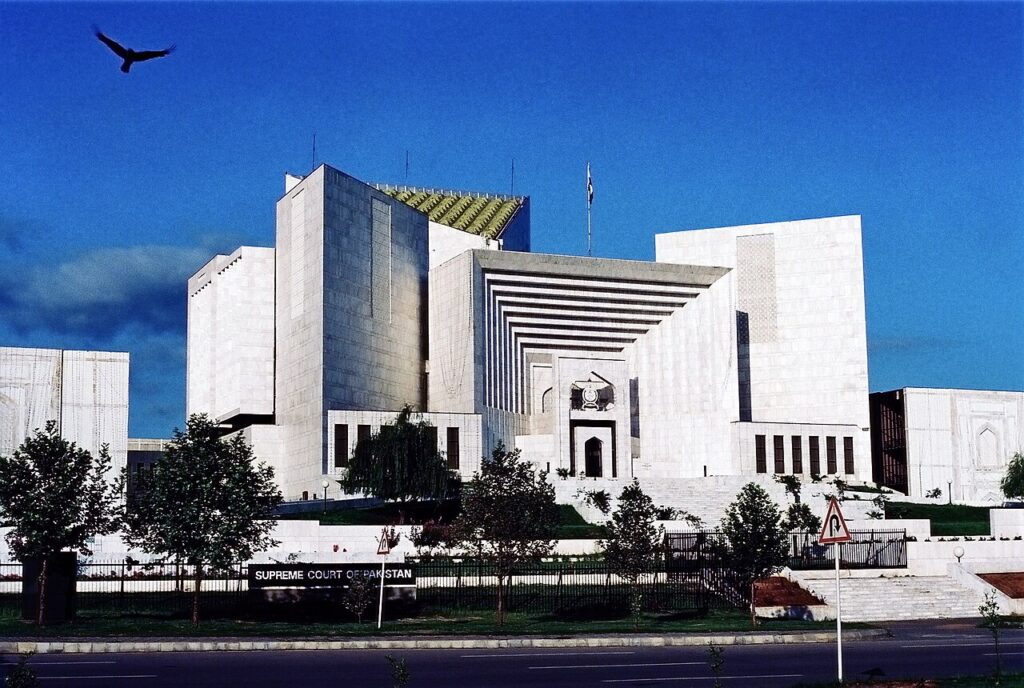
Featured image: The Supreme Court building in Islamabad. The Federal Constitutional Court announced its judgment in the capital on Thursday. Photo: Usman Ghani, Wikimedia Commons (CC BY-SA 3.0).
Sources: Dawn, The Express Tribune, Business Recorder, 19-20 November 2026.