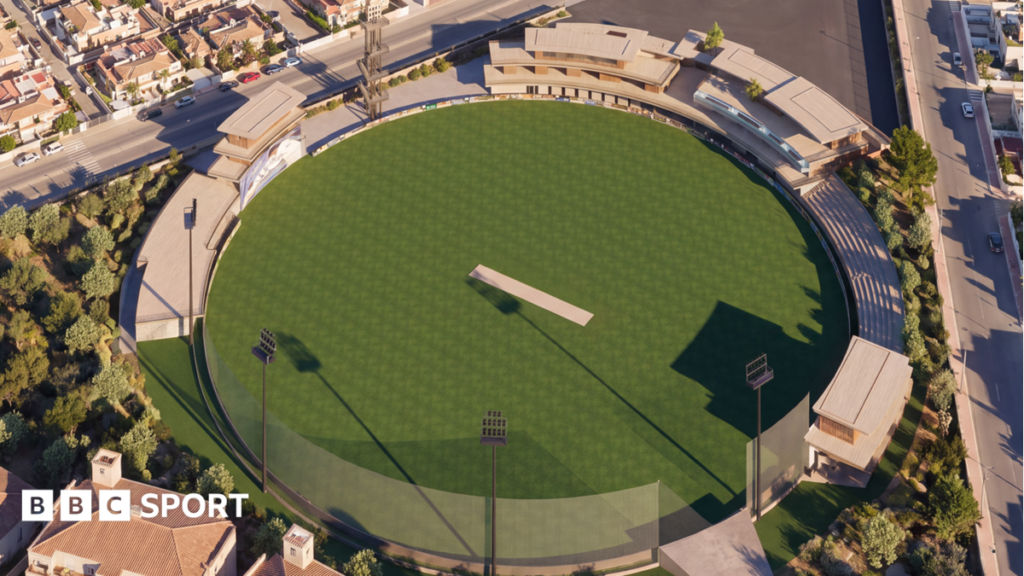
Eco-friendly Spanish cricket stadium aims for Test match
Australian entrepreneur Daniel Weston is overseeing the construction of a high‑tech cricket venue in Playa Flamenca on the Costa Blanca, a short 45‑minute drive from Alicante. The ground, to be called Campo Maximo, is being designed as one of the world’s most sustainable cricket facilities, with solar panels and rain‑water harvesting built into its infrastructure.
Weston told the Stumped podcast that he hopes the venue will one day host a Test match. “I’d love a Test match to be held there,” he said. “If I can build a place which ends up attracting Test cricket and lovers of Test cricket, that would be special.” He also believes the Indian Premier League could eventually tour Spain, much like the NFL does in other countries.
The most innovative element of Campo Maximo will be its outfield. Engineers are developing a new type of artificial grass specifically for the stadium. The synthetic turf, still in testing, is described as a short‑pile surface without loose granular infill, laid over an elastic pad and a specially designed drainage layer. The aim is to replicate the feel of natural grass while cutting maintenance costs and eliminating the need for fertiliser. Weston is confident the artificial outfield will be “better” than natural grass for cricket and that floodlights will allow play “365 days and nights a year”. He added, “I was up there in the lab last week. We’re using bowling spikes, the toughest cricket shoes, simulating the fast bowlers pounding into it. It’ll be consistent, you won’t have dips and you won’t have places where water accumulates. I think the future will be artificial outfields.”
Weston, best known as the driving force behind the European Cricket Network, played T20 internationals for Germany after moving to Munich in 2007. The 43‑year‑old Western Australian first imagined his own “field of dreams” when his artist father gave him a painting of the WACA in 1989, when he was six. He is now finalising details for a nine‑pitch square at the Spanish site and, drawing on his Perth roots, prefers a clay‑based pitch.
Campo Maximo will initially accommodate 1,000 spectators, but its modular design allows for temporary or semi‑permanent stands to increase capacity. The first ball is slated for 2028, with full operations expected in 2029. Plans also include a hotel and a nearby golf course.
Sustainability is a core focus for Weston. “I’m big into sustainable renewables. I want to think 20, 30, 50 years ahead,” he explained. Around 4,600 square metres of solar panels will sit over the car park, feeding batteries that power the floodlights and other facilities. Water recycling is also a priority; tanks capable of holding 100,000 cubic metres will sit beneath the field to store rainwater, addressing Spain’s water‑scarcity concerns.
Holding a Test match in Spain is becoming less speculative. English counties already use Desert Springs Cricket Ground in Almeria for pre‑season training, and Yorkshire played Somerset there in March as part of County Championship preparations. While Cricket España is an ICC Associate member, the ICC’s regulations do not forbid a Test between two full‑member nations on Spanish soil, provided both boards agree. Campo Maximo would need to meet the ICC’s venue standards, but the governing body already permits hybrid or fully artificial outfields, and the MCC’s Laws of Cricket contain no requirement for natural grass. The stadium would simply have to demonstrate that its surface poses no injury risk.
Sangria, tapas and cricket under the Spanish sun could soon become a reality if Weston’s vision comes to fruition. The full interview with Daniel Weston is available on the Stumped podcast via BBC World Service, ABC and Akashvani.