Canada pushes LNG expansion amid criticism over human‑rights and environmental concerns
Canada is betting on a larger role in the global liquefied natural gas market, but the move has drawn scrutiny over the track record of several major investors. LNG Canada, which began operating in mid‑2025 in Kitimat, British Columbia, is the country’s first large‑scale export plant. In late September the company approved a $33 billion expansion that will double its output in the coming years.
The Kitimat facility has struggled with its flaring system since commissioning started in late 2024. In 2025 a fault in the main flare stack caused the plant to burn about 350 million cubic metres of gas, making it one of the world’s biggest sources of flaring emissions. “The flaring noise was on a whole other level when they were first getting started up,” one resident, who asked to stay anonymous, told Al Jazeera. “It was just huge, way bigger than I think it was supposed to be.” Another local said, “I am devastated about the changes to my home territory. I can’t always see the stars like I used to from my parents’ place here. My friend returned temporarily, and her asthma has been much worse.” Residents asked not to be named because Kitimat is a small town where the project is a major employer and donor to community groups.
Political backing for the venture has grown as Canada faces trade pressure from the United States. Since President Donald Trump’s administration imposed tariffs on Canadian steel, lumber and aluminium in 2025, and added a further $20 billion worth of duties on products such as wine, dairy and textiles in August, Ottawa has pursued new trade agreements and domestic infrastructure projects to diversify its markets.
Prime Minister Mark Carney’s government recently placed LNG Canada and the Ksi Lisims LNG project on its list of major projects, promising strong federal support. The newly created Major Projects Office, a dedicated agency, is meant to speed up infrastructure deemed of national interest. “Canada is building big again,” Carney said at a news conference in Vancouver after the announcement. “A year ago, the federal government referred LNG Canada Phase 2 to our Major Projects Office. One office. One point of contact. One goal: get to the right decision, rapidly and efficiently. Working with Shell and LNG Canada, British Columbia and First Nations, we have accomplished exactly that.”
Marc Lee, senior economist at the Canadian Centre for Policy Alternatives, argued that the economics of oil and gas over the next decade or two are the real driver of these decisions, and that the government appears indifferent to the conduct of the companies involved abroad. “None of that matters to the federal government,” Lee said. “It’s all about investment.” He added that the trade dispute with the United States is being used to fast‑track projects at the cost of environmental safeguards and community health. “I don’t think it’s part of some broader strategic game around diversifying from Trump or supporting the energy transition,” Lee explained, noting that the LNG plans predate Trump’s first term. “It’s just pure growth and extraction for very short‑term benefit and long‑term costs. We’re essentially promising to liquidate this resource that should be the inheritance of British Columbians for hundreds of years into the future, and we’re squandering it all at bargain‑basement prices.” He likened the situation to a bicycle that must be constantly pedaled to stay upright, saying governments are chasing continual new capital.
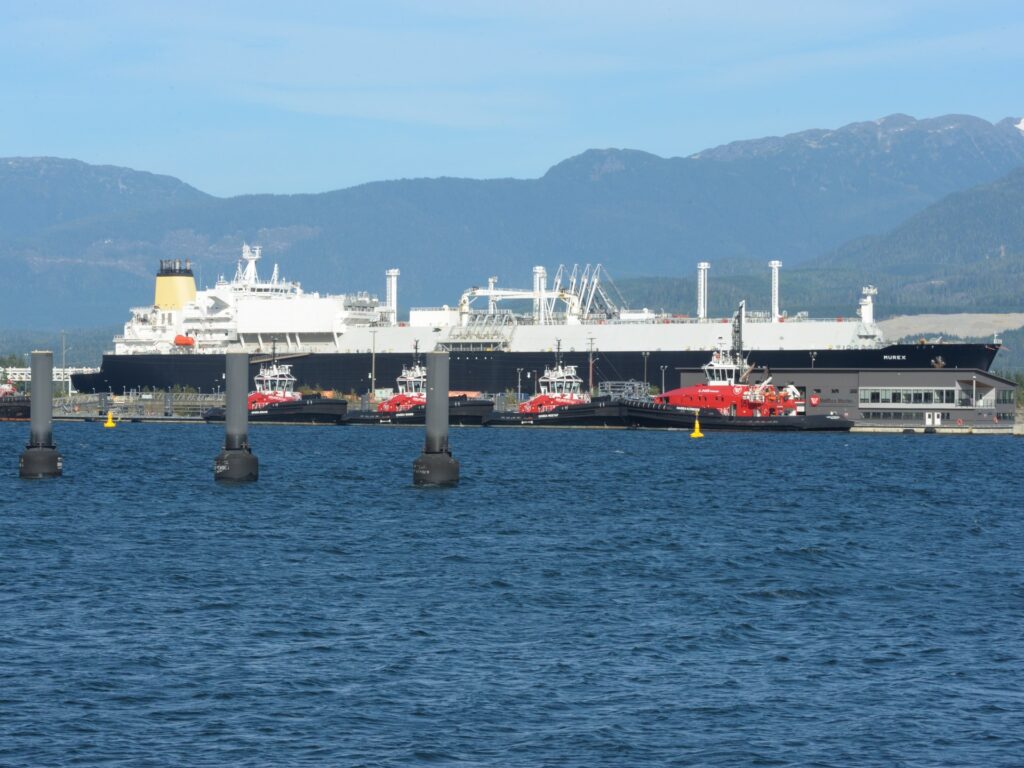
Carney’s office declined an interview request and directed questions to the Privy Council Office, which did not respond before publication. Construction on the expansion, which includes five new compressor stations on the Coastal GasLink pipeline that feeds the export plant, is set to begin immediately. An LNG tanker was photographed alongside the Kitimat dock in September 2026.
The companies tied to the two projects have histories that include environmental damage and alleged human‑rights violations, raising concerns about the broader impact of the expansion. Since the plant’s early days, technical problems have led to significant flaring, and local residents say they were unaware of the scale or nature of the issue.