
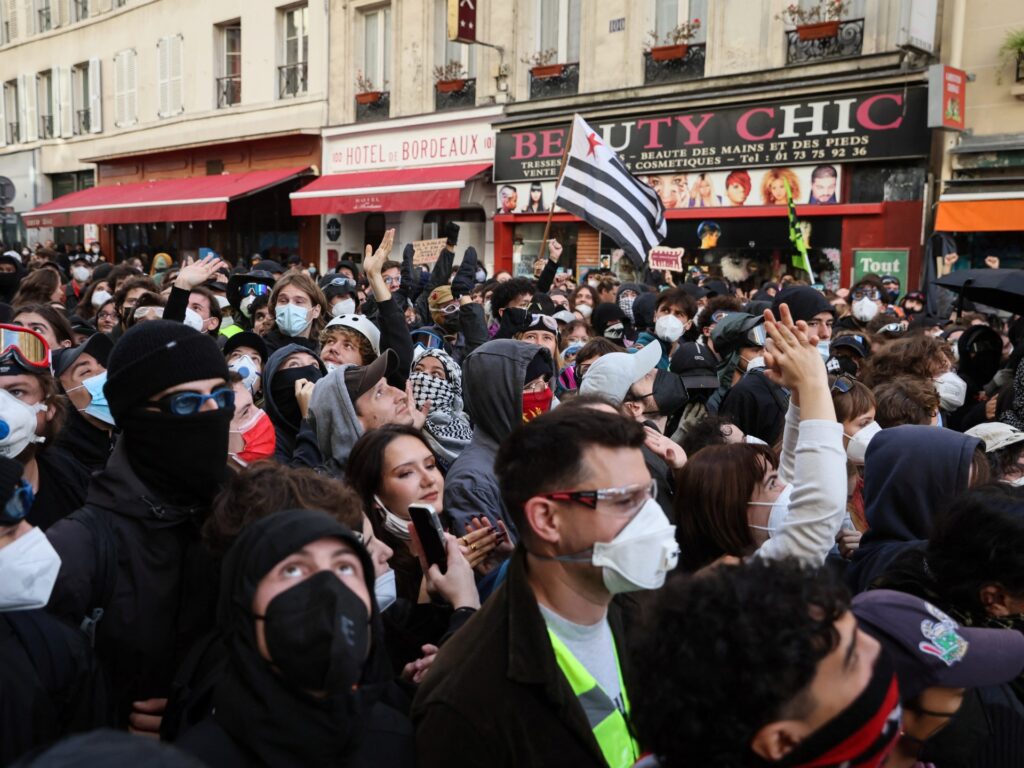
Protests spread across France as “yellow vest” activists prepare to join
Paris, France – Saturday could bring a wave of coordinated demonstrations, according to Le Monde, as France readies for possible nationwide actions that would unite high‑school students, trade unions and “yellow vest” protesters. The unrest began in mid‑September at a high school in the Paris suburb of Créteil, where pupils took to the streets over crumbling buildings, overcrowded classrooms, teacher shortages and what they describe as a deeply unequal education system.
Since then, the movement has expanded to thousands of lycées across the country and is now reflecting broader anxieties in a nation dealing with fiscal pressure, stagnant growth and rising social discontent. Teachers, trade unions and university students have joined the cause, and on Saturday some “yellow vest” activists – the remnants of the grassroots cost‑of‑living protests that shook President Emmanuel Macron’s first term in 2018 – have called for supporters to stand with the students.
“High school students are fighting for their future. Workers are fighting to earn a living from their labour. Retirees are fighting to preserve their dignity. Our paths may differ, but our concerns can converge,” said Jérôme Rodrigues, a well‑known “yellow vest” activist, in a video message released last week urging people to join Saturday’s demonstrations.
Authorities describe the unrest as among the most violent in decades, noting that more than 900 police officers have been injured since the protests began. Critics, however, argue that a minority of demonstrators resort to violence and that the actions of a few risk eclipsing the broader grievances. The government has also faced criticism for detaining thousands of minors and using force against young protesters. Reports published this week indicate that more than 6,700 children have been taken into police custody since mid‑September.
Human‑rights lawyers say several teenage students have suffered severe injuries. A 15‑year‑old lost a hand when a stun grenade exploded outside a school in Lens, and a 16‑year‑old in Tours lost his sight after being struck by a rubber bullet. Fears of further clashes persist.
“This is a moment of fatigue in the country,” Prime Minister Sébastien Lecornu said on Thursday. “We are in an atmosphere of perma‑crisis: wars, inflation and issues surrounding purchasing power.” The government has accused the far‑left France Unbowed (LFI) party of inflaming the protests, a charge the party denies.
While France has suspended the use of stun grenades at student demonstrations, Interior Minister Laurent Nunez said on Friday that police are authorised to deploy them in cases of “urban violence”. He also expects a “fairly significant” turnout on Saturday.
Social‑media calls for members of past protest movements to join the current wave have been circulating for weeks. The website 17octobregiletjaune.net, which monitors “yellow vest” actions, listed more than 1,750 planned protest sites across the country.
In an attempt to calm student anger, the government scrapped plans to raise certain higher‑education registration fees and pledged to deploy 3,000 substitute teachers to high schools. It also launched a national online survey to gather pupils’ concerns. Mathieu Roger‑Lacan, a French literature teacher in a disadvantaged area and author of *A Language of One’s Own*, argues that these steps do not address the deeper problem: an education system that fails to provide equal opportunities.
“If you have a pool that is leaking, the answer should not be to put more water into it but to work on its structure – and that costs money too,” he said, emphasizing that the issue is not merely how much France spends on education but how those resources are allocated. A government report released this week noted that 32 percent of the education ministry’s budget for next year will go toward pensions for retired civil servants.
Students are not only protesting deteriorating school facilities and crowded classrooms; they also voice a deeper anxiety about their futures. For many, a diploma no longer guarantees stable employment or social mobility. This concern is heightened by worries over the quality of education, as evidence shows persistent weaknesses in French students’ academic performance. In September, the Organisation for Economic Co‑operation and Development reported that French 15‑year‑olds’ results in mathematics and reading had fallen to some of the lowest levels on record.
“There is a gap between the diploma we give at the end of school, which is given to a huge part of the population, and the reality around us, which is that many of these young students have great difficulties even in writing French,” Roger‑Lacan said.