
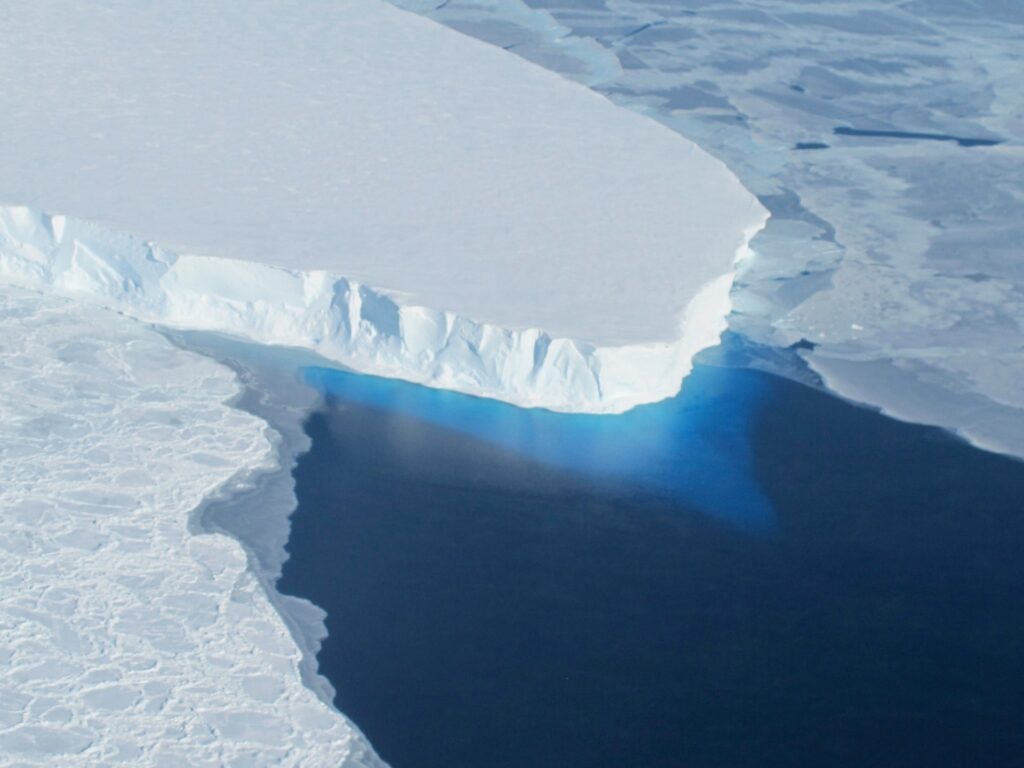
Senegal‑sized Antarctic glacier melting faster than expected, raising sea‑level concerns
A new study shows that the Thwaites Glacier in West Antarctica is losing ice more quickly than scientists had predicted, potentially contributing twice as much to global sea‑level rise over the next century. The research, published in Nature Communications, indicates that warm ocean water is infiltrating beneath the glacier and accelerating the melt of its core, a process that could add about 1.2 inches (30 mm) to sea levels even if global warming does not intensify.
The investigation was a collaboration between glaciologists at the University of California and NASA’s Jet Propulsion Laboratory. Satellite imagery from the European Space Agency, annotated by marine geophysicist Robert Larter, shows research vessels operating near the glacier’s ice shelf in 2020, an area scientists believe may break apart within the next two decades.
Thwaites, often called the “Doomsday Glacier,” spans roughly 192,000 sq km—about the size of Senegal and larger than the U.S. state of Florida. Located on the Walgreen Coast of Marie Byrd Land, it forms part of the West Antarctic Ice Sheet, which is fourteen times larger than Thwaites itself. First mapped in 1947 and named for glaciologist Fredrik T. Thwaites, the glacier has been monitored since the 1980s because of its rapid melting.
Because of its size, a collapse of Thwaites would raise global sea levels dramatically, although researchers expect such an event to occur decades or even centuries from now. Together with nearby glaciers such as Pine Island, Thwaites acts as a buttress that holds back the vulnerable West Antarctic Ice Sheet. If that ice sheet were to melt, many coastal cities worldwide could be submerged. Today, ice loss from Thwaites accounts for about four percent of total global sea‑level rise. Since 2000, the glacier has shed more than 1,000 billion tonnes of ice and continues to lose roughly 50 billion tonnes each year.
Scientists attribute the accelerated melting primarily to warm ocean water reaching the glacier’s base. Human‑driven climate change, especially the burning of fossil fuels, is warming the seas. A 2019 NASA study identified a massive underwater cavity beneath Thwaites—about two‑thirds the size of Manhattan—that appears to speed up thinning. The European Space Agency reports that glaciers have lost around five percent of their ice since 2000 due to rising temperatures.
The latest research employed new computer models that provide a clearer view of melt activity at the glacier’s grounding line, the point where ice transitions from resting on bedrock to floating as an ice shelf. Instead of treating the grounding line as a fixed boundary, the UCLA team introduced the concept of a broader “grounding zone.” In this zone, tidal pumping lifts and lowers the ice, allowing warm water to penetrate deep beneath the sheet and cause vigorous melting, lead author Mattia Poinelli explained.
This process is hastening the glacier’s “unpinning” from the Mouginot Ridge, an underwater ridge that currently stabilises Thwaites from below. The study estimates a 60 percent chance that the glacier will detach from the ridge by the end of the century. However, experts caution that additional research is needed to refine estimates of future ice loss.
Separate work by the British Antarctic Survey suggests that Thwaites will keep losing ice for at least the next 150 years, even under scenarios of extreme ocean cooling. Together, these findings underscore the importance of continued monitoring and improved modeling to understand how Antarctica’s biggest glacier may shape sea‑level rise in the decades ahead.