
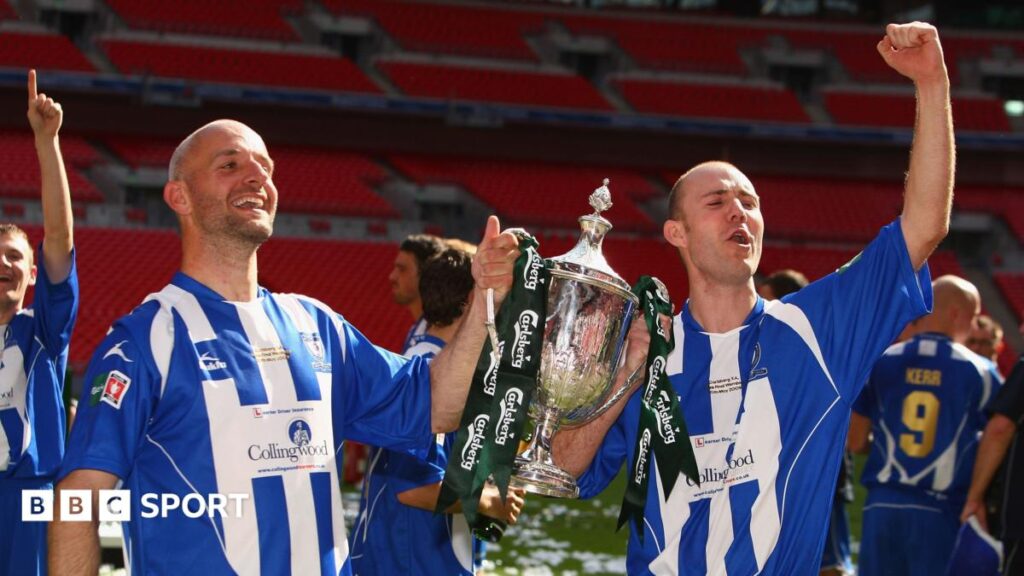
Part‑time workers who clinched three consecutive Wembley finals
By Emma Smith, BBC Sport
Question: Which two men’s clubs have lifted three back‑to‑back competition finals at the new Wembley? Most people recall Pep Guardiola’s Manchester City winning three League Cups in a row from 2018 to 2020 before adding a fourth in 2021, but another side achieved the hat‑trick first.
Whitley Bay, a ninth‑tier Northern Football League team, captured three straight FA Vase titles between 2009 and 2011 – an unprecedented feat in non‑league football. The FA Vase, a national cup for amateur clubs, was founded in 1974; in more than fifty years the Seahorses are the only side to have won it four times, including that three‑year streak.
The triumphs came under the guidance of an unassuming IT manager from Sunderland, who used “quiet moments in the day” to plot historic cup success. Ian Chandler, a former Whitley Bay player who enjoyed three spells with the club, took over as manager in 2004 and remained in charge for a decade. Any non‑league manager will tell you that the job is far from easy. Rather than spending his evenings in boardrooms, Chandler says he devoted more time to sorting hotel bookings and reviewing scouting reports.
The team were motivated by a painful Wembley miss in 2007‑08, when Whitley Bay reached the FA Vase semi‑finals. They lost the first leg 4‑0 to Lowestoft Town and, despite taking a 3‑0 lead inside 20 minutes of the return match at Hillheads Park, could not overturn the aggregate deficit. After that elimination, Chandler adopted a superstition of never giving a pre‑match interview again – the last one had been before the 4‑0 defeat. Whether the change was due to renewed focus or a collective desire to redeem themselves, it forged a group determined to make history.
“It’s the hardest thing to keep a team together – as soon as players get noticed, they get picked up at a higher level,” Chandler told BBC Sport. “But after we got to the Vase semi‑finals, the players wanted to stay and prove what they could do. Then they wanted to do it again. And again.”
Despite being a lifelong Sunderland supporter, Chandler admits he modeled his side on Kevin Keegan’s Newcastle, prioritising entertainment even above winning. “There was a standing joke in the team, two or three at the back? One time we chased a game with two at the back,” he recalled. “The Premier League can be so boring; fans want to be entertained, that’s what we promised.”
Chandler was already a Whitley Bay hero when chairman Paul McIlduff appointed him, having scored the winner in the 2002 FA Vase final against Tiptree United at Villa Park. After a slow start – the then‑35‑year‑old had no managerial experience – he built a talented squad that soon became the envy of non‑league football across the country. “We played good football. We had pace on the wing, fantastic midfielders, and strikers who were deadly,” said McIlduff, who has chaired the club since 2001. “When we brought them in, it was about fitting the psychology of the dressing room. No one thought they were better than anyone else, they played for each other.”
A rising star in the side was dubbed the “Whitley Bay Maradona”. Paul Robinson, who came through Newcastle United’s academy before a career in various north‑east non‑league clubs, played for Whitley Bay from 2007 to 2013. Like several teammates, he worked with Chandler both at the software firm Sage and on the pitch at Hillheads Park. “He was my manager at work and football, I was sick of him,” Robinson laughed. “But it helped get time off for matches and gave me an understanding boss when my mind drifted at work.”
Robinson says zoning out was common, visualising goals, opponents and hoping the opposition would be weak enough for an easy walk‑over. His most memorable Whitley Bay moment came in the 2010 FA Vase semi‑final second leg, when a last‑minute diving header in driving rain secured a 6‑5 aggregate win over Barwell and sparked a pitch invasion. “Everyone goes to the finals, you were there, you could enjoy it,” he said. “But the rounds before were the bigger games. At home we would get two or three thousand fans each match. You felt like a real player. You associate those memories with the 1990s FA Cup – you never think it will happen in non‑league.”
Chandler also featured in a 2‑0 victory over Preston in the second round of the FA Cup, helping Whitley Bay reach the third round for the first and only time in the 1989‑90 season, and they repeated a second‑round appearance the following year. Those successful campaigns made The Bay a feared opponent for non‑league clubs nationwide and prepared them for big‑stage matches in a way most amateur sides are not. “One quarter‑final against Biggleswade in 2009, they turned up in suits and ties,” recalled Robinson. “We thought, this is their day out, their cup final. We won 5‑2. By the end, teams were turning up afraid of us. We had it won beforehand.”
Off the pitch, the club’s triumphs lifted the whole community of Whitley Bay. The working‑class town near Newcastle, once a Victorian holiday resort, found a surge of local pride along the north‑east coast. As with any lower‑league club, the success relied on dedicated volunteers who went into overdrive before each Vase final, knocking on doors in Tynemouth, North Shields and Whitley Bay to rally support. A ticket‑selling van was even parked outside Woolworths to maximise attendance.