Paris Shines a Light on Lee Krasner After Jackson Pollock
In July 1956 Lee Krasner made her first trip to Paris alone, leaving husband Jackson Pollock behind in Springs, New York. She lodged at a hotel on the Quai Voltaire, toured the Louvre and admired works by Uccello, Mantegna and Goya, and met fellow artist Helen Frankenthaler and dealer Betty Parsons. Though the couple’s marriage was strained, Krasner wrote Pollock a letter—now in the Smithsonian Archives—describing her experiences, telling him “I miss you and wish you were sharing this with me,” and thanking him for the “most beautiful deep red roses” he had sent. A few weeks later she learned of Pollock’s death in a car crash and returned to the United States at once.
Seventy years after that Parisian visit, Krasner’s first solo exhibition in the city opened just before Art Basel. Titled “Lee Krasner: Works from the 1960s,” the show is a collaboration between Gagosian, Olney Gleason and the Pollock‑Krasner Foundation, presenting a pivotal decade of the artist’s output. The exhibition coincides with the Metropolitan Museum’s major show “Krasner and Pollock: Past Continuous,” which surveys both artists and highlights Krasner’s three‑decade career after Pollock’s death.
Krasner was not unknown in France; she received the Knight of the Order of Arts and Letters in 1983, a year before her death at 75. Yet many visitors, whether newcomers or longtime admirers of her vigorous mark‑making, will find a concentrated look at American abstraction that reflects her intensely personal and ever‑changing method.
During a walkthrough I was joined by Eric Gleason, whose gallery represents the estates of both Krasner and Pollock worldwide; Caroline Black, executive director of the Pollock‑Krasner Foundation; and Kara Vander Weg, managing director of Gagosian in New York. Beneath a large skylight that highlighted Krasner’s bold use of color, we discussed how the 1960s reveal a restless, experimental spirit. Gleason noted, “She was a restless experimenter, pivoter, editor, and even within this concise ten‑year period there’s a lot of range. The diversity is evident when you put these paintings together.”
Vander Weg explained that the show was designed to complement the Met exhibition, especially because Krasner remains less familiar to French audiences. Of roughly 600 works she created, about 210 paintings survive—she often dismantled, repurposed and collaged older canvases. Approximately one‑third of those are on view at Gagosian.
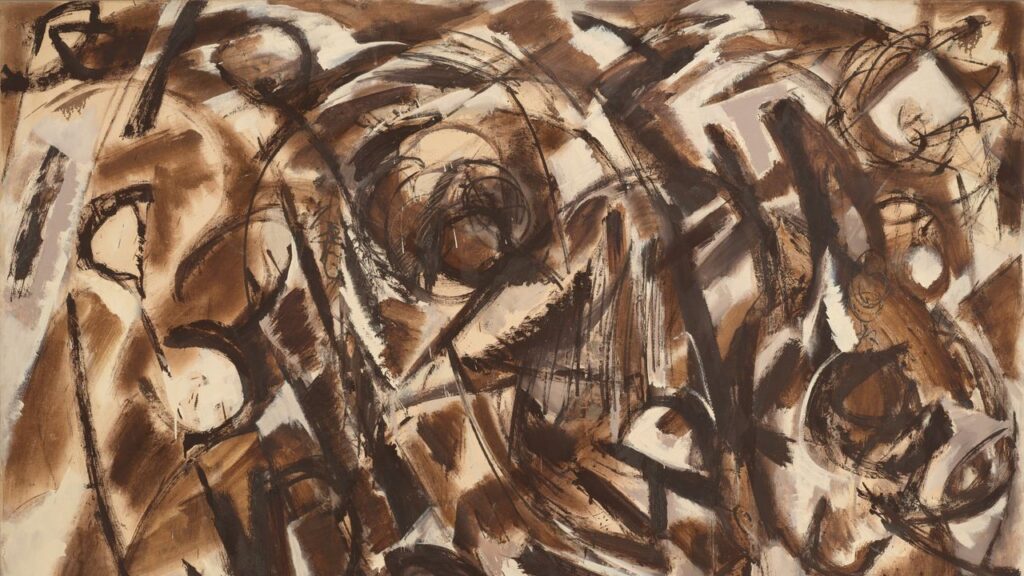
Among the sixteen paintings and works on paper displayed are two from her 1960 Umber series, Seeded and Uncaged, painted while she suffered insomnia after her mother’s death. Their dark brown and black tones convey a fierce urgency that fills opposite walls of the main gallery. “Don’t you feel like she’s just roaring, letting herself go?” Vander Weg asked.
Along the longest wall three large canvases burst with layers of coral, mauve, ochre and purple. Gleason pointed out that Krasner completed Chrysalis and Icarus with a broken right wrist, the result of an aneurysm‑induced fall; the finer stippling was applied with her left hand while guiding the brush with her injured right.
In an adjoining room, textured gouache works on pebbly Howell paper include the vivid orange Camouflage, which deliberately resists blending into its surroundings, and Portrait in Green, noted for its bold gestural lines. Fashion designer Ulla Johnson, who collaborated with the Pollock‑Krasner Foundation for printed pieces in her spring 2025 collection, selected Portrait in Green and Comet (1966–70) as inspiration. Comet, the latest painting in the show, moves toward a more diffuse arrangement of floating geometric shapes.
“Karen and I were talking earlier that this piece looks back and looks forward,” Black said while wearing Johnson’s blouse, its ruffled front echoing the magenta and green accents of the painting.
The Pollock‑Krasner Foundation does more than preserve the legacies of its namesakes; it provides grants to artists and organizations worldwide. To date, more than 5,200 artists in 80 countries have received nearly $96 million in support. “We will occasionally let Eric sell a piece,” Black laughed, adding that Krasner would never have imagined an artist‑endowed foundation at the time of her death. Gleason emphasized, “It’s meaningful for us to know all the funding goes right back to artists, arts communities, and organizations.”